
The short answer.
Agentic search is search carried out by an AI agent on a person’s behalf: the agent runs many searches, reads the pages it finds, compares the options against the brief and then takes a step, such as filling in an enquiry form, requesting a quote or booking an appointment. For a B2B service firm, the practical change is that the first “visitor” to read your service page and use your form may be software, and it drops firms whose scope, price approach, availability or contact path it cannot find in plain text.
Buyers are not handing over the signature. In G2’s July 2026 survey of more than 1,000 software buyers, 61% use or plan to use AI agents in buying, but only 9% are comfortable with an agent completing a purchase within approved guardrails. So the agent builds the shortlist and the human chooses from it. Getting onto that shortlist is the work behind our AI search visibility service. If you sell products online, agentic checkout is a different problem, covered in our guide to ChatGPT shopping and AI Mode for DTC brands.
Prolinkage framework, built from the agent features Google and OpenAI document (chapter 3). The brief is an illustrative example. Statistic: G2, 2026 Buyer Behavior Report, published 22 July 2026; G2 is a software review platform.
Search, answer, agent: what “agentic” means.
“Agentic” describes software that pursues a goal over several steps and takes actions, rather than replying once. An AI agent is a language model given tools (a browser, a search index, a calendar) and permission to use them until the task is done. Agentic browsing is the browser part: the agent opens real pages, reads their structure, clicks and types.
Is ChatGPT an agentic AI? Partly. A ChatGPT reply with search is an AI answer; when it opens a browser to carry out a task, it is acting as an agent, and OpenAI identifies that browser separately (chapter 9). Google’s AI Mode is the same: mostly it answers, and for some tasks it now books.
| Classic search | AI answer | Agentic search | |
|---|---|---|---|
| Who reads your page | The buyer | The engine, quoting a passage | The agent, page by page |
| What comes back | Ten links | A written answer with sources | A finished task: a shortlist, quotes, a booking |
| Your form is used by | A person | A person, after clicking a citation | Often the agent, for the person |
| Where you lose | Ranking | Not being cited or named | Not named, or named but impossible to act on |
Under the bonnet, all three share the same index. Google’s documentation, updated 24 November 2026, says its generative features are “integrated directly with Google’s core web ranking, information retrieval, and quality systems” and may run several related searches (query fan-out) to find supporting pages. So agentic search does not replace SEO. It adds a final test: once found, can the agent use what it found? Our guide to Google AI Mode covers the fan-out mechanics.
What agents can already do, with dates.
Most of what is live is consumer-facing and US-first, but the same infrastructure and habits move up-market. What the platforms have documented:
| Date | What launched | What the agent does |
|---|---|---|
| 21 Aug 2025 | Google AI Mode agentic features (US, AI Ultra, Labs) | Checks live availability across reservation sites; links to the booking page, the user finishes |
| 4 Nov 2025 | AI Mode tickets and beauty and wellness appointments (US, Labs) | Shortlists options and prices; sends the user to complete the booking |
| Live (read 25 Nov 2026) | AI Mode “check local availability and pricing” (English, signed-in over-18s) | Searches the web and, when online information is limited, Google phones businesses for details; results in up to 30 minutes |
| 22 Jun 2026 | Chrome’s agent-ready toolkit and Lighthouse “Agentic browsing” category (Chrome 150+) | Tests whether agents can read and operate a page; experimental |
| 4 Nov 2026 | Home-services booking links in AI Mode (US) via Angi, Thumbtack, Housecall and Jobber | Compares local providers, then books through a partner |
| Live (read 25 Nov 2026) | ChatGPT’s agent browser (OpenAI’s help page now calls it Cloud browser) | Browses on the user’s behalf and signs its requests so sites can verify it |
Two patterns stand out. The agent stops before the irreversible step: Google hands the user to the booking page to finish. And when the facts are not online, Google picks up the phone: its help page says that when online info is limited, “Google can make calls on your behalf”. A firm that publishes prices and availability answers the agent; one that does not gets a call, or gets skipped.
UK buyers see less of this so far: home-services booking is US-only, and Google’s help page lists the UK only for dining reservations. General agents such as ChatGPT’s browser do the same jobs in both markets, so the website requirements are the same.
How far B2B buyers will let an agent go.
The forecasts are large and the surveys are cautious, and both are true. Gartner predicted at its 2025 IT Symposium/Xpo that AI agents will intermediate more than $15 trillion of B2B spending by 2028 (as reported by Digital Commerce 360; we could not open Gartner’s own release). Forrester’s 2027 predictions, published 28 October 2026, say agentic buying “will play a role in 75% of B2B purchases”, while fully autonomous purchasing stays in “high-volume, low-risk, repeatable scenarios”.
G2, 2026 Buyer Behavior Report: more than 1,000 B2B software buyers and decision-makers, published 22 July 2026. Bar length is the percentage on a 0–280 scale. G2 sells software reviews, so treat it as an interested source.
For a service firm the reading is simple. Engagements are scoped and signed by a person, so the agent’s job ends at the shortlist and the first contact. Forrester adds that buyers will “double their human interactions to validate AI-generated recommendations”: the agent narrows the field, then a person checks every firm left on it. Our guide to how buyers verify vendors after AI names them covers that second check.
One shortlist, step by step.
Here is a realistic B2B brief, traced through an agent. A quality manager at a US manufacturer types: “Find three accredited calibration labs within 100 miles of Columbus, Ohio that can calibrate torque wrenches with a turnaround under 10 working days. Ask each for a quote for 40 tools.”
- 01 · FITIs torque calibration listed as a service, in text?
- 02 · PROOFIs the accreditation and its scope stated and linked?
- 03 · PLACEIs the location or service area within 100 miles?
- 04 · TIMEIs a standard turnaround published?
- 05 · ACTIONIs there a quote form it can fill without a dead end?
A lab that fails any step is dropped or marked “could not confirm”. The buyer sees the three that passed.
Not on the list: the homepage slogan, the blog or the logo wall. The agent is filling a comparison table, and every empty cell weakens a firm’s case. “Turnaround: contact us” gives it nothing to compare; a rival’s “standard 5 working days, express 48 hours” does. Our guide for calibration and testing labs covers that sector in depth.
The UK version of the brief, “three Manchester employment-law firms offering fixed-fee contract reviews, intro calls next week”, needs the same things: the service named as a fixed-fee offer, a fee range, the office location and a booking path. See how accountants and law firms get recommended by AI.
What agents read on your site.
An agent reads a page much as a screen reader does. Chrome’s team wrote in June 2026 that agents “rely on the accessibility tree … as their primary data model”, the structure browsers build from your HTML. Text in images, prices in PDFs and facts that appear only after a script runs are weak or invisible to it. Google’s advice for its AI features matches: keep key information in text.
ILLUSTRATIVE EXAMPLE · WHAT AN AGENT EXTRACTS FROM ONE SERVICE PAGE
Service: Fractional finance director for UK SaaS companies, 20–150 staff. Found in H1 and first paragraph.
Price approach: Monthly retainer, two to four days a month; typical range stated. Found in a “How we price” section.
Availability: “Taking new clients from January 2027.” Found in text near the form.
Proof: ICAEW-qualified; two dated case studies linked. Found in text, not only as badges.
Next step: Form with five labelled fields, or a calendar for a 20-minute call. Usable without a puzzle.
A made-up firm, to show the format. Every line is something the agent can copy into its comparison table, with a place on the page it came from.
How much does publishing those facts matter? The only published test we found is a vendor study. First Page Sage, an SEO agency, ran 657 agentic shortlisting and purchase tasks across ChatGPT, Gemini (including AI Mode) and Claude between June and September 2026, and measured how often a brand was shortlisted depending on how each fact was published.
First Page Sage, “Impact of structured data on AI rankings”, published 2 October 2026: 657 agentic shortlisting and purchase tasks, 1,089 brands, 14 industries, 8 June–18 September 2026. A vendor study from an SEO agency; the method is published but the raw data is not.
Two readings matter more than the precise percentages. The biggest gap in every row is between “missing” and “clear text”: stating the fact at all roughly doubles or triples the rate. Schema markup helps most on the booking path, where the agent must act. The same study found that facts consistent on your site and on third-party profiles were shortlisted at 37.3%, against 9.6% when they appeared on your site only. Our play on matching facts across every profile shows how to audit that.
Price and availability: the facts agents phone about.
Service firms are reluctant to publish prices because every engagement is scoped. But an agent cannot compare “contact us for pricing”, and Google’s fallback is to call. You need enough for the agent to place you, not a price list:
- The pricing model. Fixed fee, retainer, day rate or per project.
- A typical range or starting point. “Most audits fall between X and Y” or “Retainers start at Z a month”. If you will not publish a number, publish the factors that set it.
- Minimums and exclusions. Minimum term, minimum company size, sectors you do not take.
- Lead time. “We can start within three weeks”. A stale date is worse than none.
- Service area. Cities, regions or “US and UK, remote”, in text, not a map image.
Our play on publishing a pricing approach has wording that works for scoped services. One caution for regulated sectors: some professions have their own rules on how prices are shown. Check them before publishing fees.
A form an agent can complete.
The last step is the easiest one to break. Chrome’s Lighthouse added an experimental “Agentic browsing” category in Chrome 150 that tests exactly this. It does not give a 0–100 score; it reports how many readiness checks a page passes. Here is what it checks and what that means for an enquiry page:
| Check area | What Lighthouse looks at | The fix on a service site |
|---|---|---|
| Names and labels | Every interactive element has a programmatic name | Visible labels on every field; no placeholder-only inputs; buttons that say “Request a quote”, not an icon |
| Tree integrity and visibility | Valid roles; interactive content not hidden from the accessibility tree | Real <select> and <button> elements, not styled divs; no form inside an unlabelled pop-up |
| Stability | Cumulative Layout Shift | Reserve space for chat widgets and cookie banners so the submit button does not move |
| Discoverability | An llms.txt file at the root (a missing file is not a fail) | Optional; see our llms.txt guide before spending time on it |
| WebMCP | Whether forms are exposed as tools an agent can call | An origin trial, so try it on a test page only |
WebMCP is a proposed standard that lets a page declare a form as a tool: add toolname and tooldescription to an existing form, such as <form toolname="request_quote" tooldescription="Request a calibration quote">, and an agent can call it with the right fields. Chrome says the form stays visible and, unless you add toolautosubmit, the user still clicks Submit. It is an origin trial, and Chrome says the API is “subject to change”.
Then the defences. A form that challenges every automated visitor will stop the agent working for your best prospect. Signed agents can be let through while scripts are still filtered; our sibling guide on bot and AI-agent form fills covers how to score what arrives. And if a call is your real conversion, Google Ads now documents a “Book appointment” conversion goal (help page updated, reported 24 November 2026), so bookings can be measured as bookings rather than as page views.
Which agent is knocking.
Your logs see several OpenAI and Google visitors. What matters is whether a person triggered the visit.
| Visitor | What it does | robots.txt | Treat it as |
|---|---|---|---|
| OAI-SearchBot | Indexes pages for ChatGPT search | Respected | A search crawler: allow it |
| GPTBot | Collects content that may train OpenAI models | Respected | A policy choice; blocking it does not remove you from search |
| ChatGPT-User | Fetches a page when a user asks | “may not apply” | A person’s request |
| ChatGPT agent browser | Browses and acts for a user; signs requests with a Signature-Agent header set to chatgpt.com | User-initiated | A prospect using a tool: verify, then let it reach the form |
| Google-Agent | Agents on Google infrastructure that navigate and act on user request | User-triggered fetchers “generally ignore” it | As above; Google is testing Web Bot Auth signatures |
The practical check is a log review: are these visitors reaching your service pages and form, and getting 200 responses rather than 403s or challenges? Our AI crawler log file guide walks through it. Google warns that user-agent strings can be spoofed, which is why the signatures matter: Cloudflare, Akamai, HUMAN and Vercel verify ChatGPT’s automatically, according to OpenAI.
Rendering is the other quiet failure: if service details are injected by JavaScript, check what arrives without it. Our play on server-rendered content shows the test.
The agent-readiness check.
Open your main service page and your enquiry page, then tick what is true today. The check groups the answers into the four places an agent drops a firm, as in the journey map. Nothing you tick is sent anywhere.
0 of 8 checks in place
Tick what is true today to see where an agent is most likely to drop you.
The weighting is our judgement: ties go to the earlier stage, because an agent that cannot find your facts never reaches your form. Then test for real: give ChatGPT’s agent and AI Mode the brief your buyer would write, and note where each stops.
What this looks like in our work.
Agent-readiness work starts as an audit: which buyer briefs should surface a client, what engines and agents find on each page, and where the trail breaks. Then we fix pages and profiles in that order.

“Prolinkage conducted a detailed audit followed by in-depth discussions, providing valuable insights into the implementation process and ensuring seamless execution.”
See our case studies
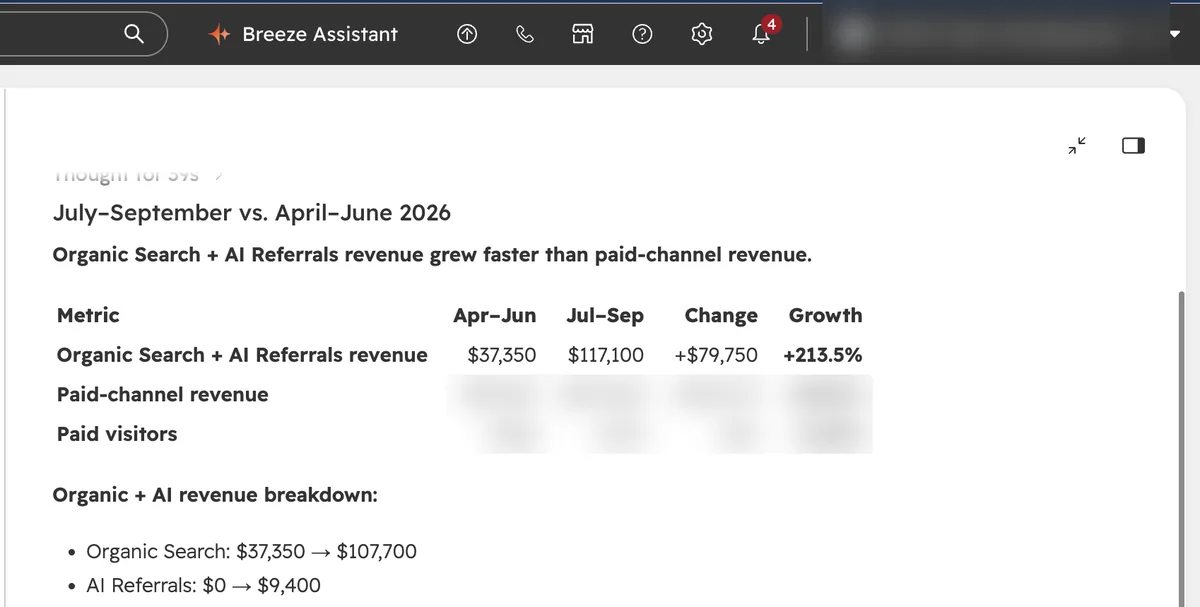
Agents and AI answers only matter if they reach revenue, so we measure them into the CRM. For a US B2B company (name withheld), HubSpot credited organic search and AI referrals with more closed-won revenue in the third quarter of 2026 than in the second, and AI referrals appeared as a revenue source for the first time.
A US B2B company (name withheld). Closed-won HubSpot revenue credited to Organic Search and AI Referrals: $37,350 (Apr–Jun 2026) to $117,100 (Jul–Sep 2026). AI Referrals alone: $0 to $9,400.
 Open the screenshot at full size ↗
One quarter against another is not a controlled test, and HubSpot cannot tell an agent-made enquiry from a human one. It shows the measurement to set up before agents send you enquiries: AI referrals in their own channel, carried through to deals. Our write-up of that CRM result explains the method, and the GA4 AI channel setup is the first step.
Questions owners ask.
What is agentic search?
Search done by an AI agent for a person: it runs several searches, reads the pages, compares options against the brief and takes a step such as requesting a quote or booking a call. Google’s AI Mode and ChatGPT’s agent browser both do this for some tasks.
What is agentic browsing?
The part of agentic search where the agent opens real web pages, reads them through their structure (the accessibility tree) and clicks or types. Chrome’s Lighthouse has an experimental “Agentic browsing” category that tests how well a page supports it.
Will AI agents replace B2B buyers?
Not for considered purchases. In G2’s July 2026 survey only 9% of software buyers would let an agent buy within guardrails, and Forrester expects autonomous buying to stay in high-volume, low-risk purchases. Agents build shortlists; people choose.
Should we block AI agents from our website?
Not the ones acting for a user. Blocking ChatGPT’s agent browser or Google-Agent turns away prospects who use those tools. Verify signed agents, keep filtering scripted bots, and score what reaches your form.
Does schema markup help AI agents choose us?
It helps most at the action step. In a vendor study of 657 agent tasks (First Page Sage, October 2026), a machine-readable booking path was shortlisted at 36.8% against 19.4% for clear text. But clear text against nothing made the larger difference, so publish the facts first and mark them up second.
Sources: Google, AI Mode agentic features, 21 Aug 2025; TechCrunch, 4 Nov 2025; Google Search Help, local availability and pricing; Search Engine Roundtable, 5 Nov 2026; Search Engine Roundtable, 24 Nov 2026; Google Search Central, updated 24 Nov 2026; Google-Agent; Chrome, agent-ready toolkit, 22 Jun 2026; Lighthouse agentic browsing; WebMCP declarative API, updated 25 Sep 2026; OpenAI, crawlers; OpenAI, agent allowlisting; G2, 22 Jul 2026; Forrester, 28 Oct 2026; Digital Commerce 360 reporting Gartner, 28 Nov 2025; First Page Sage, impact of structured data on AI rankings, 2 Oct 2026 (vendor study, not linked). All accessed 25 Nov 2026. Client result: HubSpot, closed-won revenue by original traffic source, Q3 vs Q2 2026, client anonymised.