Conversion rate optimisation for service and lead-generation websites. Improve the offer, proof, page flow and enquiry experience around how your customers make a decision.
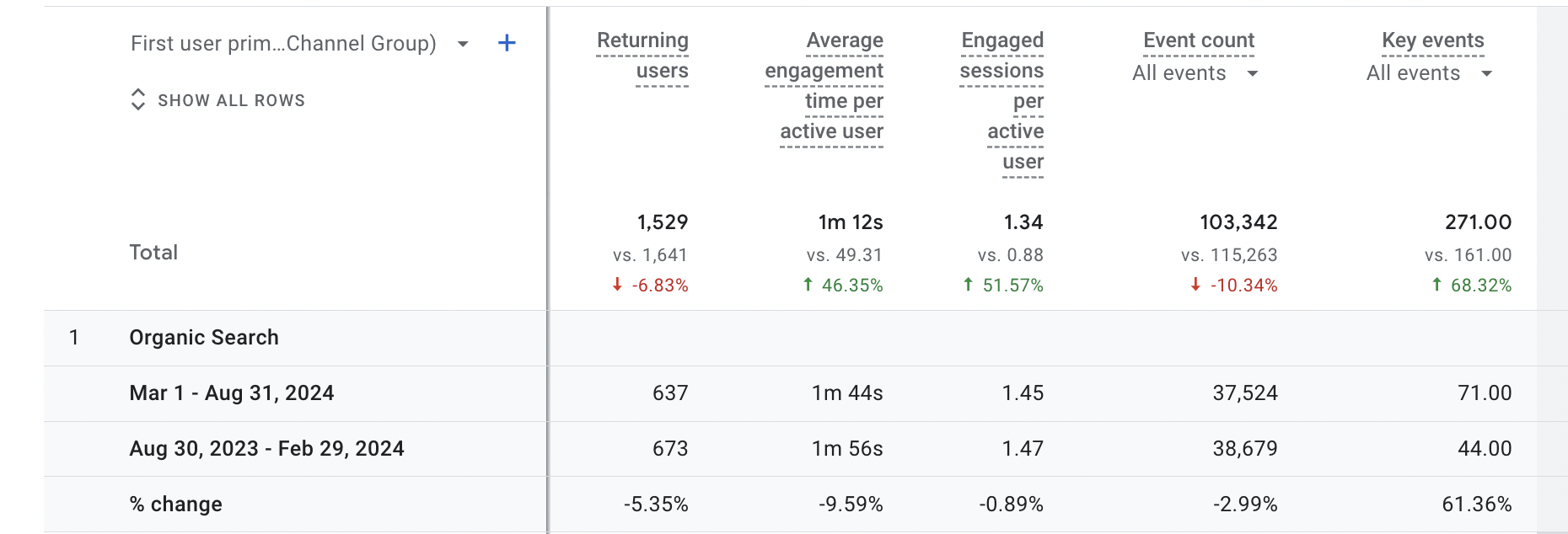
Inspect original screenshot ↗GA4 User acquisition · First user primary channel group · Organic Search · All key events. 1 March–31 August 2024 vs 30 August 2023–29 February 2024.
The metric describes the stated report, not verified revenue. Open the case study for scope and limitations.
The question behind the brief
How do we improve conversion without attracting more poor-fit leads?
We assess the offer, evidence and friction against the enquiries your sales team can use. Tests review accepted opportunities alongside submission volume, with a clear hypothesis and decision point. The aim is a more effective buying journey and a proportionate first scope.
A focused engagement, with a named owner, agreed scope and implementation capacity. We establish the priorities before recommending the next investment.
01 / Conversion Rate Optimisation
Find where the buyer loses confidence
An underperforming page may be attracting the wrong audience, explaining the offer poorly or asking for too much too early. We review the page in the context of the ad, search or referral that brings someone there.
Customer questions, sales objections, enquiry samples and available analytics help identify the friction. The aim is to improve the buying decision, not decorate the same weak proposition.
02 / Conversion Rate Optimisation
Put the evidence where the decision happens
A relevant case study or named testimonial can answer a concern more effectively than a generic trust badge. We place proof near the claim it supports and keep the link between the result, client and source clear.
Page structure helps a visitor understand fit, scope and next steps. Information that matters to qualification should be easy to find, including budget expectations or delivery requirements where appropriate.
03 / Conversion Rate Optimisation
Qualify without making the form feel like an interview
A form should collect the information needed for a useful next conversation. Service context can be carried forward automatically; budget and a short description of the problem help establish fit without an unnecessary sequence of pages.
We review labels, required fields, error states and confirmation behaviour. A more selective form may reduce submission volume while improving the usefulness of enquiries. That trade-off needs to be measured rather than assumed.
04 / Conversion Rate Optimisation
Choose a test that your traffic can support
Where there is enough suitable traffic, a controlled experiment can compare meaningful changes. Where there is not, we prioritise evidence-informed improvements and label before-and-after observations appropriately.
The hypothesis should identify the buyer problem, proposed change and outcome. Traffic mix, seasonality and concurrent changes can affect interpretation, so a higher completion rate is not automatically proof of the design’s impact.
05 / Conversion Rate Optimisation
Check the quality after the conversion
A form that is easier to complete can also attract more unsuitable requests. We review qualification and progression where sales records are available, alongside the page-level conversion measure.
This keeps the work aligned to the business goal. The next iteration may improve offer clarity, change the qualification question or strengthen a proof block rather than simply make the button more prominent.
Client experience
What it’s like to work with us.
Named clients. Their own words. Excerpts from published Prolinkage testimonials.
Georgia BenageReal Estate Broker
“Prolinkage was excellent in their approach to understanding our real estate service business.”
John BrysonCEO & Founder, Sek Sauna & Sek Franchise
“Prolinkage's strong project management, timely communication, and adaptive strategies have ensured our goals are met, making them a reliable partner in driving digital growth.”
Not for every improvement. Controlled experiments need adequate data; lower-traffic sites can still benefit from clear diagnosis and carefully interpreted changes.
Will shorter forms always convert better?
They may increase completions, but the effect on lead quality matters. We collect enough information for the next useful conversation.
Do you redesign the whole website?
Only when the diagnosis justifies it. A focused landing page, proof section or form change may address the main problem.
What counts as success?
The agreed business outcome, which may include more qualified enquiries or better progression—not only a higher form-completion rate.