
Where you appear
Observed mentions and linked citations in a sample of relevant questions.
A free AI visibility audit of the questions your buyers ask: where Google’s AI Overviews, ChatGPT and Gemini mention or cite you, and who they name instead. Receive the findings without committing to a sales call.
A selection of brands we’ve worked with

Observed mentions and linked citations in a sample of relevant questions.
Other businesses and sources that show up in those answers.
A practical starting point for improving useful content and measuring the outcome.
Before asking for yours, read ours. We ran the same check on Prolinkage on 6 November 2026: the US shortlist question on ChatGPT, Perplexity and Google, plus what ChatGPT says about us by name. ChatGPT, Perplexity and Google named 18 other agencies, and none named us.
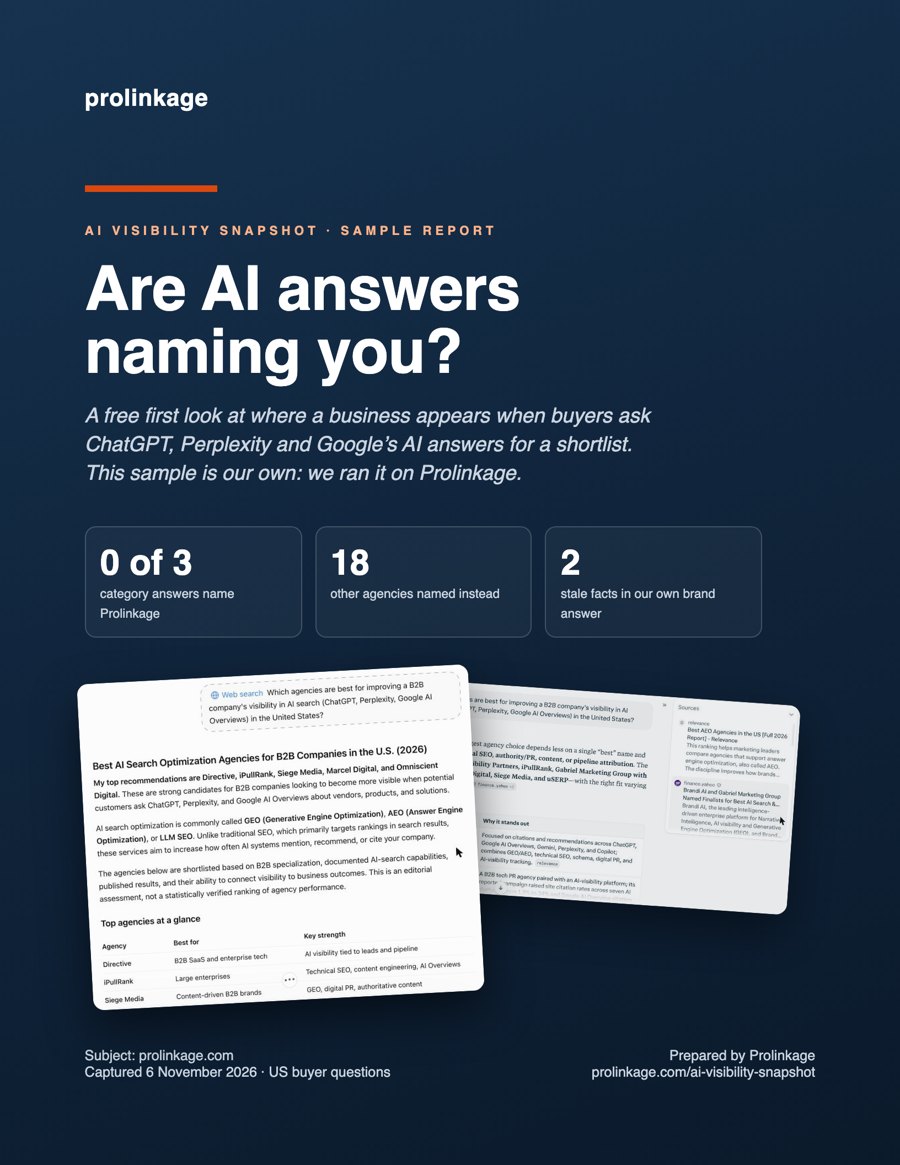
Named or not, who is named instead, and what the engines get wrong about you.
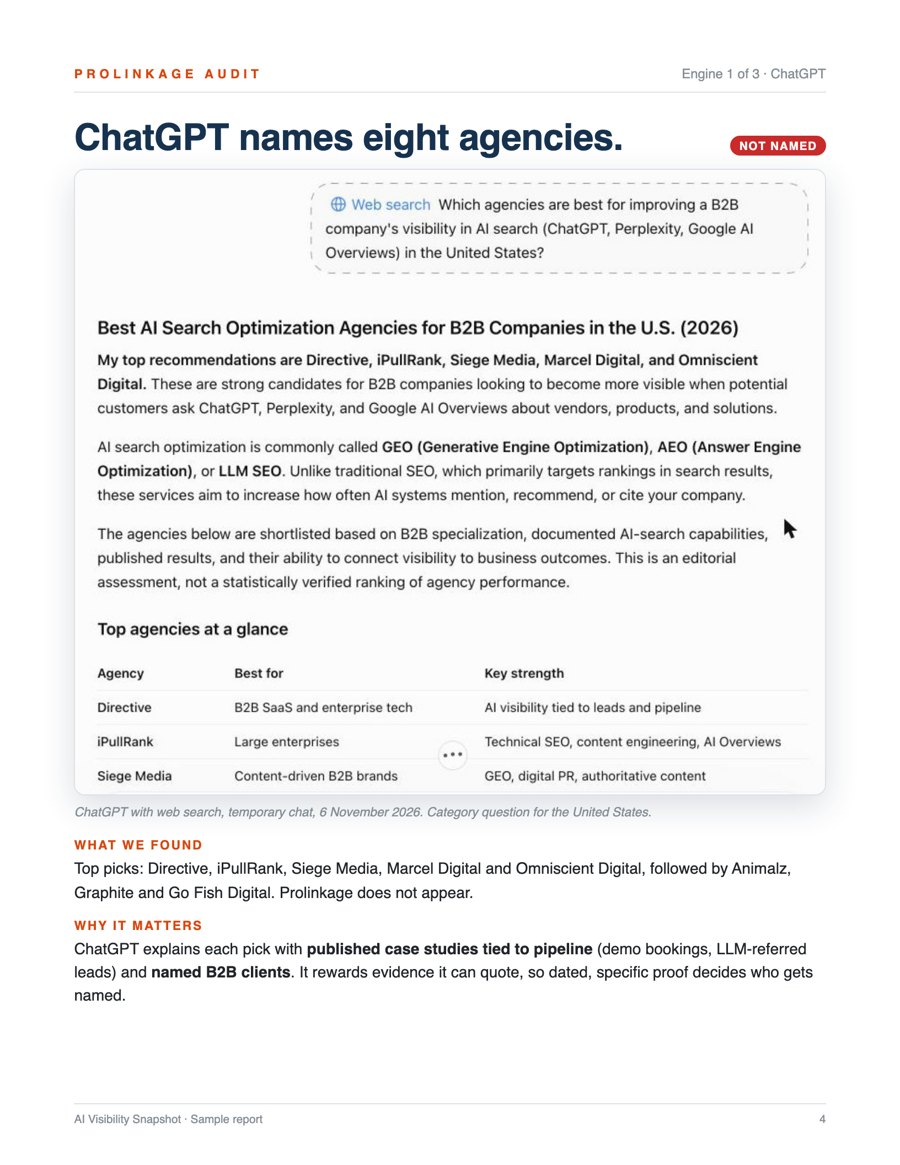
Dated captures from each engine, so you can check every line yourself.
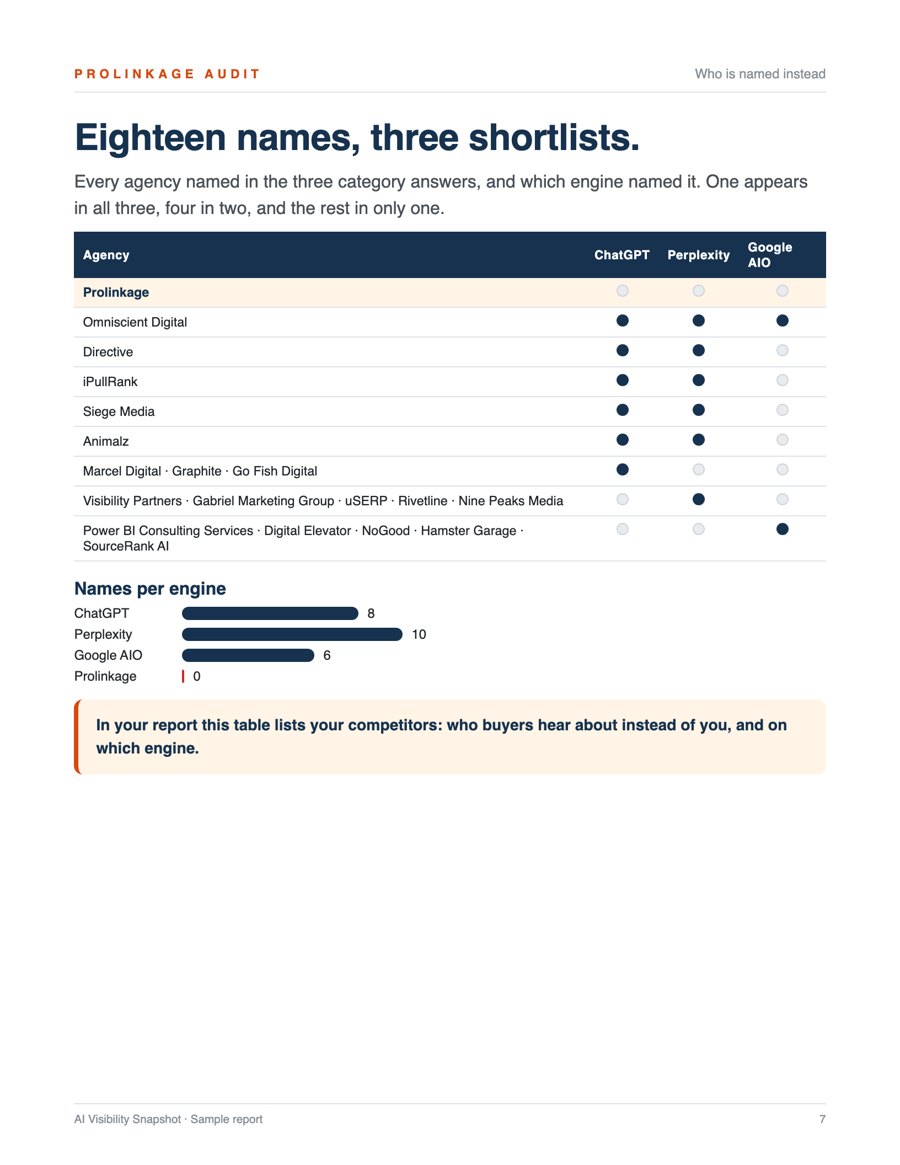
A side-by-side of the names each engine recommends, and the sources it read.
An AI visibility audit answers one question: when a buyer asks an AI engine for a provider like you, does the answer name you, cite your website, or leave you out? We answer it with a fixed panel of buyer questions, run on one day and recorded answer by answer.
Around 12 questions a buyer in your category would ask, written from what your own homepage says you do: shortlist, cost and comparison questions, plus a few that name your brand, set for the US or UK market.
Each question goes to Google, where we read the AI Overview, and to ChatGPT and Gemini. That is up to 36 answers (Google does not show an AI Overview for every question), each kept in full with its sources.
For every answer we record whether your brand is named in the text, whether your website is listed as a source, both, or neither.
We count the competitors each engine names, so you can see which businesses buyers hear about when you are missing.
We count the websites the answers cite across all questions. These are the pages, directories and publications that shape what the engines say about your category.
Alongside the AI answers, we note where your site ranks in Google’s ordinary results for each question, with a short read of your organic search footprint and competitors.
Illustrative example only. “Northfield Payroll” is an invented company, not a client, and every result below is made up to show the format. A real audit fills this grid with your own questions and the answers recorded on the test date.
| Buyer question | Google AI Overview | ChatGPT | Gemini | Question score |
|---|---|---|---|---|
| Best payroll software for UK small businesses | Absent | Named | Named and cited | 50 |
| Payroll software for accountants with many clients | Cited, not named | Absent | Absent | 17 |
| How do I switch payroll provider mid-year? | Absent | Absent | Cited, not named | 17 |
| Affordable payroll for a 20-person company | Named and cited | Named | Absent | 50 |
| Payroll tools that connect to cloud accounting software | Absent | Named | Absent | 17 |
Named: the brand appears in the answer text. Cited: the website is listed among the answer’s sources. Across these five invented questions, the AI Visibility Index would be 30. A real report also shows your Google rank for each question, the competitors named instead and the sources cited most often.
Each question can earn six marks: named and cited in Google’s AI Overview, named and cited in ChatGPT, and named and cited in Gemini. A question’s score is the marks it earns divided by six, times 100, and the AI Visibility Index is the average of those scores across all questions. Named means a form of your brand appears in the answer text; cited means your domain is listed as one of the answer’s sources. The counting is done by script from the recorded answers rather than by judgement, so the same answers always produce the same score. For a longer explanation, read how an AI visibility score works.
The score is a dated snapshot, not a ranking. AI answers vary from one run to the next and by location, so the test date and market are printed on every report. It does not measure traffic, enquiries or every question a buyer might ask; it shows where a defined sample of buyer questions lands today.
Your AI visibility audit arrives by email as a short, branded PDF report, built from the recorded answers.
Your AI Visibility Index, plus the full question-by-engine grid showing named, cited or absent for every answer.
A verbatim AI answer, the businesses named in your place, and the sources the engines cite most often.
Five practical fixes, each tied to dated evidence from your own results, alongside a short view of your Google search footprint.
If you would like to talk the fixes through, reply to the email and we will offer an optional 20-minute walkthrough. No call is needed to receive the report.
You can run a rough version of this audit by hand in an afternoon. It will be less consistent than a scripted question panel, but it will show you the shape of the problem.
Our guide to checking your AI search visibility walks through the manual method in more detail, and the answer engine optimisation guide covers what to change once you know where the gaps are.
The free audit is a focused first look. A full engagement is worth considering when the report shows a gap that matters commercially: competitors named for the questions that bring you revenue, or a site that ranks in Google but is rarely cited in AI answers.
It also makes sense when you need a wider question panel, repeated runs over time, and the content, technical and off-site work that closes those gaps. That is the work our AI search visibility service covers. Either way, the free report is the place to start.
No. It is a focused initial review. A larger technical or conversion audit is scoped separately.
No automatic marketing subscription is attached to this request.
An AI visibility audit tests the questions your buyers ask in AI engines and records, answer by answer, whether your business is named, cited as a source or absent, and who is named instead.
Google’s AI Overviews, ChatGPT and Gemini, using around 12 buyer questions set for the US or UK market.
Each question can earn six marks: named and cited in each of the three engines. A question’s score is its marks divided by six, times 100, and the index is the average across all questions.
Named clients. Their own words. Excerpts from published Prolinkage testimonials.

“ProLinkage has the technical depth to understand the product and space.”
SAAS Industry · Testimonial excerpt
Published client feedback ↗
“Prolinkage was excellent in their approach to understanding our real estate service business.”
Real Estate Agent · Testimonial excerpt
Published client feedback ↗
“Prolinkage conducted a detailed audit followed by in-depth discussions, providing valuable insights into the implementation process and ensuring seamless execution.”
Project Management Certification and Training · Testimonial excerpt
Published client feedback ↗