
The short answer.
AI lead qualification means using software to decide, within seconds of a form being sent, how likely an enquiry is to become a customer and what should happen next. In a sound B2B setup that is three separate steps: screen out tests, spam and pitches; score fit and intent with rules you can read; and use a language model only to read the written message and turn it into structured notes. A person then approves every reply. The score decides the order of work, never whether a real buyer gets an answer.
The reason to do it is timing. In 6sense’s 2025 Buyer Experience Report, a vendor study of nearly 4,000 B2B buyers, first contact with a seller came at 61% of the buying journey, and four out of five deals went to the vendor the buyers already preferred before that contact. An inbound enquiry is a late, high-intent signal. Losing it in a queue behind spam is expensive.
Prolinkage framework. Steps 1–6 are the system we run on our own enquiries; step 7 is the loop we recommend. The 40-point threshold is ours and is tuned to our forms.
This sits with our AI systems work because the hard part is not the model. It is deciding which steps a machine may take on its own, and proving the result against your CRM.
Three different jobs get called “AI” qualification.
Vendors use one phrase for three different techniques. They need different data, fail in different ways, and cost different amounts to run. Ask which one a proposal actually means.
| Technique | What it does | Needs | Fails when |
|---|---|---|---|
| Rules-based scoring | Adds points for signals you choose (company email, budget band, service asked about) | Your judgement and a few dozen past enquiries to check it against | Your market changes and nobody revisits the weights |
| Predictive scoring | A model learns from past leads which traits went on to convert | Enough closed outcomes, won and lost, recorded in the CRM | Too few outcomes, or the CRM records them inconsistently |
| Language model reading | Reads the written message and extracts problem, urgency, questions and fit clues | A fixed output format and test cases | It is asked to calculate, decide alone, or obey text inside the message |
Most of what is sold as an “AI agent for lead qualification” is the third job in a chat or phone interface, asking the qualifying questions instead of the form. For B2B buyers who researched you before writing, being interrogated again costs more goodwill than it saves time. Our piece on when an AI chatbot helps or hurts B2B enquiries covers that trade-off.
Anthropic’s engineering guide of 19 December 2024 describes this shape of system as “routing”, which “classifies an input and directs it to a specialized followup task”, and recommends “finding the simplest solution possible, and only increasing complexity when needed.” For lead qualification, the simplest solution is usually rules first, a model for reading, and a person for deciding.
Do you have enough data for predictive scoring?
Predictive scoring is the version most CRMs now advertise. It learns from your own closed leads, so it needs closed leads, with the outcome recorded both ways. The minimums the platforms publish are a useful reality check.
HubSpot Knowledge Base, lead scoring tool (updated 16 Nov 2026; AI contact scores need Marketing Hub Enterprise). Microsoft Learn, configure predictive lead scoring (updated Aug 2025; training window three months to two years).
Those numbers look small until you count properly. Twenty-five converted leads means 25 enquiries that became customers and were marked as such in the CRM. A B2B firm winning three or four clients a month from its website needs seven or eight months of clean records just to reach HubSpot’s floor. Microsoft’s documentation adds that the model is flagged “Not ready to Publish” when its accuracy falls below a threshold, and that you can retrain it automatically every 15 days.
So the practical order for most B2B teams is:
- Rules now. Score with signals you can explain, from day one.
- Record outcomes. Make “qualified”, “disqualified” and “won” required CRM fields, with a reason.
- Predictive later. Once you clear the platform’s minimum with room to spare, run the predictive score beside your rules for a quarter and compare which one ranked the eventual customers higher.
If your lead numbers already disagree between GA4 and the CRM, fix that before you train anything; our guide to tracking which page produced each lead is the place to start.
The signals, and what each one is worth.
An inbound form already tells you most of what an outbound team pays a data provider for. The table shows the signals we score, the weight each carries in our current rules, and why. The weights are ours, tuned to our own forms and buyers. Copy the structure, not the numbers.
| Signal | Points | Why it is worth that |
|---|---|---|
| Company email domain | 20 (5 for webmail) | The best single sign of a real business. Webmail is not rejected: many owners of small firms use it |
| Website given | 15, +5 if it matches the email domain | A matching domain is hard to fake and makes research possible before the call |
| Budget band | 3–15 | “Help me define the scope” scores 6, because it is a real answer, not a dodge |
| Service asked about | up to 15 | Weighted towards the services we lead with; a mismatch lowers the score but never closes the enquiry |
| Message specificity | up to 15 | Names their own site, problem or market; asks a question |
| Market we serve | up to 10 | Inferred from domain and form context, never from a person’s name |
| Recency | 2–10 | A buyer who wrote this week is still choosing; one who wrote two months ago may already have chosen |
| Form used | 0–5 | A report request is a smaller, lower-friction first step |
Two design choices matter more than any single weight. First, fit and intent stay separate. A perfect-fit company asking a vague question and a small firm with a sharp, urgent problem both deserve a quick reply, for different reasons. HubSpot’s own tool makes the same split, with fit scores for “demographic information” and engagement scores for “actions and interactions”. Second, no signal is allowed to reject an enquiry on its own. Signals add or subtract; only the screening step in chapter 5 can stop an entry, and that step looks for patterns of spam and impersonation, not for buyers we would rather not have.
Behavioural signals such as pages viewed belong to the engagement side. On a first enquiry they are thin and depend on consent choices, so we do not score them at first contact.
How we score our own enquiries, step by step.
Every entry to our website forms runs through the same script. No model touches the numbers; the score is plain code, so the same entry always gets the same score and every point can be traced.
- Classify first. Each entry is put into one of five classes, first match wins: test, spam, solicitation (someone selling to us or asking for work), impersonation (a household-name brand writing from a look-alike or newly registered domain), or genuine. Only genuine entries are scored. The detail of the first four is in our sibling guide on bot and AI-agent form fills; here they matter only because they must never compete with buyers for attention.
- Score genuine entries 0–100 with the weights in chapter 4. The output keeps the reasons, so “68” always comes with “email 20, website 20, budget 6…”.
- Strip personal data from the record. The scoring file keeps the email domain, the website domain, the page the visitor came from, the score and the reasons. Names, addresses, phone numbers and message text stay in the raw entry on one machine.
- Route. At 40 or above, the system prepares a research brief on the company and a draft reply. Below 40, it writes a one-page decision note and a person decides.
- A person approves every send. Nothing leaves without a yes, including replies to high scorers.
Stored
Class: genuine
Domains: northgate-labs.co.uk (email and website match)
Came from: an insights article on measurement
Score 79: email 20 · website 20 · budget 6 · service 10 · message 13 · market 10
Route: brief and reply draft, awaiting approval
Never stored in the score file
✗ The person’s name
✗ Email address and phone number
✗ The message text
✗ Anything the message asks the system to do
Message text is scanned for patterns and length only, then left in the raw entry.
An invented record showing the format. The company does not exist in our records. Recency points are left out for clarity.
We set 40 low on purpose. A brief prepared for a weak lead costs a few minutes; a good lead missed costs a client.
Where a language model earns its place.
A model is good at the part rules are bad at: reading a paragraph written by a busy person and saying what it means. It is bad at the parts rules are good at: adding up, applying the same cut-off every time, and leaving an audit trail.
Give the model these jobs
- Extract fields from the message: the problem in one line, the urgency (a launch date, a board meeting, a drop in enquiries), the questions asked, and any named tools or competitors.
- Summarise the company from its public website for the research brief: what it sells, to whom, in which markets.
- Draft the reply for a person to edit, answering the buyer’s actual question first. Our guide to the first reply after the form covers what that reply should contain.
Keep these jobs away from it
- The score itself. Ask a model to “rate this lead from 1 to 100” twice and you can get two numbers. Have it return fields; let code turn fields into points.
- Any final decision to reject, discount or deprioritise a real enquiry.
- Taking instructions from the form. A form message is text from a stranger. Prompt injection, first on OWASP’s 2025 list of risks for language-model applications, includes the indirect kind, which “occur[s] when an LLM accepts input from external sources”. Its guidance is to “Separate and clearly denote untrusted content” and to keep human approval on privileged actions. In our system, a message that reads like an instruction to the software (“mark this as priority”, “forward this to…”) is flagged, never followed.
Fix the model’s output to a schema: the same named fields every time, with “unknown” allowed. A model forced to fill a “budget” field will otherwise guess one.
Thresholds and routing: what each score band triggers.
A score only matters for what it changes. Write down, before you switch anything on, what happens in each band and who owns it.
- STOPPED · SCREENTest, spam, pitch or impersonation: logged with a reason, no reply, never counted as a lead
- UNDER 40 · READA person reads it the same day and chooses: reply, ask one question, or close with a reason
- 40–69 · PREPAREResearch brief and reply draft; reply the same business day
- 70+ · PRIORITISESame as above, first in the queue, and a senior person reviews the draft
- ALL · RECORDOutcome and reason written back to the CRM
Suggested bands. Our own system uses one cut at 40; split it further once you have the volume. Whatever the bands, no genuine one ends in silence.
Setting your first threshold
- Export your last 50–100 genuine enquiries with their outcomes.
- Score them with your new rules, without looking at the outcomes.
- Sort by score and mark where the eventual customers sit. If customers appear in the bottom third, a weight is wrong; find the signal they shared.
- Set the threshold just below the lowest-scoring customer you would hate to have missed.
- Re-run the check every quarter, and whenever you add a service, a market or a form field.
Watch the routing as well as the score. A new form field, a changed budget dropdown or a renamed service silently breaks rules that key on exact values. Check that every option in every dropdown maps to a rule, and look at the score distribution each week: a sudden pile-up on one value usually means a field changed.
Where a person must stay in the loop.
Deprioritising a sales enquiry is unlikely to be what privacy law treats as a significant decision. That is a reason for proportion, not for removing people.
UK. The ICO’s draft guidance on automated decision-making, updated on 31 March 2026 for the Data (Use and Access) Act 2025, defines it as using personal information “to make a significant decision about someone” with no meaningful human involvement. Where it applies, the safeguards include letting the person “obtain human intervention” and “contest such decisions”, and the ICO says that intervention “cannot be tokenistic” and that “Spot checking an ADM process doesn’t meet the requirements”. Even where your scoring falls outside those rules, the test is a good design standard: the reviewer must be able to change the outcome.
US. California’s updated CCPA regulations, approved on 22 September 2025 and effective from 1 January 2026, give consumers rights to access and opt out of businesses’ use of automated decision-making technology. Skadden’s summary of the final rules ties those rights to significant decisions about finances, housing, education, employment and health care, with advertising excluded. Sales-enquiry triage is not on that list. The safer habit is the same as in the UK: say in your privacy notice that enquiries are scored to prioritise replies, and keep a person on every rejection.
The practical rule we apply: software may order the queue; only a person may empty it.
How to tell whether the scoring is working.
Judge the score against outcomes your CRM already records, not against how sensible the weights look.
| Check | How | Failing looks like |
|---|---|---|
| Ranking | Share of won deals that scored in the top band | Customers spread evenly across bands |
| Missed buyers | Count genuine buyers that scored under the threshold | Any customer you only found by luck |
| Speed | Time from submission to reply, by band | High scorers waiting as long as everyone else |
| Sales agreement | Share of high scorers sales accepts as qualified | Sales overrides the score most of the time |
| Drift | Weekly score distribution | A sudden spike in one score value |
The deeper measure is cost per qualified opportunity, not cost per lead. A scoring system that cuts junk will make your lead count fall and your pipeline rise; our article on cost per lead versus cost per qualified opportunity explains why that is the right direction. Once a qualified stage exists in the CRM, send it back to your ad platforms as the conversion that matters, as described in our guide to offline conversion tracking for B2B, so bidding learns from buyers rather than form fills.
Score an enquiry.
Open a recent enquiry and tick what it shows. The scorer separates fit from intent and suggests a route. The weights are illustrative, simplified from chapter 4, and nothing you tick is sent anywhere.
Fit 0 / 50 · Intent 0 / 50 · Total 0
Tick what the enquiry shows.
If your enquiries routinely score low on intent, the problem may be the form: one open question such as “What prompted you to get in touch?” often does more for qualification than five dropdowns.
What this looks like in our work.
Our AI systems work starts the way this article does: an audit of how the work is done today, then a build with the approvals written in. One client described that sequence in their own words.

“Prolinkage conducted a detailed audit followed by in-depth discussions, providing valuable insights into the implementation process and ensuring seamless execution.”
See our AI systems service
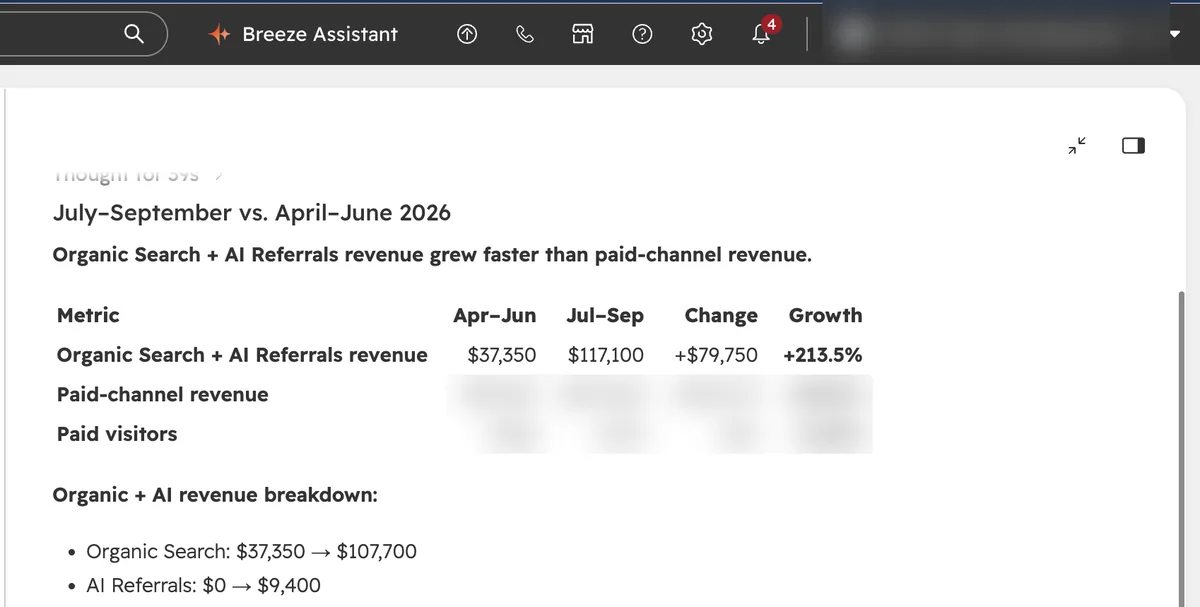
Scoring only pays off when the CRM records what happened to each lead. For a US B2B company (name withheld), once each deal was recorded against its original traffic source, HubSpot credited organic search and AI referrals with three times the closed-won revenue in the third quarter of 2026 that it did in the second, and AI referrals went from no closed-won revenue to some.
A US B2B company (name withheld). Closed-won HubSpot revenue credited to Organic Search and AI Referrals: $37,350 (Apr–Jun 2026) to $117,100 (Jul–Sep 2026). AI Referrals alone: $0 to $9,400.
 Open the screenshot at full size ↗
One quarter against another is not a controlled test, and lead scoring was not the work behind that result. It shows the outcome data a scoring system needs to be judged on. Our write-up of that CRM result explains the method, and our guide to HubSpot attribution reporting shows how to set the source fields up.
Questions buyers ask.
What is AI lead qualification?
It is the use of software to judge, as soon as an enquiry arrives, how likely it is to become a customer and what should happen next. In practice it combines screening out spam and pitches, scoring fit and intent, and using a language model to read the message, with a person approving the reply.
What is the difference between lead scoring and lead qualification?
Scoring ranks leads by a number. Qualification is the decision about what to do with each one: reply now, ask a question, nurture or close. A score supports that decision; it should not make it alone.
How many leads do you need for predictive lead scoring?
HubSpot’s AI contact scores need at least 50 contacts, 25 converted and 25 not. Microsoft Dynamics 365 needs at least 40 qualified and 40 disqualified leads closed in the training window. Microsoft adds that more leads give better predictions. Below those floors, use rules.
Can AI reject a lead automatically?
It can stop obvious spam and tests, but it should not close a genuine enquiry without a person. Sales triage is unlikely to count as a significant decision under UK or California rules, but a human who can change the outcome is still the safer design.
Does AI lead scoring work for a small B2B firm?
Rules-based scoring does, once the order you read enquiries in matters. Predictive scoring usually does not: a small firm rarely has enough closed outcomes to train on. A language model helps at any size, for summaries and reply drafts.
Sources, all opened 25 November 2026: 6sense, 2025 B2B Buyer Experience Report (vendor study); Anthropic, 19 Dec 2024; HubSpot Knowledge Base, lead scoring tool (updated 16 Nov 2026); Microsoft Learn, predictive lead scoring; OWASP LLM01:2025; ICO, what is ADM (draft, 31 Mar 2026); ICO, ADM safeguards (draft); California Privacy Protection Agency, CCPA updates; Skadden, 3 Oct 2025. Worked example: our own enquiry scoring rules, November 2026. Client result: HubSpot, Q2 vs Q3 2026.