
The short answer.
SEO for law firms in 2027 means accepting that Google now answers many legal questions itself, and putting your effort where a person still has to choose a firm. In research on 99 UK and Irish law firm websites, Google clicks fell 27.1% between summer 2025 and summer 2026. Practice-area searches fell 35.8% and immigration searches 60.5%, while searches for firms by name rose 0.2%. The visitors who did arrive enquired at the same rate as before, 6.4%.
Fewer people now click to learn the law; more arrive holding a shortlist from an AI answer, a directory or a friend, and check you. Win that check: practice-area pages that state who you act for, what it costs and how long it takes; correct profiles on the registers and directories AI engines read; and reporting that counts enquiries, not visits.
MLT Digital, 99 law firm websites in England, Wales, Scotland and Ireland, Jun–Aug 2026 vs Jun–Aug 2025; search-type split from 94 sites. Agency research, reported by Legal Futures on 11 Nov 2026. Bar length relative to a 100% fall.
What changed in 2026.
UK and Ireland: the clicks fell, the enquiry rate did not
The clearest data comes from MLT Digital, a legal marketing agency, which compared June to August 2026 with the same months of 2025 across 99 firm websites in England, Wales, Scotland and Ireland, as reported by Legal Futures on 11 November 2026. The fall steepened each month, from 25.3% in June to 28.2% in August. Enquiries fell 13.4%, in line with visits, so the share of visitors who enquired stayed at 6.4%. Google AI Overviews now appear on 49 of the 75 high-volume UK legal searches MLT tracks.
The split is the useful part. Practice-area clicks fell 46.0% in England and Wales; criminal and road traffic fell 35.4%. Family and divorce fell only 11.7%, and searches for a family solicitor rose 3.2% while searches about divorce and separation fell 12.9%. The questions fell away; the hunt for a firm did not.
US: AI is now part of how people research an attorney
In the US, the best repeated measure is an annual survey by iLawyer Marketing, an agency serving law firms (1,110 adults, published 14 July 2026; fieldwork dates not stated). The share who would use ChatGPT to research an attorney rose from 9% in 2023 to 41.9% in 2026, and fewer of them now check the answer on Google: just over 70%, down from 94% in 2025.
iLawyer Marketing annual consumer survey, 1,110 US adults aged 18–65, press release 14 Jul 2026. Agency research; fieldwork dates not stated.
Two other studies set limits. A Rev survey of 1,002 US adults (published 28 January 2026) found 65% had used an AI chatbot for a legal purpose, but 41% would rely only on a lawyer for serious matters such as criminal accusations, divorce or immigration. In the UK, JUSTICE (3,287 people, published 1 September 2026) found about one in six people with a recent legal dispute had asked an AI chatbot about it; only 6% relied on AI alone. People use AI to understand the problem, then look for a person. Your SEO has to meet them at that second step.
Why practice-area searches lose the most.
Most practice-area traffic was never people choosing a firm. It was people trying to understand a problem: how long a spouse visa takes, whether a speeding offence means a ban. An AI Overview answers those in a paragraph, and they are the searches that fell.
Immigration is the extreme case: procedural questions, well documented on government sites, asked in the same words by thousands. Firms whose pages explained visa routes built traffic on exactly what Google now summarises. Family law shows the opposite. Someone searching “family solicitor near me” needs a person nearby who takes their kind of case, and that search held up.
| Search type | Example | What happens now | Where to put effort |
|---|---|---|---|
| Legal question | “how long does a skilled worker visa take” | Answered on the results page; few clicks | One accurate, dated answer page; expect citations, not visits |
| Process and cost | “probate solicitor fees” | Partly answered; the searcher still needs a real firm’s price | Published fee ranges, stages and timescales |
| Find a firm | “employment solicitor Leeds”, “DUI lawyer Phoenix” | Map pack, directories and AI shortlists | Location and practice pages, profiles, reviews |
| Check a firm | “[firm name] reviews”, “[partner name]” | Steady; the searcher already has your name | Brand results, bios, register links, review responses |
If your traffic is down but rankings look flat, separate the two causes before you change anything. Our guide to whether a traffic drop comes from AI Overviews or a core update walks through the Search Console checks.
Where AI answers find law firms.
When someone asks an AI assistant how to find a good lawyer, the answer rarely starts with a firm’s own website. A study by 5W, a US PR firm, asked 24 lawyer-finding questions three times each in ChatGPT, Claude, Gemini and Perplexity on 26 October 2026 (288 answers, US English, via the engines’ APIs; vendor research, first published 28 June 2026 and updated 30 October 2026). State bar associations were named in 57.3% of answers. Directories followed closely.
5W Legal AI Visibility Report 2026, version 2 (updated 30 Oct 2026). 288 answers from ChatGPT, Claude, Gemini and Perplexity, measured 26 Oct 2026. Vendor research, one measurement day, API access rather than the consumer apps. Bar length equals the percentage.
Three findings matter more. Directories and rankings supplied 30.5% of the 2,447 citations and company or brand websites 27.4%, so your own site is still a large source. Being named is not being cited: one large US firm was named in 17.0% of answers, but its domain was cited in only 1.5% of grounded answers. And the engines disagreed: Justia appeared in 54.2% of Gemini answers and 12.5% of Perplexity answers.
The same study saw AI Overviews on only 4 of 72 US lawyer-finding searches, against MLT’s 49 of 75 high-volume UK legal searches. The query sets differ, but the pattern fits chapter 3: AI Overviews cluster on legal questions, not on the search for a firm.
For the narrower question of how business owners ask AI to recommend an adviser, read our guide on how accountants, advisers and boutique law firms get recommended by AI.
Practice-area pages that still earn the visit.
A practice page that only explains the law competes with the AI Overview and loses. A page that helps someone decide whether to instruct you does a job the Overview cannot, provided it states the deciding facts plainly, near the top, in text a machine can lift.
1 · WHO WE ACT FOR
“We act for employees bringing unfair or wrongful dismissal claims in the Employment Tribunal, in Yorkshire and by video across England and Wales.”
2 · WHAT IT COSTS
Fee basis, a total or range per stage, likely disbursements and VAT, in page text, not a PDF.
3 · STAGES AND TIMESCALES
Early conciliation, claim, hearing: what happens at each step and how long it usually takes.
4 · WHO DOES THE WORK
Named solicitor and supervisor, years qualified, a link to each bio and the regulator’s register.
5 · WHEN WE ARE NOT THE RIGHT FIRM
“We do not act for employers on these claims” or “claims under £X are usually better handled by…”
6 · ONE CLEAR NEXT STEP
A short enquiry form with a reply time, plus the phone number, above the long explanation.
Illustrative structure, not a real firm’s page. Items 2–4 mirror what the SRA Transparency Rules require for this service in England and Wales.
In England and Wales, the regulator already asks for most of this. The SRA Transparency Rules (in force from 11 April 2025) require firms advertising certain services to publish the cost or a range, the basis of charge, disbursements, VAT, key stages, timescales and the experience of whoever does the work. The services include residential conveyancing, uncontested probate, immigration applications (except asylum), employment tribunal claims and debt recovery up to £100,000.
Many firms comply with a separate pricing page or PDF. Move the substance onto the practice-area page: it is what a searcher asks an AI assistant (“how much does a probate solicitor cost in Bristol”), and plain text is what an answer engine can quote. US firms have no general equivalent, so a stated fee approach (a flat fee for an uncontested divorce, or the contingency percentage) is rarer there and gives a searcher something concrete to compare.
What to cut
- Explainers that duplicate government guidance. Keep one accurate, dated answer per common question.
- City pages that swap the town name and nothing else. See our guide to location pages that are not thin.
- Stock phrases (“aggressive representation”, “client-focused”) that say nothing checkable.
Google’s guidance on helpful, reliable content gives extra weight to trust signals on topics that affect people’s finances or safety, says “trust is most important” and strongly encourages accurate bylines. For a law firm, that byline is a named, qualified lawyer linked to their register entry. See also the page patterns AI engines quote.
Protect the name searches you already own.
Firm-name searches held flat while everything else fell: demand earned through referrals and reputation, now a larger share of your search traffic. Measure it first: in Search Console, filter queries containing your firm’s and partners’ names and compare that line with the rest. Our walkthrough of branded vs non-branded search shows the regex. If branded clicks are steady and non-branded clicks are falling, the problem is the practice-area content, not your reputation.
Then search your name as a cautious client would, on Google and in two AI assistants (“[firm] reviews”, “is [firm] any good for divorce”).
- Google Business Profile. Google treats lawyers as individual practitioners: the office has a profile and each public-facing lawyer may have one titled with their name only (Google’s guidelines). Keyword-stuffed names (“Smith Law – Car Accident Lawyer”) break the rule that the name reflects the real-world name.
- Lawyer bios. Replace adjectives with admission date, jurisdictions, the matters the lawyer handles and a register link. Bios are what an AI assistant reads when someone asks about that lawyer.
- Review replies. Never confirm that the reviewer is a client or discuss the matter; confidentiality applies in a reply as much as in a letter.
If an AI assistant describes your firm wrongly, the fix starts with the sources it read; our guide to correcting what AI says about your company covers the order to work in.
Directories, registers and profiles.
Because AI answers lean on registers and directories, the old citation chore now matters: be correct and consistent on the handful of sources the engines read for your market.
| Source | Market | What to check |
|---|---|---|
| State bar member directory | US | Name, firm, address and practice areas match your site; discipline record is what you expect |
| Martindale-Hubbell, Avvo, Justia, FindLaw | US | Claimed, complete, same practice list and offices; old profiles of departed lawyers removed |
| SRA register and Law Society Find a Solicitor | England & Wales | Firm and individual entries match names on your site; SRA digital badge displayed |
| Chambers and Partners, Legal 500 | US and UK, commercial work | Submissions on time; ranked practice names match your practice pages |
| Google Business Profile | Both | Office and practitioner profiles, categories, hours, review replies |
Keep one master record of firm facts (legal name, offices, practice list, partners, admissions) and update every profile from it. Re-check whenever a partner joins or leaves; stale entries are a common source of wrong AI answers. Our study of the off-site sources AI answers trust explains why third-party facts carry so much weight.
What the conduct rules let you say.
In law, the regulator shapes the marketing page as much as the search engine does, and most rules push you towards specific, checkable statements. Confirm the detail with your compliance lead.
| Decision | US | England & Wales |
|---|---|---|
| Calling a lawyer a “specialist” | Restricted by state versions of ABA Model Rule 7.2. Minnesota’s, for example, bars it unless certified by an accredited body, or the page says plainly that the lawyer is not certified | Must not mislead; name the accreditation or panel membership you actually hold |
| Publishing prices | No general duty; any price shown must not mislead | Required for the services in the Transparency Rules, prominently on the site |
| Who is responsible for the page | Minnesota’s rule, for example, requires the name and contact details of at least one responsible lawyer or firm | SRA number and digital badge on the website |
| Paying for recommendations | Generally barred, with exceptions such as reasonable advertising costs and qualified referral services | Referral fees banned in personal injury and death claims since 1 April 2013 (LASPO) |
The Minnesota example comes from its Rule 7.2, most recently amended with effect from 1 September 2022. Other states vary, so treat it as an illustration. The personal injury referral fee ban is set out in the SRA’s guidance on LASPO sections 56–60; it matters for SEO because paid lead sources and “claims directories” can fall inside it.
For SEO, that means two things. Do not let anyone, human or AI tool, scatter “specialists in” across practice pages as a keyword tactic. And put regulatory facts in page text, because a register number that can be checked is exactly what an AI assistant uses to confirm a firm is real.
Measure enquiries, not sessions.
When visitors arrived, 6.4% enquired, exactly as before. Reporting that stops at sessions makes 2026 look like a crisis; reporting that counts enquiries by practice area tells you what to fix. The minimum:
- Every form and call counted as a key event, with the practice area attached (see website lead tracking).
- AI referrals separated in GA4 with a custom AI channel.
- A “how did you hear about us” field with “AI assistant” as an option, because people who met you in an AI answer may come back by typing your name.
- Enquiries matched to instructions monthly, so you see which practice areas bring retained work.
Clicks from AI features are counted in Search Console’s normal Performance report under the Web search type (Google Search Central); there is no separate AI Overview report to wait for.
Proof from our own work
We have not published a law-firm engagement, so these results come from other sectors. They show the evidence to ask any provider for: a named metric, a date range and its source system.
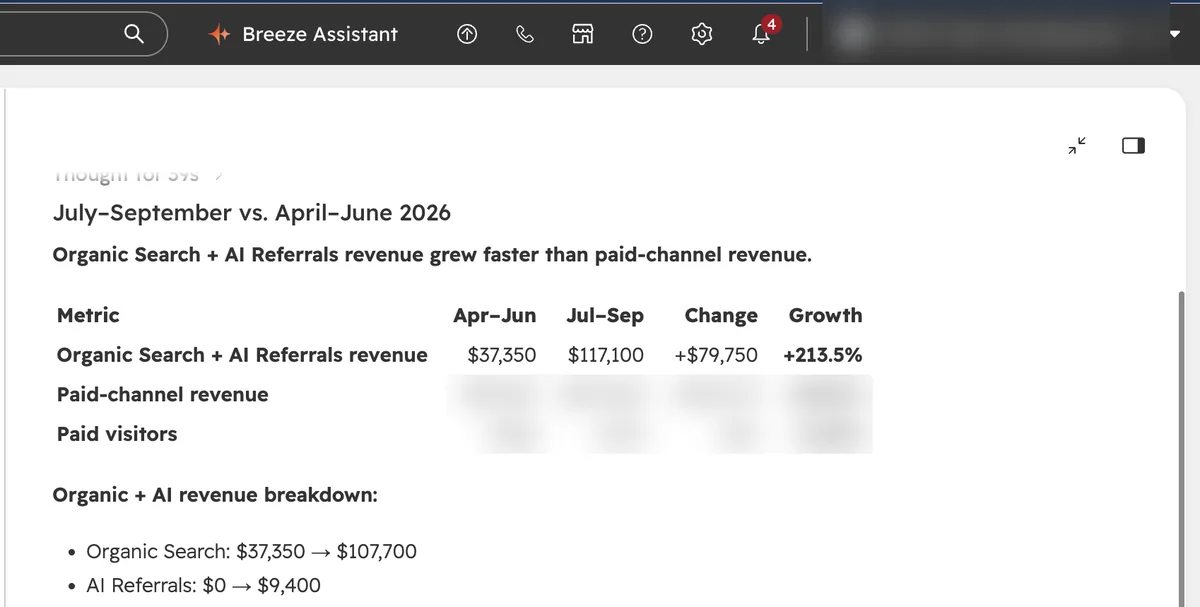
+213.5%
A US B2B company (name withheld). Closed-won revenue credited in HubSpot to Organic Search and AI Referrals (original traffic source) rose from $37,350 (Apr–Jun 2026) to $117,100 (Jul–Sep 2026). AI Referrals alone went from $0 to $9,400.
 Open the screenshot at full size ↗
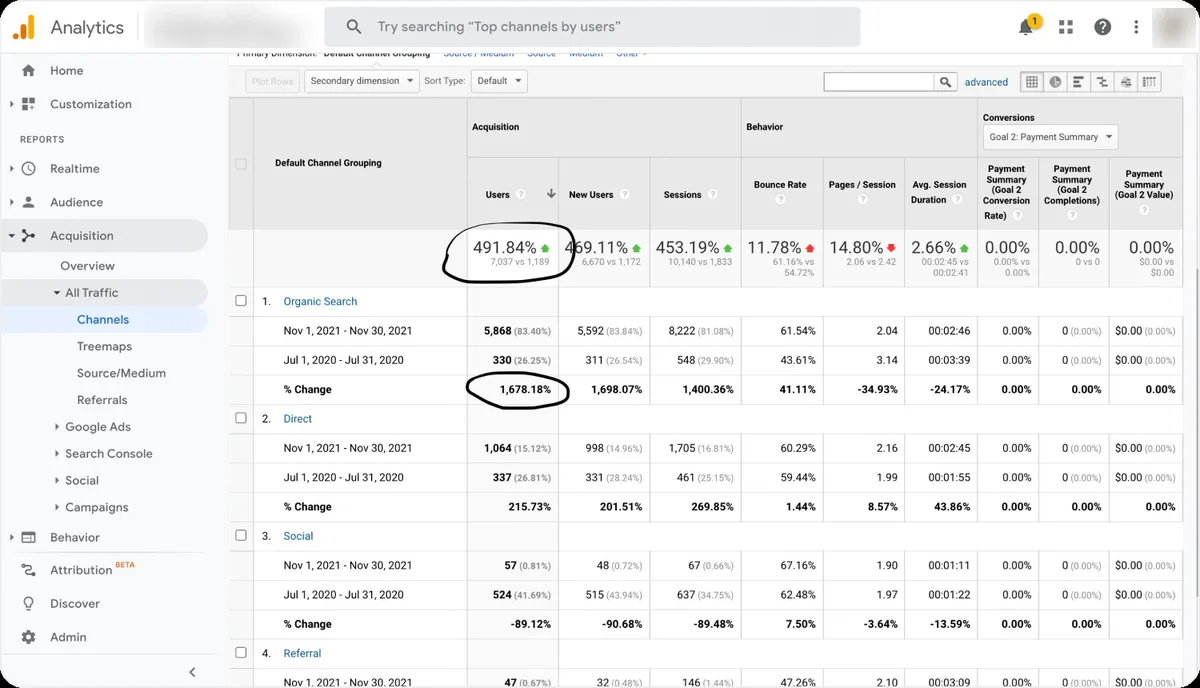
330 → 5,868
JustShip, a Singapore parcel-shipping platform. Organic-search users a month rose from 330 in July 2020 to 5,868 in November 2021, up 1,678% (Universal Analytics). Read the JustShip case study.
 Open the screenshot at full size ↗

“Prolinkage conducted a detailed audit followed by in-depth discussions, providing valuable insights into the implementation process and ensuring seamless execution.”
Project Management Certification and Training · Testimonial excerpt, as published on prolinkage.com
A 90-day order of work.
Fix what a searcher sees when they already know your name, then the pages that decide instructions, then the content that feeds AI answers.
- DAYS 1–15 · MEASUREBranded vs practice-area clicks; enquiries by practice area
- DAYS 10–30 · VERIFYRegisters, directories and Business Profiles match one record
- DAYS 20–50 · CONVERTTop five practice pages: who, cost, stages, who does it
- DAYS 40–70 · ANSWEROne dated answer page per common question, by a named lawyer
- DAYS 60–90 · CHECKRe-run AI questions; compare enquiries, not sessions
The stages overlap on purpose.
Choose the five practice pages by fee value and enquiry volume, not traffic. A page with high traffic and no enquiries is usually explainer traffic, the kind AI Overviews absorb first. For the AI side, write ten questions a client would ask, such as “probate solicitors in Leeds with fixed fees” or “how do I find a good DUI attorney in Phoenix”, run them monthly in ChatGPT, Gemini and Perplexity, and record which firms and sources are named.
Comparing providers? Our 20 questions to ask an SEO agency apply unchanged. Note how competitive that market is: US advertisers bid about $101 a click for “seo for law firms” and about $175 for “law firm seo agency” (Google Ads data via DataForSEO, pulled 25 November 2026). That cost ends up in someone’s fees, so ask for monthly terms and see what SEO costs for published ranges. If you want us to do it, see our SEO and AI search visibility services.
Check your practice-area exposure.
Tick what is true for your firm to see how exposed your search enquiries are and what to fix first. Nothing is sent anywhere.
Tick what applies to see your exposure.
Based on the patterns in this guide. A prompt for discussion, not an audit.
Start with the first fix the check names. The steady demand, people looking for a firm, is where the work pays back.
Questions firms ask.
Is SEO still worth it for law firms in 2027?
Yes, for different searches. Research on 99 UK and Irish firm sites found practice-area clicks down 35.8% in summer 2026, while name searches held flat and visitors still enquired at 6.4%. Invest in pages and profiles that help someone choose a firm, not explainers AI Overviews answer.
Why has my law firm’s traffic dropped while rankings look stable?
Most likely because Google now answers more legal questions on the results page, so clicks fall even where positions hold. Compare branded and non-branded clicks in Search Console, then check enquiries by practice area before changing pages.
Do AI assistants recommend specific law firms?
Sometimes, but more often they point to state bar associations and directories such as Martindale-Hubbell and Avvo; in a vendor study of 288 answers in October 2026, state bars were named in 57.3%. Accurate directory and register entries are now part of SEO for law firms.
Should a law firm publish its fees online?
In England and Wales, firms advertising services such as conveyancing, probate, immigration and employment tribunal claims must already publish prices under the SRA Transparency Rules. Elsewhere it is a choice, but plain fee information in page text is what clients and AI assistants look for.
How long does SEO take for a law firm?
Profile and directory fixes can show within weeks; rewritten practice pages usually take a few months. Judge the work on enquiries and instructions by practice area over at least two quarters, not monthly traffic.
Is SEO or paid search better for a law firm?
They do different jobs. Paid search buys find-a-firm clicks at once, but they are costly and stop when spend stops; SEO builds pages and profiles that keep being found. Many firms run both while organic work matures; see why Google Ads click costs keep rising.
Method and sources: MLT Digital via Legal Futures (11 Nov 2026); iLawyer Marketing (14 Jul 2026); Rev (28 Jan 2026); JUSTICE (1 Sep 2026); 5W, version 2 (30 Oct 2026); SRA Transparency Rules and LASPO guidance; Minnesota Rule 7.2; Google help pages. Agency and vendor studies are labelled in the text. All accessed 25 Nov 2026. Client results: HubSpot (a US B2B company, name withheld), Jul–Sep vs Apr–Jun 2026; JustShip, Universal Analytics, Nov 2021 vs Jul 2020. This guide is general marketing information, not legal or regulatory advice.