
The short answer.
Healthcare SEO for organisations and healthtech vendors is the work of making your evidence easy to find, read and check. Google gives “even more weight” to content with strong experience, expertise, authoritativeness and trust when a topic can affect people’s health, and its AI features hold sensitive topics to “an even higher bar for quality”. Pages that name their clinical and technical people, state regulatory status in exact words, publish dated outcomes and match what third parties say about you give both search systems and buyers something to check. Those are the pages AI answers can cite safely.
This is a different job from clinic marketing, where map listings and reviews decide; see our guide to local SEO for clinics. This guide is for companies selling to health systems, NHS trusts, payers and clinicians: digital health platforms, medtech manufacturers, and health data and coding vendors. It is the work our SEO service does for complex, regulated products.
Prolinkage framework, built from Google Search Central guidance on helpful content and on how AI Overviews choose links (read 25 Nov 2026). Chapter 5 takes each layer in turn.
Who this guide is for.
“Healthcare” covers businesses whose buyers and rules have little in common. The search work differs most by who signs the order.
| Segment | Who buys | What they search and ask AI | What they must be able to verify |
|---|---|---|---|
| Digital health and healthtech SaaS | CMIO, CIO, service lead, procurement | “remote monitoring platform for heart failure”, “ambient scribe for NHS”, vendor comparisons | Outcomes evidence, integration with their EHR, data protection and security artefacts |
| Medtech and device manufacturers | Clinical lead, value analysis committee, supply chain | Device category plus indication, “alternatives to [device]”, specification terms | Regulatory status and intended purpose, clinical data, instructions for use |
| Health data, coding and revenue cycle vendors | Finance director, revenue cycle or coding lead | Coding and billing terms, workflow problems, “[EHR] add-on for…” | Accuracy measures, customer references, integration depth |
If you run a single-site clinic, the clinic guide is the better fit. If you sell IT services into dental practices and groups, our piece on how dental practices choose an IT provider covers that buyer. Everything below assumes a long sales cycle and claims someone will check.
Why health gets a higher bar.
Google’s guidance on creating helpful content calls “Your Money or Your Life” topics those that “could significantly impact the health, financial stability, or safety of people”, and says its systems give “even more weight to content that aligns with strong E-E-A-T” for them. Of the four parts of E-E-A-T, it says, “trust is most important.”
The AI features follow the same line. Google’s page on how AI Overviews and AI Mode choose links (last updated 24 November 2026) says they are built on Search’s ranking and quality systems, that the model “cites and links to the pages that support the information in the response”, and that Google applies “an even higher bar for quality for sensitive topics”, sometimes showing no AI answer at all. Only pages that are indexed and eligible to show with a snippet can be cited.
Where health AI answers appear, and where they do not, is visible in BrightEdge’s yearly snapshot of healthcare keywords. This is a vendor study, published on 24 December 2025:
BrightEdge, “Healthcare AI evolution in Google 2023–2025” (vendor study), snapshots taken 22 Dec each year, published 24 Dec 2025. In 2023 treatment queries were at 45% and local provider queries at 100%.
Two readings matter for a B2B health company. The informational questions your buyers ask are now almost always answered in Google’s AI layer first, so the aim is to be a cited source. And the coding row is not a patient query at all: it is the search a revenue cycle or coding vendor wants to own, and 90% of it showed an AI summary.
The system is not settled. In January 2026, after a Guardian investigation into misleading answers about liver blood test ranges, Google stopped showing AI Overviews for two exact phrasings, while close variants still produced summaries (TechCrunch, 11 January 2026). Google said it works to “make broad improvements”. Health AI answers are watched and adjusted, and the sources that survive scrutiny say who stands behind them.
What 2026’s core updates did to health search.
The clearest data on health came from the March 2026 core update. Amsive’s analysis of SISTRIX visibility (published 30 April 2026) found that the big consumer health publishers lost ground while primary sources gained: the organisations that run the research, set the guidance or sell the product.
Amsive analysis of SISTRIX Visibility Index, 27 Mar–8 Apr 2026, published 30 Apr 2026. SISTRIX measures keyword visibility, not traffic. Bar length relative to 20 points.
Amsive’s summary of the pattern across industries was that “the company that owns the thing” beat “the platform people use to talk about the thing”. For a healthtech or medtech company that is good news: you are the primary source for your own product, outcomes and integrations.
The November 2026 core update began rolling out on 10 November; Google called it “a regular update” and said the rollout may take up to two weeks (Search Engine Roundtable, 16 November 2026). No health winners-and-losers dataset existed when we wrote this, so treat any pattern you hear about as unmeasured. If your traffic moved this month, our guide to telling an AI Overviews loss from a core update loss shows how to separate the two, and our note on the December 2026 core update covers what Google has said about the next one.
The evidence map, layer by layer.
Each layer in the map at the top of this guide answers a question a buyer or a search system asks before trusting you. A gap in any one is visible from outside.
1. Who: named people with checkable credentials
Google’s guidance asks whether it is “self-evident to your visitors who authored your content”. On a health company site, readers expect a named clinical lead and named technical owners for security and integration pages, each with a profile page listing role, registration, publications and talks. Clinical pages carry a dated line: “Clinically reviewed by [name, role], [month year]”.
2. Evidence: outcomes a reader can check
For every outcome claim, publish the setting, sample size, dates, comparator and a link to the full paper, with the summary in HTML on your own site. A PDF behind a form is invisible to most search systems and to every AI answer.
3. Status: regulatory facts in the regulator’s words
Whether a product is a regulated medical device, its class, its clearance or conformity marking and its intended purpose should sit on one page, worded exactly as in your regulatory file. Paraphrase is where trouble starts, as chapter 6 explains.
4. Assurance: the procurement paperwork, made public
Security certifications, data protection documents, clinical safety statements and, for NHS suppliers, the assessments in chapter 8. Most get emailed as attachments during procurement; a public trust centre makes them findable.
5. Fit: integrations and workflows
One page per EHR or system integration: the method (for example HL7 FHIR APIs), what data flows and what it takes to switch on. Buyers search these combinations by name.
6. Corroboration: the same facts elsewhere
AI answers cite pages that support each statement. When your site, your directory listings, trade press and framework entries all state the same facts, every one of them supports the answer. When they disagree, the answer may cite someone else or repeat the wrong version. Our guide to fixing wrong facts in AI answers shows how to trace a bad fact to its source.
What your pages may claim.
For a health product, your website is not only marketing: in both markets regulators can treat it as part of the product’s labelling. This is a working summary, not legal advice; your regulatory and legal people sign off claims.
- United States, devices. The FDA’s device labelling page says “Most, if not all advertising, is labeling,” and reads “accompanying” liberally. A web page describing what your device does can be held to the same standard as the instructions for use.
- United States, any health product. The FTC’s Health Products Compliance Guidance (December 2022) applies to health-related products including apps, and expects “competent and reliable scientific evidence”, generally randomised, controlled human clinical testing for health benefit claims. Testimonials do not replace that evidence.
- United Kingdom, devices. The MHRA’s guidance on software as a medical device defines intended purpose by what the manufacturer supplies “on the labelling, in the instructions and/or in promotional materials”. Your marketing copy can therefore shift what your product is claimed to do.
- United Kingdom, advertising. The ASA’s advice on medical devices (29 January 2026) says objective claims need evidence, “if relevant consisting of trials conducted on people”, that CE or UKCA certification “does not in itself constitute evidence for advertising claims”, and that you should not say or imply a device is “approved” or “certified” by the MHRA.
| Claim on the page | The risk | A version that holds up |
|---|---|---|
| “Reduces readmissions by 30%” | Undated, no setting, implies every buyer gets it | “In a 2025 evaluation at [site], 30-day readmissions fell from X% to Y% (n = …). Full report ↗” |
| “MHRA approved” or “FDA approved” | Misstates status; the ASA warns against implying MHRA approval | The exact status: registration, class and marking, or the clearance type and number |
| “Works with any EHR” | Unverifiable; buyers check integrations by name | List live integrations, the method and a reference site for each |
| Clinician quote praising outcomes | A testimonial is not substantiation; a paid or connected endorser must be disclosed | Quote on workflow or experience; disclose any connection; keep outcomes to the study |
The version that survives legal review is also the one an AI answer can quote: specific, dated, sourced and limited to what you can show.
The pages that carry trust.
Many healthtech sites we have looked at have a strong homepage, a product tour and a gated whitepaper library, and little a buyer can check without a sales call. These page types change that, in the order we usually build them.
- Evidence hub. Every study and evaluation with date, setting, size and outcome, each linking to a short HTML summary.
- Regulatory status page. Product by product: device or not, class, marking or clearance, intended purpose, date last reviewed.
- Trust centre. Dated certifications, data protection documents, clinical safety statements and an assurance contact.
- Integration pages. One per EHR or platform, written for whoever will switch it on.
- Use-case pages by buyer. The same product for the clinical lead, the finance director and the IT lead, who search differently.
- People pages. Clinical, scientific and technical leads with credentials.
Evidence / Remote monitoring
Remote monitoring after cardiac surgery: 12-month service evaluation ①
Setting: two hospitals, one NHS trust · n = 412 · Jan–Dec 2025 · Comparator: prior year ②
Result: unplanned readmissions within 30 days, X% → Y% ③
Regulatory status: UKCA Class IIa, intended purpose as registered ④
Clinically reviewed by [name, role], Nov 2026 · Full report (PDF) ↗ ⑤
- A title that names the use and the study type, so it answers a real question.
- Setting, sample size, dates and comparator, the facts an AI answer needs to quote you safely.
- One outcome with its unit and baseline, not a percentage on its own.
- Status in the words of the regulatory file, linked to the status page.
- A named reviewer, a date and the full source, all in crawlable HTML.
Illustrative layout with placeholder values, not a real study.
Our guide to the page patterns AI engines quote covers sentence-level structure, and the play on writing dated case studies applies directly to study summaries. If the product itself is hard to explain, the approach in SEO for a complex B2B or SaaS product carries over to clinical software.
What buying committees check.
Health buyers rarely buy from a website, but they shortlist from what they can verify before the first call.
United States: incumbents set the bar
L.E.K. Consulting’s 2026 healthcare IT survey (published 29 September 2026) asked 136 US hospital and health system executives and technology leaders involved in purchasing. Among those with a preference, nearly two-thirds favoured an established vendor, including their EHR vendor’s own capability, over a large technology company or a purpose-built AI vendor. Their leading concern about AI was whether outputs are accurate, reliable and unbiased, followed by budget, data privacy and security, unproven return and integration. L.E.K. found integration, workflow fit and institutional trust outweighed the appeal of a newcomer.
If you are the newcomer, your site has to answer those concerns in public: accuracy methods and results, integration pages by EHR, and a trust centre a security reviewer can read before the meeting.
United Kingdom: DTAC and the NHS assurance trail
NHS buyers assess digital health suppliers with the Digital Technology Assessment Criteria (DTAC). A refreshed form, reported by HTN on 25 February 2026, replaced the previous version from 6 April 2026, with about 25% fewer questions and duplicates of the Data Security and Protection Toolkit (DSPT) removed. 8fold Governance (30 March 2026) notes that DSPT compliance is now expected before a new product is released and that suppliers must explain how patient data is used. The areas remain clinical safety, data protection, technical security, interoperability, and usability and accessibility. Every one of them is a page a supplier can publish.
- 01 · PROBLEMSearches or asks AI about a workflow problem
- 02 · NAMESGets three to five vendor names
- 03 · FITChecks integration with their own systems
- 04 · PROOFLooks for outcomes in a similar setting
- 05 · ASSURANCESecurity and clinical safety reviewed
Steps 3 to 5 happen on your site, or they become emails your sales team answers one by one.
Our research on how B2B buyers verify vendors after AI names them covers steps 3 to 5 in other sectors; in health the assurance step is longer.
Corroboration off your site.
Because AI answers cite pages that support each statement, the sources that repeat your facts matter as much as your own pages. In health they are mostly earned through real work, not bought.
| Source type | Examples | What it corroborates |
|---|---|---|
| Peer-reviewed and conference publications | Journal papers, conference abstracts, evaluation reports | Outcomes, with an independent author |
| Health trade press | Sector news sites in the US and UK, NHS digital publications | Deployments, partnerships, customer names |
| Procurement frameworks and marketplaces | Public framework listings, EHR app marketplaces | That you are a listed, assessed supplier |
| Customer organisations’ own pages | Board papers, annual reports, news releases | Who uses you, at what scale |
| Software review directories | Category pages on review sites | Category, buyer satisfaction, comparisons |
A practical routine: list the ten facts AI answers must get right (category, regulatory status, integrations, headline outcome, markets) and check each against these sources once a quarter. Our guide to the off-site sources AI engines use for B2B companies explains how to find which ones cover your category.
Technical groundwork.
Health company sites tend to fail on the same technical points, usually from compliance caution rather than neglect.
- Evidence locked in PDFs or behind forms. Keep the summary in HTML and let the gated version be the full pack.
- Organisation facts unclear. Google’s Organization structured data documentation recommends placing it on the home page or one page that describes the company, with properties such as
legalNameandsameAsfor profiles elsewhere. A legal name matching your regulatory records helps systems join them up. - Markup that says more than the page. Structured data should describe what is visible, not add claims; our play on schema that matches the page covers the checks.
- AI features switched off by accident. Google’s page on AI links says a site must be included in Search generative AI features in Search Console to be cited. Check that setting and your snippet controls before you assume content is the problem.
Proof from our own work
We do not have a healthcare client result to show you, and we will not borrow one. The closest work we can point to is search for a complex technical product in a crowded category, sold to specialist buyers.
Bipp, a business intelligence software company. 2.9K ranking keywords in Semrush’s US desktop database, in the January 2022 snapshot.
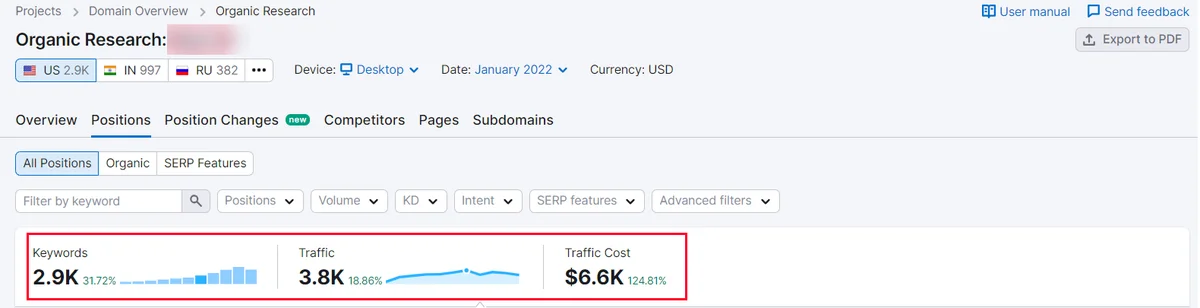 Open the screenshot at full size ↗
“ProLinkage has the technical depth to understand the product and space.”
 Vishal JoshiFounder & CTO, Bipp Analytics
The screenshots and full account are in the Bipp case study.
Self-check your evidence.
Tick what a buyer could find on your public site today without asking sales. Nothing is sent anywhere.
0 of 8 layers in place.
Tick what is public today. The advice updates as you go.
Where this does not apply
- Single-site clinics and practices: local search and reviews matter more; use the clinic guide.
- Products before any evaluation: build the evidence first. No page structure makes up for missing data.
- Consumer symptom content at scale: you would compete with publishers and government sites.
- Sales made only through closed tenders: search still helps with reputation and assurance, but it will not replace the framework.
Choosing a healthcare SEO agency.
Many agencies ranking for “healthcare SEO agency” mainly serve practices and clinics: map listings, reviews and patient acquisition. That is a different job from search for a regulated B2B product. Four questions separate the two.
- Who reviews clinical and regulatory content before it goes live? The right answer names your people, not theirs.
- How do you handle claims? Look for a claims log tied to sources and a sign-off step, not “we write compelling copy”.
- How will you measure AI answers? A fixed set of buyer questions, run repeatedly across engines, with the sources cited, beats a single visibility score.
- Whose accounts are they? In our engagements, accounts stay in the client’s name, access is least-privilege, personal data is kept to a minimum, payment is monthly and the IP is assigned to the client.
Our 20 questions to ask an SEO agency before hiring extends this into a full interview, and GEO for B2B SaaS covers the page types that software products need in AI answers.
Questions buyers ask.
What does a healthcare SEO agency do for a B2B health company?
It makes your evidence findable and checkable: technical fixes, pages for outcomes, regulatory status, assurance and integrations, expert-reviewed content, and consistent facts across the sources AI answers cite. For a clinic the label usually means local listings and reviews.
Is SEO for healthtech different from SEO for other SaaS?
The mechanics are the same, but the bar is higher. Google gives more weight to strong E-E-A-T on health topics, its AI features apply a higher quality bar to sensitive topics, and regulators in the US and UK can treat web copy as part of a device’s labelling or intended purpose.
Can a medtech company say its product is clinically proven?
Only with evidence that supports exactly that claim, and it is safer to name the study instead. The FTC expects competent and reliable scientific evidence for health claims, and the ASA says CE or UKCA certification is not in itself evidence for advertising claims.
How do we get our company into AI answers about our category?
Be a source the answer can cite: indexed pages with clear, dated facts, inclusion in AI features in Search Console, and the same facts repeated by trade press, frameworks and directories. Then test a fixed set of buyer questions regularly.
How long does healthcare SEO take to show results?
New evidence pages can be indexed within weeks, but shortlist effects follow long buying cycles. Judge early progress on pages shipped, indexed and cited, and pipeline over a longer window agreed at the start.
Method: every external figure was read at its source on 25 Nov 2026; dates and samples are given where each is used. Vendor studies are labelled. Client result: Bipp, Semrush US desktop, January 2022 snapshot. Review as published on prolinkage.com. Engagement terms confirmed by Prolinkage, 13 Nov 2026. Not legal or regulatory advice.