
The short answer.
Cybersecurity SEO in 2026 has one job beyond rankings: getting your company named when a buyer asks ChatGPT, Gemini, Perplexity or Google’s AI Overview for a shortlist of vendors. In a vendor study of 100 security companies across 10 categories, 73% received zero ChatGPT citations for category recommendation prompts (GrackerAI, February 2026). The vendors that are named have three things in common: independent validation (analyst coverage, certifications, marketplace listings, reviews), plain-text product facts on their own domain, and pages that answer the comparison and compliance questions buyers actually type.
Most security teams produce plenty of content. The gap is that the facts an engine needs (what you protect, for whom, with which integrations, under which certifications) sit in gated PDFs, logo walls and JavaScript-rendered trust centres. That is fixable, and it is the work behind our AI search visibility service. How the engines choose in general is covered in our explainer on how ChatGPT decides which companies to recommend; this guide stays on what is specific to security vendors.
Prolinkage framework. Build from the bottom: layers 4 and 5 are earned off your site, but engines can only connect them to you if layers 1 to 3 state the facts plainly. Statistic: GrackerAI, State of AI Search Visibility in Cybersecurity, a vendor study, February 2026.
The shortlist gap, in numbers.
The broadest study of this category we found comes from a company that sells AI visibility software, so read it as a vendor study. GrackerAI tested 100 cybersecurity vendors across 10 sub-categories (EDR, SIEM, Zero Trust and SASE, IAM, cloud security, email security, vulnerability management, MDR, DLP and network security) with 250 buyer-intent prompts in six engines, between September 2025 and January 2026.
The headline is the gap. 73% of vendors received no ChatGPT citations for category recommendation prompts, while the most-cited vendor in each category was cited in roughly half to four-fifths of answers. The authors describe the pattern as winner-take-most, with a gap of 30 to 50 points or more between the category leader and the category average on their score.
GrackerAI, State of AI Search Visibility in Cybersecurity (vendor study, published February 2026, page modified 23 September 2026). Prompts run September 2025 to January 2026. Figures as reported; the underlying data is not published.
Caveats: the score is the vendor’s own and described by its authors as directional, the per-category figures are not reconciled with the 73% headline, and several multipliers in the report come without data, so we have left them out.
What survives is the shape: a handful of names absorb most mentions, and the long tail of capable vendors is close to invisible. For a mid-size vendor, the realistic goal is not to displace the leader for “best EDR” but to be named for the narrower questions where you are genuinely the better fit.
Who the engines name today.
A second index, published by the PR firm 5W and updated on 9 November 2026, asked 24 security questions three times each in ChatGPT, Claude, Gemini and Perplexity through their APIs (288 answers) and checked 57 Google searches, all of which showed an AI Overview. It tracked 42 vendors.
5W Cybersecurity Index 2.0 (PR firm research), measured 3 November 2026, page updated 9 November 2026. 24 questions × 3 runs × 4 engines via API. One question names two of the vendors directly, which the authors say inflates their counts.
Two findings matter more than the league table. First, the sources: gartner.com was cited in 46.2% of grounded answers, a security buyer’s guide site in 24.3%, and company or brand sites made up 34.4% of all citations. Vendors’ own domains do get read; Palo Alto Networks’ were cited in 19.4% of grounded answers. Second, no tracked name differed by more than 12 points between engines, which suggests the same underlying evidence is driving all four.
How security buyers use AI.
The buyer surveys cover B2B software in general, not security alone, but the pattern carries over. In G2’s survey of 1,076 B2B software buyers (March 2026), 51% now start research in an AI chatbot more often than in Google, and AI chatbots were the most common influence on which vendors made the shortlist (54%), ahead of review sites (43%), market research firms (36%) and vendor websites (36%). 69% said a chatbot led them to a different vendor than they had planned.
What happens next is verification. TrustRadius’s 2026 report (1,862 technology buyers, surveyed January 2026) found 63% used AI in their software purchase research, and 94% of those fact-checked its answers at least some of the time. Only 13% used analyst reports directly in their latest decision, while 74% used reviews. G2 adds that 45% of buyers find review-site citations the most confidence-inspiring signal in an AI answer.
In security, that check is formal procurement: a security questionnaire, the latest SOC 2 Type II or ISO 27001 certificate, data residency for UK and EU buyers, FedRAMP for US public sector. If those answers are easy to find on your site, the AI shortlist and the human check point the same way. Our guide to how B2B buyers verify vendors after AI names them covers that second step in detail.
- 01 · ASK“Best MDR for a 300-person UK firm”
- 02 · NARROWIntegrations, compliance, deployment
- 03 · COMPARE“X vs Y”, “X alternatives”, reviews
- 04 · VERIFYTrust centre, certificates, references
- 05 · CONTACTThe top two or three, rarely more
Steps 1 to 4 can now happen without a sales conversation.
The prompts that build a security shortlist.
Security buyers rarely ask “best cybersecurity company”. They ask with constraints: size, stack, sector, framework, region. G2 found that 33% of software buyers’ first AI prompts are category questions and 31% name a competitor, which in security means “alternatives to” the incumbent the buyer is unhappy with. Each prompt type is answered by a different kind of page.
| Prompt type | Example a buyer might type | The page an engine needs |
|---|---|---|
| Category with constraints | “Best MDR provider for a mid-size US manufacturer with no SOC” | A category page stating who you serve, team size and sectors, in plain text |
| Region and framework | “Cyber Essentials Plus certified managed security providers in the North of England” | A UK page naming the certification, its date and the regions you cover |
| Public sector | “Which SIEM tools are on the FedRAMP Marketplace?” | A public-sector page linking to your marketplace listing |
| Competitor | “Alternatives to [incumbent] for a lean security team” | A fair comparison page with dated claims and who should stay with the incumbent |
| Integration | “EDR that integrates with Microsoft Sentinel and Okta” | An integrations list in crawlable HTML, not a logo grid |
| Problem | “How do I cut alert fatigue in a two-person SOC?” | A practitioner article with numbers from your own deployments |
| Description check | “Is [your company] any good for a 500-seat law firm?” | A dated product facts page and recent reviews that agree with it |
The examples are illustrative, not recorded prompts. Most are long, specific questions where a mid-size vendor can be the most relevant answer, which is where the leaders’ dominance is weakest.
Search demand is small but rising: Google search data via DataForSEO (November 2026) shows about 110 monthly US searches for “cybersecurity seo”, up 189% quarter on quarter, and 110 US and 40 UK searches for “cybersecurity marketing agency”, at around $35 a click in the US.
The validators engines lean on.
Security is a category where third-party validation is unusually formal, and engines reach for it. The 5W index found an analyst firm’s domain cited in nearly half of grounded answers; GrackerAI reports that analyst inclusion and review profiles drive the highest citation rates, though it does not describe the test behind that. Beyond analysts, both the US and the UK run public registries that buyers and engines can read.
| Source | Market | What it proves | What to do |
|---|---|---|---|
| FedRAMP Marketplace | US federal | A searchable database of FedRAMP certified cloud services; 563 certified services on 25 November 2026, 40 of them under FedRAMP 20x | Link your listing from your public-sector page and keep the service description current |
| Cyber Essentials and Cyber Essentials Plus | UK | The NCSC-developed baseline; Plus adds independent technical testing. A growing number of organisations require it from suppliers | State your level and certificate date on your trust centre |
| CREST Marketplace | UK and international | Accredited providers for penetration testing, incident response and related disciplines | Services firms: link your listing from each service page |
| Analyst coverage | Global | Inclusion in the analyst lists engines cite most | Publish what you are included in, with the year; never imply a placement you do not have |
| Peer review platforms | Global | Recent, specific customer reviews | Ask for reviews after go-live and respond to them; engines and buyers read both |
None of these is a ranking trick. They are facts buyers check anyway, and an engine can only use them if it can connect them to you: same company name, a link from your site, matching dates. Our guide to the off-site sources AI uses to recommend B2B firms ranks review sites, lists and directories by effort and value.
What to publish on your own domain.
Brand sites supplied about a third of citations in the 5W data, yet GrackerAI found most vendor content is not cited. The difference is usually format: engines quote pages that state a checkable fact in one sentence, and skip pages that describe a vision.
ILLUSTRATIVE EXAMPLE · A TRUST CENTRE AN ENGINE CAN QUOTE
Weak: “Security is in our DNA. Request our compliance pack.” (Everything useful is behind a form or inside a PDF.)
Strong: “SOC 2 Type II report covering 1 Jan–31 Dec 2025, available under NDA. ISO 27001 certificate number and expiry date. Cyber Essentials Plus, renewed March 2026. Customer data hosted in AWS eu-west-2 (London) or us-east-1, chosen at onboarding. Sub-processor list updated monthly.”
Why it works: each sentence answers a procurement question, carries a date, and can be lifted into an AI answer without losing meaning. The report stays gated; the fact that it exists does not.
A made-up vendor, to show the format. Publish only what is true of your own certifications.
The pages that most often carry security vendors into answers:
- A crawlable trust centre. Many trust-centre tools render with JavaScript behind a request button. Keep a plain HTML summary on your own domain that lists certifications, dates, hosting regions and the process for requesting reports.
- Category pages with constraints. “MDR for mid-size manufacturers” beats “Next-generation managed detection”. Name team sizes, sectors and the stacks you work with.
- An integrations directory. Text, not logos. Buyers name their SIEM, identity provider and cloud in prompts; both names need to appear on your page.
- Framework pages. How your product supports NIST CSF 2.0, ISO 27001 controls, DORA or NIS2 for UK and EU customers, written by someone who has done the audit.
- Fair comparison pages. One per real competitor, dated, with a line on who should choose the other product.
- Dated case studies. Sector, size, problem, measured result, date. Our play on writing case studies AI engines can quote sets out the format.
If the engines already describe you wrongly, such as an old product name, a retired tier or a missing certification, correct the source first. Our guide to fixing wrong information AI gives about your company walks through it.
Cybersecurity SEO still does the heavy lifting.
Is SEO still relevant in 2026? For security vendors, more than before, because every AI answer above draws on indexed pages. Google says a page needs no special markup or AI-specific files to appear as a supporting link in AI Overviews or AI Mode: it must be indexed and eligible to show with a snippet. Google also notes that these features may run several related searches across subtopics, so a page that ranks for the narrower sub-questions has more chances to be used. OpenAI’s documentation says sites that block OAI-SearchBot will not appear in ChatGPT search answers, and that GPTBot (training) can be blocked separately.
That is where security sites most often trip up. The problems we look for first:
- Bot rules written by the security team. A WAF or bot-management rule that blocks AI search crawlers, often added for good reasons, quietly removes you from ChatGPT search. Check robots.txt and the WAF logs separately; our AI crawler log file check shows how.
- Gated substance. The threat report, the buyer’s guide and the architecture paper are PDFs behind forms. Publish an ungated summary page with the key findings and dates; gate the full report if you must.
- Docs on a separate stack. Product documentation on a subdomain with its own robots rules, no internal links from the main site and no sitemap is invisible to most engines.
- No owner per topic. Five pages half-answering “what is XDR” compete with each other. One page per question, linked from the rest.
Our guide to SEO for complex B2B and SaaS products covers feature, integration and use-case page structure in more depth, and our SEO services handle the technical side.
The 10-prompt test.
Replace the brackets with your category, competitor and integrations, then run each prompt in ChatGPT with search on, in a fresh chat, logged out or in a clean profile. Record what happened. Repeat in Gemini and Perplexity on another day; answers vary, so one run is a sample, not a measurement. Nothing you select is sent anywhere.
Named in 0 of 10 prompts · top three in 0
Record each prompt’s result to see where your gap sits.
Log the raw answers, date and engine for each run; the three-month trend matters more than one score. For a scoring method you can report upwards, see our explainer on how an AI visibility score is calculated.
What this looks like in our work.
We have not published a cybersecurity case study. The closest work we can show is for a technical software vendor competing with much larger platforms, the position most security vendors are in. Bipp Analytics, a business-intelligence platform, described the starting point in its founder’s review: “We have a very complex technical product and we operate in a large space with billion dollar competitors, and we had no idea where to start on our SEO efforts.” In Semrush’s US desktop database, bipp.io had 2.9K ranking keywords in the January 2022 snapshot. The Bipp case study shows the report and explains what that snapshot does and does not show.

“ProLinkage has the technical depth to understand the product and space.”
Read the Bipp case study
Visibility only matters if it reaches revenue, so we track it into the CRM. For a US B2B company (name withheld), HubSpot credited organic search and AI referrals with more closed-won revenue in the third quarter of 2026 than in the second, and AI referrals appeared as a revenue source for the first time.
A US B2B company (name withheld). Closed-won HubSpot revenue credited to Organic Search and AI Referrals: $37,350 (Apr–Jun 2026) to $117,100 (Jul–Sep 2026). AI Referrals alone: $0 to $9,400.
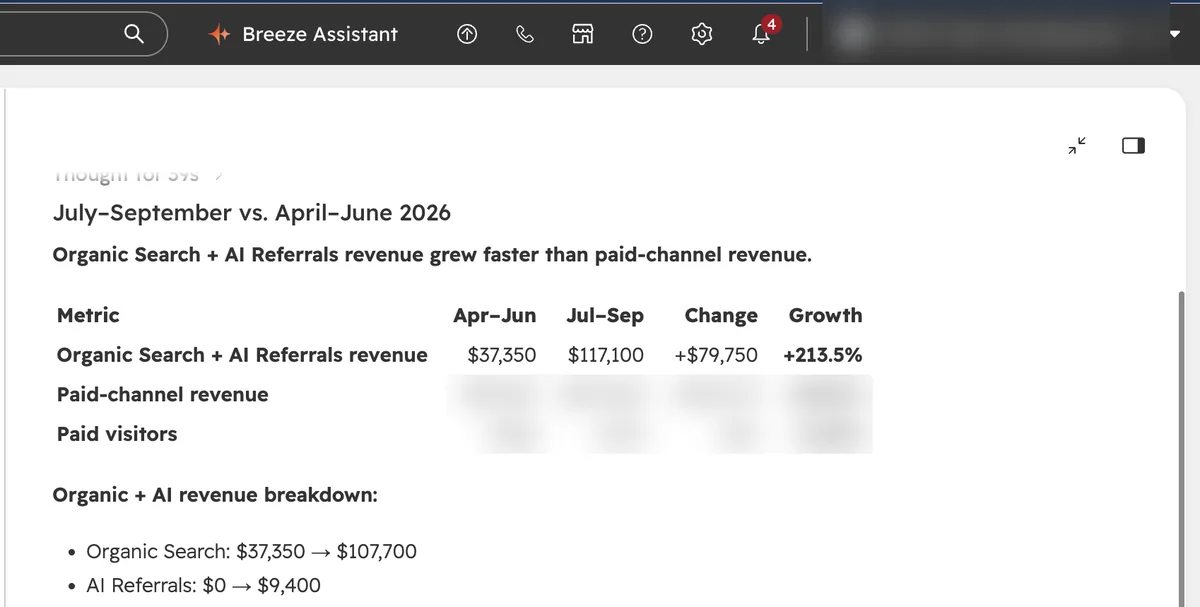 Open the screenshot at full size ↗
One quarter against another is not a controlled test, and this client does not sell security. It shows the measurement we set up first: AI referrals in their own channel, carried through to deals. Our write-up of that CRM result explains the method, and the GA4 AI channel setup shows the first step.
Hiring help, and when not to.
If you are comparing cybersecurity marketing agencies, ask questions specific to this category:
- Can they explain your category’s buyer (a SOC lead, a CISO, an IT manager at a 200-seat firm) without your sales deck?
- Will they run a dated baseline of named prompts across engines before proposing anything, and share the raw answers?
- How do they handle claims? Every certification, customer and number should be checked against evidence you own.
- Will your security team review technical content before it ships? It should, and the plan should budget for it.
- Do they report qualified pipeline, not only mentions and traffic?
Our 20 questions to ask an SEO agency before hiring covers the general interview.
Questions security marketers ask.
What is cybersecurity SEO?
It is search engine optimisation for security vendors and service providers: technical health, pages that answer buyers’ category, comparison and compliance questions, and third-party validation. In 2026 it also covers being named in AI answers, which rely on the same indexed pages and listings.
Why does ChatGPT recommend the same few security vendors?
Because the evidence it draws on is concentrated: analyst coverage, review profiles and buyer’s guide sites mention the leaders far more often. A February 2026 vendor study found 73% of 100 security vendors had no ChatGPT category citations. Smaller vendors have their best chance on narrow, specific questions, where the leaders’ coverage thins out.
Should a security vendor block AI crawlers?
Separate search from training. OpenAI says blocking OAI-SearchBot removes you from ChatGPT search answers, while GPTBot, its training crawler, can be blocked on its own. Check your WAF rules too, since bot protection often blocks crawlers that robots.txt allows.
Do certifications like Cyber Essentials or FedRAMP help AI visibility?
They help when buyers ask framework or public-sector questions, and when your listing, your site and the certificate dates agree. They do not lift you for broad category questions on their own.
How long before a security vendor shows up in AI answers?
Fixes to crawler access can show within days; OpenAI says robots.txt changes take about 24 hours to affect search. New pages, reviews and listings usually take months to be reflected consistently. Re-run the same prompts monthly and judge the trend.
Sources: GrackerAI, State of AI Search Visibility in Cybersecurity, vendor study, Feb 2026; 5W, Cybersecurity Index 2.0, PR firm research, updated 9 Nov 2026; G2, The Answer Economy, 15 Apr 2026; G2, 2026 AI search insight report; MarketScale on TrustRadius 2026; Google Search Central, AI features and your website; OpenAI, crawlers; FedRAMP; NCSC, Cyber Essentials; CREST; Google search data via DataForSEO, US/UK, November 2026. All accessed 25 November 2026. Client results: Bipp Analytics, Semrush snapshot January 2022; a US B2B company (name withheld), HubSpot, Q3 vs Q2 2026.