
The short answer.
Choose a B2B search engine marketing company on six things, in this order: the ad account, Tag Manager and analytics stay in your company’s name with you as an Admin; Google’s costs are shown separately from the agency’s fee; bidding is set up to learn from qualified leads rather than every form fill; a named person reviews search terms and automated recommendations every week; the people who pitch are the people who run the account; and the fee model does not reward spending more for its own sake. The first two are deal-breakers, and so is any promise of a top ad position or a fixed number of leads, which Google itself calls misrepresentation. The rest you weigh.
A Google Partner badge is a useful filter, not a verdict. Google awards it for an optimisation score, spend and certifications. It does not measure whether the leads became customers. That part you have to check yourself, and the scorecard in chapter 9 helps. If you also need an SEO or AI search partner, our 20 questions to ask an SEO agency cover that hire separately.
Prolinkage framework. Areas 1 and 2 rest on Google Ads Help (access levels) and Google’s third-party policy; chapters 3 and 4 give the detail. A promised top position is a third deal-breaker (chapter 7).
What you are actually hiring.
Google defines search engine marketing as increasing a product or service’s visibility on a search results page “through paid advertising”, and notes that older definitions sometimes included unpaid work too. In 2026 most agencies use SEM to mean paid search: Google Ads first, often Microsoft Advertising, sometimes ads inside AI answers. SEO is the unpaid side. Before you compare companies, decide which you are buying, because a proposal that blends both makes the fee impossible to judge.
Search is the largest single digital channel in both the US and the UK, so a weak choice wastes real money.
US: IAB/PwC Internet Advertising Revenue Report, full year 2025 (released 16 Apr 2026; company-reported, not audited). UK: IAB UK and Oliver Wyman Digital Adspend 2025 (3 Mar 2026; new method from 2025, not comparable with earlier editions).
Three kinds of provider sell SEM to B2B companies, and they suit different situations:
- A specialist paid search agency: deep on bidding, structure and testing; you may need someone else for landing pages and CRM work.
- A full-service or growth agency: paid, SEO, tracking and pages under one team; check that paid search is not the junior part of it.
- A freelancer or consultant: senior judgement at lower cost for one account; check cover for holidays and how changes are documented.
Is SEO still relevant if you are buying ads? Yes, and the two work best when one plan covers both: organic pages lower the blended cost of each customer, and paid search shows quickly which searches turn into pipeline. We cover what B2B SEO costs separately.
Ownership and access: the non-negotiables.
Whoever holds Admin access to the Google Ads account controls who else can see it, which manager accounts are linked and whether conversion data can be imported. Make sure that is your company, before any campaign is built.
Google Ads has five access levels. The difference that matters when you hire is between Standard, which can edit campaigns, and Admin, which can also decide who has access.
| Level | What it can do (Google Ads Help) | Who should hold it |
|---|---|---|
| Admin | Everything, including adding users, changing access levels, accepting or unlinking manager accounts, and linking Google Analytics to import conversions | At least two people at your company |
| Standard | Edit campaigns and billing information; no user management | The agency’s account team, or the agency via a linked manager account |
| Read-only | View campaigns, billing, users and managers; run reports | Finance, sales leadership, an outside reviewer |
| Billing | View and edit billing and payment details only | Finance |
| Email-only | Receive notifications and reports | Anyone who just needs the monthly report |
One detail catches buyers out. Google’s help page notes that if a linked manager account has ownership of your account, its admins can also edit user access, managers and product links. An agency linking through its manager account is normal. An agency’s manager account owning yours means it controls the keys. Ask which it will be, in writing.
The same rule applies beyond Google Ads: Google Tag Manager, GA4, Microsoft Advertising, the CRM fields that record lead quality and any landing pages the agency builds. If the relationship ends, you should be able to remove the agency’s access in an afternoon and keep every campaign, conversion action and audience list.
What Google requires an agency to tell you.
Agencies that buy or manage Google ads for clients are bound by Google’s third-party policy. Most buyers never read it, and it answers half the questions you would otherwise have to ask.
Under the policy’s transparency requirements, a third party must tell new clients in writing about any management fee before the first purchase and disclose it on every invoice. Where Google’s terms require the agency to send a monthly report, it must give cost, clicks and impressions at account level and “the exact amount charged by Google, exclusive of any fees”. It must also give you your Google Ads customer IDs when you ask. Google’s advertiser guide adds that the agency must set up a separate account for you, that you should get your agreement in writing, and that anyone who promises a top ad position is “misrepresenting how Google’s advertising works”. Advertising, it notes, has no effect on organic rankings.
What the Google Partner badge proves
Google’s current Partner requirements are a minimum optimisation score of 70% on the agency’s manager account, $10,000 of ad spend across managed accounts over 90 days, and at least half of account strategists certified in Google Ads. Google checks them daily. Premier Partners must also rank in the top 3% of participating companies in their country, judged once a year on client growth, retention, product diversification and spend.
Read that list for what it leaves out. Optimisation score is Google’s “estimate of how well your Google Ads account is set to perform”, and Google says both applying and dismissing recommendations change it. A high score shows the agency deals with recommendations. It does not show that the recommendations suited your leads. Ask any Partner which recommendations it dismisses and why; a good answer names a few, such as broad match or Search Partners expansion on a lead-generation account. To verify a badge, Google suggests clicking it: a real one opens the agency’s profile on Google. You can check our Google Partner profile the same way.
Auto-apply deserves its own question. Google lets accounts apply chosen recommendation types automatically, including adding broad match keywords, removing keywords, changing bid strategies or targets and expanding to Search Partners. Each can be sensible. Switched on unseen, they change what you pay for. Ask which types will be on, and ask to see the setting.
Fees and the incentives they create.
How an agency charges tells you what it is paid to do. Few sources publish PPC fees with a stated sample, so treat the figures below as practitioner ranges, not market statistics.
A Search Engine Journal “Ask a PPC” column from April 2025, written by a product liaison at Microsoft Advertising, puts percentage-of-spend fees at 5% to 15%, often with a fixed component of $500 to $2,500 a month, and flat management fees at $2,500 to $10,000 a month. It suggests that budgets under $2,500 a month may be better run in-house, because fees can eat too much of the budget, and warns that some performance-based deals leave the agency owning the account. Clutch’s PPC pricing guide, compiled from verified client reviews (updated 21 September 2026), lists $100 to $149 an hour for Google Ads work and a typical engagement of 14 months.
| Model | Rewards the agency for | Ask |
|---|---|---|
| Percentage of spend | Spend rising, whether or not leads do | Who proposes budget increases, and on what evidence? |
| Flat monthly fee | Keeping the account steady with a known workload | What is included, and what costs extra (landing pages, tracking)? |
| Hybrid (base plus a share) | Both effort and scale, with a floor | At what spend does the percentage start? |
| Performance-based | Whatever the contract counts as a result | Who owns the account, and is a “lead” defined by your CRM? |
The worked example below uses figures inside the published ranges to show the incentive, not anyone’s price.
10% of spend + $1,000Flat $4,000
Invented example inside the ranges in Search Engine Journal’s Ask a PPC column (26 Apr 2025). Not a Prolinkage price.
Neither model is wrong. The point is to know which way the agency is pulled, and to tie budget increases to cost per qualified opportunity rather than to the fee. For the auction side of the cost, our guide to Google Ads cost per click in 2026 charts the published benchmarks.
The B2B question: what counts as a lead?
This is the question that separates agencies that run B2B accounts well from those that run them busily. Ask it in the first call and listen to whether they ask it back.
A B2B account usually has a handful of genuine enquiries a week, mixed with job seekers, students, suppliers, existing customers and spam. If the account counts every form fill as a conversion, Smart Bidding will find more form fills, efficiently. A good agency will want to know your sales stages, how quickly sales qualifies an enquiry, and whether qualified and won outcomes can be sent back to Google Ads. Our article on cost per lead versus cost per qualified opportunity explains why the second number is the one to judge them on.
Good answers in that first call sound like this:
- “Before we change bids, we’ll audit your conversion actions and remove anything that isn’t a real enquiry.”
- “We’ll keep one primary goal for bidding and import qualified stages from your CRM once there is enough volume.”
- “We’ll report cost per qualified opportunity by campaign, and we’ll need someone in sales to mark leads within a week.”
The set-up behind those answers is covered in our sibling guide to Google Ads conversion tracking for lead generation and in offline conversion tracking. If your current numbers already disagree with your CRM, our GA4 lead numbers audit is a fast place to start.
Red flags and green flags.
Most of these come up in a proposal or the first two calls. A red flag in any of the first three rows is enough to walk away.
| Area | Red flag | Green flag |
|---|---|---|
| Account | Created by the agency, owned by its manager account; you get read-only | Your company owns it and holds Admin; the agency links in |
| Fees | One blended “media” invoice; fee not stated | Google’s charges and the fee shown separately on each invoice |
| Promises | A top position or a fixed number of leads promised | A test plan with ranges, and what would make them change course |
| Conversions | Reports “conversions” without asking what a qualified lead is | Asks for your CRM stages and sales follow-up time |
| Automation | Every recommendation auto-applied; optimisation score as the headline | Names which recommendations it dismisses, and why |
| People | Senior pitch, unnamed delivery team | Names your account lead and how many accounts they run |
| Proof | Large percentages with no dates or source | Dated results, the metric named, ideally a screenshot |
| Exit | Long lock-in; campaigns or audiences kept on leaving | Short notice; everything stays in your accounts |
Google’s advertiser guide adds two warnings of its own: be wary of anyone who claims to be from Google without a google.com email address, and of anyone who says they can remove your business from organic results. The second is not possible.
What the first month should look like.
A good agency spends the first month on the account’s foundations before it asks for more budget. Google’s guide recommends testing third parties one at a time, because only one ad per business shows on a results page; running two agencies in parallel mostly bids against yourself.
A first-month report worth paying for
Spend (Google’s charges): $12,400. Management fee: invoiced separately.
← Google’s charges reported without the fee, as its third-party policy sets out
Search terms reviewed: 1,180. Added as negatives: 214, mostly jobs, courses and template searches.
← someone read the report
Conversion actions found: 7. Kept as primary: 1, the enquiry form; a duplicate GA4 import removed.
← measurement fixed before bids
Enquiries: 31. Marked qualified by sales: 9.
← the number that matters, from your CRM
Auto-apply: on for ad assets only. Next month: split brand from non-brand; test one exact-match campaign for the top service.
← a plan you can hold them to
Invented figures for illustration only.
Our guide to what to expect from an agency in the first 90 days sets out the later milestones. If leads arrive but do not turn into sales, the cause may be after the click; see our recovery playbook for Google Ads leads that don’t convert.
The scorecard.
Fill this in once for each company you are considering, from its proposal and your calls. Each answer scores 0 to 10 points. Nothing you enter is sent anywhere.
Score: 0 / 100 (0 of 10 answered)
Answer as you go through each proposal. Unanswered questions score zero.
Score two or three companies the same way and compare the gaps, not only the totals. A company scoring 70 whose gaps are all “not in writing yet” is closer than one scoring 75 that said no to a measurement plan.
What this looks like in our work.
We hold ourselves to the same scorecard. Our standing terms: accounts stay in the client’s name, we take least-privilege access, personal data is kept to a minimum, payment is monthly and the contract assigns the IP to the client.
 Google Partner
View our Partner profile ↗
PPC, SEO and social, 3 July 2024
We work with many companies in both
In a Clutch verified review dated 3 July 2024, Leopard Project Controls, a US project-controls firm, rated our work 5.0 overall and 5.0 on quality, schedule, cost and willingness to refer, for a project covering pay-per-click, SEO and social media from January 2022 to March 2024.
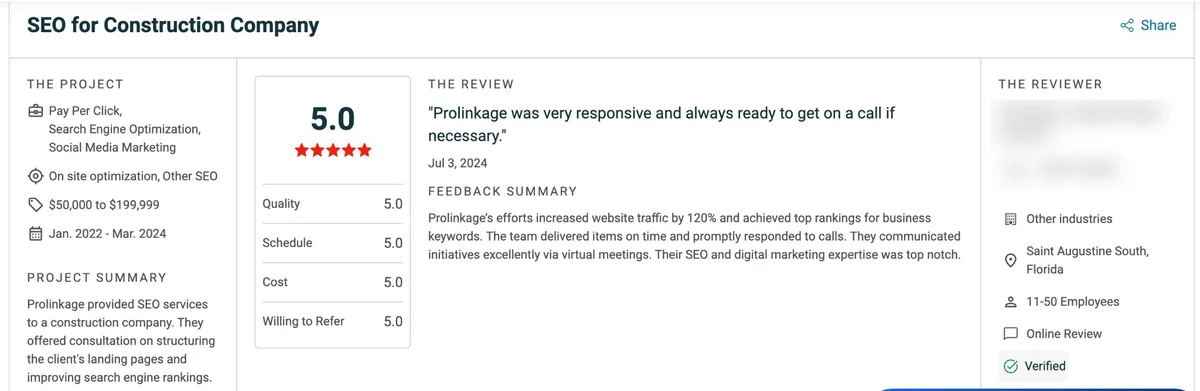 Open the screenshot at full size ↗
“Prolinkage was very responsive and always ready to get on a call if necessary.”
Clutch verified review, 3 July 2024 · See our case studies
Area 3 of the scorecard is where results are decided. For a US B2B company (name withheld), we set up HubSpot reporting by original traffic source, so closed-won revenue could be traced to the channel that first brought each buyer in.
A US B2B company (name withheld). Closed-won HubSpot revenue credited to Organic Search and AI Referrals: $37,350 (Apr–Jun 2026) to $117,100 (Jul–Sep 2026). AI Referrals alone: $0 to $9,400.
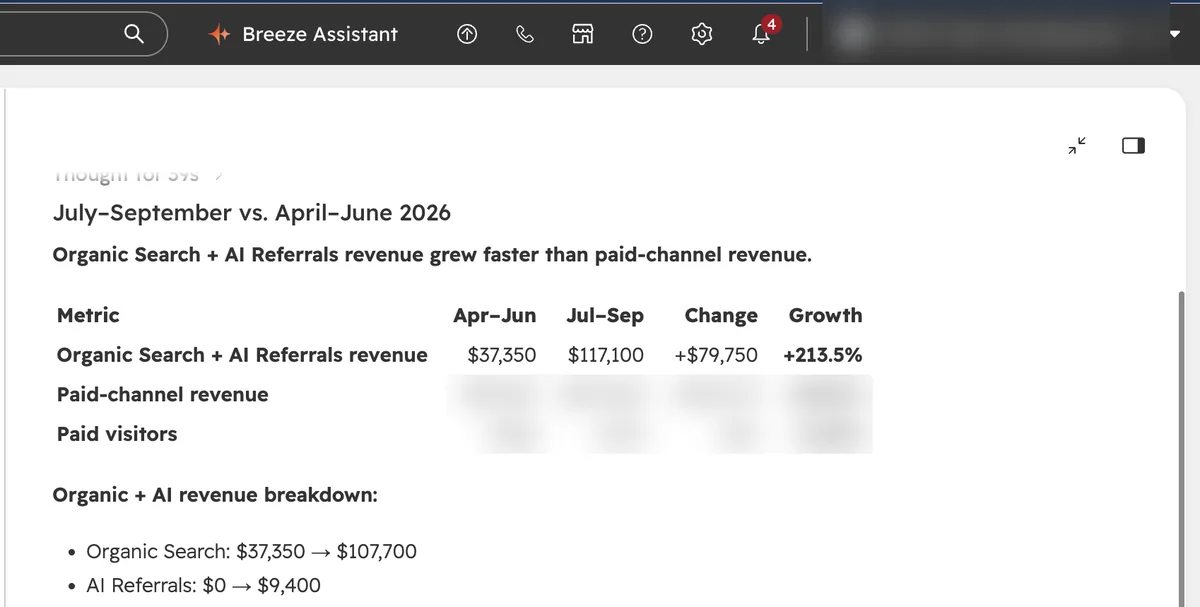 Open the screenshot at full size ↗
That result is organic search and AI referrals, not paid, and one quarter against another is not a controlled test. We show it because it is the report format to ask any SEM company for: revenue by source, from your CRM. For software companies, our guide to SaaS PPC that reaches pipeline applies the same idea to trials and demos.
When not to hire an agency.
Can you run Google Ads, or SEO, yourself? Often, yes. Plenty of B2B companies should start in-house and hire later.
If the agency you prefer is based outside your market, the scorecard still applies; our guide to hiring an India-based agency for US or UK work adds the questions specific to that choice. If you are weighing ads inside ChatGPT as well, read ChatGPT ads versus Google Ads for B2B before splitting a test budget.
Questions buyers ask.
What is search engine marketing, in simple words?
Paying to appear on search results pages. Google defines search engine marketing as increasing a product or service’s visibility on a search results page through paid advertising. Older definitions included SEO as well, which is why proposals sometimes mix the two; ask which one you are being quoted for.
How much does a search engine marketing company cost?
Practitioner ranges published by Search Engine Journal in 2025 put percentage fees at 5% to 15% of ad spend, often plus a fixed $500 to $2,500 a month, and flat fees at $2,500 to $10,000 a month. Clutch lists $100 to $149 an hour for Google Ads work. Ad spend is paid to Google on top.
Does a Google Partner badge mean an agency is good?
It means the agency meets Google’s thresholds: a 70% optimisation score, $10,000 of spend across client accounts over 90 days and half its strategists certified. Premier Partners are also in the top 3% in their country. Neither measures whether your leads become customers, so use the badge as a filter, then score the rest.
What is the 3-3-3 rule in marketing?
It is not a Google or industry standard, and people use the phrase for different rules of thumb, so ask whoever quotes it what they mean. If you want a three-part test for an SEM company, use three questions: whose name is on the account, what counts as a conversion, and how the fee is calculated.
Is SEO still relevant in 2026 if we run ads?
Yes. Paid search stops the moment the budget does, while organic pages keep bringing visitors and lower the blended cost of each customer. The two work best on one plan: ads show quickly which searches turn into pipeline, and SEO builds lasting pages for those searches.
Sources, all read 25 November 2026: Google Ads Help, access levels; Google third-party policy, transparency requirements; Google, advertiser guide to working with third parties; Google Ads Help, becoming a Google Partner or Premier Partner; Google Ads Help, optimisation score; Google Ads Help, applying recommendations automatically; Google, what is search engine marketing; Search Engine Journal, Ask a PPC, 26 Apr 2025; Clutch PPC pricing guide, updated 21 Sep 2026; IAB/PwC, 16 Apr 2026; IAB UK, 3 Mar 2026. Client results: Clutch verified review, 3 Jul 2024; HubSpot, Apr–Sep 2026 (name withheld). Fee chart, first-month report and scorecard defaults are illustrative.