
The short answer.
Query fan-out is the technique Google uses in AI Mode, and in some AI Overviews, to answer a complex question: it breaks the question into subtopics, runs several related searches at once, and builds one answer from the pages that rank for those sub-searches. Google’s own documentation describes it as “issuing multiple related searches across subtopics and data sources”. For a B2B company, that means you rarely win the buyer’s whole question with one page. You win individual sub-searches, such as pricing, an integration, a compliance requirement or a comparison, and each one needs a page or section that answers it plainly.
On 12 November 2026 Google put Gemini 4 Hydrogen into Search, said it “supercharges” fan-out, and promised “a broader range of helpful links than before”; Google’s Robby Stein called it the new default model in AI Mode. More sub-searches mean more chances to be cited, but only for companies whose pages answer the narrow questions. For what AI Mode is and how it differs from AI Overviews, read our Google AI Mode guide for B2B sites; this guide stays on fan-out and how to cover it.
Prolinkage framework. Illustrative: the sub-searches are our prediction from Google’s description of fan-out, not a log from AI Mode, which Google does not publish. The buyer question is a realistic example, not a recorded prompt.
What Google says fan-out is.
Google has described fan-out in three places, and they agree on the mechanism:
- The AI Mode launch post (20 May 2025) says AI Mode works by “breaking down your question into subtopics and issuing a multitude of queries simultaneously on your behalf”. Deep Search, the research mode inside AI Mode, uses the same technique “taken to the next level” and “can issue hundreds of searches”.
- Search Central’s AI features page says AI Overviews and AI Mode “may use” fan-out, and that there are “no additional requirements” to appear: a page must be indexed and eligible to show with a snippet.
- A new Search Central page on how AI features choose links (last updated 24 November 2026) sets out the order: examine the ranked results for the query, run “one or more related searches (also known as ‘query fan-out’)”, ground the response in what those searches return, then cite the pages that support each statement, which Google calls “corroboration”. The same page says your site must also be included in generative AI features in Search Console.
Two things follow. Fan-out runs on Google’s normal index and ranking, so ordinary SEO decides which pages each sub-search returns. And citation is per statement. A page that answers one sub-question precisely can be cited for that line even if it would never rank for the buyer’s full question.
What changed with Hydrogen.
On 12 November 2026 Google announced Gemini 4 Hydrogen in Search. Google’s post says Hydrogen’s reasoning “supercharges our query fan-out technique”, runs “simultaneous queries across all the relevant subtopics”, and handles “questions with multiple parts, hard-to-understand typos, or highly specific requests”. Robby Stein of Google said it is “now the new default model in AI Mode” and handles the hardest questions in AI Overviews (reported by Search Engine Roundtable the same day; Google’s post itself does not say “default”).
For B2B, “questions with multiple parts” is the important phrase. Business buyers ask with constraints: company size, country, the systems they run, a budget, a regulation. Each constraint is a candidate sub-search, and the vendor whose site states those specifics in plain text is the one lifted into the answer.
- 01 · ASKA buyer types one long question
- 02 · SPLITEach constraint becomes a subtopic
- 03 · SEARCHRelated searches run in parallel
- 04 · GROUNDThe answer is written from what ranks
- 05 · CITEPages supporting each line are linked
Steps 2 to 5 happen before the buyer sees a single link.
Google has also moved the first inline link lower in many answers. Search Engine Roundtable reported vendor data from Peec AI showing the share of AI Overviews whose first inline link sits in the top third of the answer fell from 76.8% on 21 September to 51.8% on 20 November 2026. A citation is now less likely to be the first thing seen, which is one more reason to judge this work by enquiries.
Why ranking for the question is not enough.
If AI answers simply quoted the top results for the buyer’s query, fan-out would not matter. The studies say they increasingly do not.
Ahrefs (SEO tool vendor), “38% of AI Overview citations pull from the top 10”, 2 March 2026: 863,000 keyword results and 4 million cited URLs. Ahrefs notes its citation parsing improved since July 2025, so part of the drop may be better detection.
Ahrefs links the shift to fan-out: pages that rank across the sub-query results get cited even when they are nowhere near the top for the original query. It is a hypothesis, and Google has not confirmed any change to fan-out behaviour, but it fits the other data. seoClarity, another tool vendor, analysed 1,000 transactional US queries on desktop in September 2025 and found only 19% of 12,011 AI Mode citations came from the top 20 web results for the same query. BrightEdge put top-10 overlap for AI Overviews at about 17% in February 2026, using a different method.
The methods differ; the direction does not. Ranking for the buyer’s exact phrasing predicts citation less well than it did a year ago, and ranking for the pieces of the question matters more. Our study of where AI answers get their sources shows the same pattern from the citation side.
The seven facets of a B2B question.
When we map buyer questions for B2B clients, the sub-searches fall into the same seven facets almost every time. They are a working framework, not Google’s categories, but they make the gap visible: most B2B sites answer the first facet well and the other six poorly.
| Facet | Example sub-search | The page that wins it | The usual gap |
|---|---|---|---|
| 1. Category with constraint | “cyber insurance broker for UK tech start-ups” | A service page naming the segment, size and country | Generic page for “all businesses” |
| 2. Integration or stack | “CPQ that syncs with Salesforce and NetSuite” | An integrations list in HTML, one line each | A logo wall with no text |
| 3. Alternative approach | “fractional CFO vs outsourced accounting” | An explainer that says when each option wins | Only pages selling one option |
| 4. Price | “SOC 2 audit cost for a 50-person company” | A pricing-model page: drivers, ranges, examples | “Contact us for a quote” |
| 5. Compliance or regulation | “SOC 2 Type II report” (US) or “UK GDPR data residency” (UK) | A plain page per framework, with dates | Facts locked in a PDF or trust portal |
| 6. Comparison | “[you] vs [competitor] for mid-market” | A dated, fair comparison page | None, or a one-sided attack page |
| 7. Proof | “[you] reviews” or “[you] case study manufacturing” | Dated case studies and third-party reviews | Undated logos and anonymous quotes |
Facets 1 to 5 are usually won on your own site. Facets 6 and 7 are often won by third parties, such as review sites, directories and trade press, which is why our guide to the off-site sources AI trusts for B2B matters here too. For the page formats themselves, see the plays on use-case pages, explaining your pricing approach and comparison pages.
How to predict your buyers’ sub-searches.
Google does not show the fan-out queries behind an AI Mode answer, so every method is an estimate. Ours combines three inputs, in this order.
1. Start from real questions, not keywords
Pull 20 to 30 questions buyers asked in the last six months, from sales-call notes, proposal requests and demo forms. Keep the constraints they used (“we’re on HubSpot”, “we have staff in Texas”, “under £30k”). Those constraints are the raw material of fan-out. A keyword tool will give you the category phrase; it will not give you the constraint.
2. Split each question into facets
Take each question and write one search per facet from chapter 5 that it contains. A question with a country, an integration and a budget becomes at least three sub-searches plus the category search. Then search each one in Google, logged out, in the buyer’s country, and note who ranks. That list is your real competition, and it is often not the companies you meet in pitches.
3. Watch a model fan out through the Gemini API
Google’s Gemini API can ground answers with Google Search, and its documentation says the response contains “the search queries the model executed”. Run your buyer questions through it and log those queries. It is not AI Mode and will not match it query for query, but it shows how a Gemini model splits your kind of question, which facets it reaches for, and in what words. For Gemini 3 and newer models, Google bills each search query the model runs: 5,000 a month are included, then $14 per 1,000 (Google’s documentation, read 25 November 2026). A 30-question test costs very little.
ILLUSTRATIVE · WHAT TO RECORD FROM ONE API RUN
Prompt: “Which payroll software covers UK and US staff and works with Xero?”
Queries the model ran: “payroll software UK and US employees” · “international payroll Xero integration” · “employer of record vs global payroll UK US”
Domains cited: two vendor sites, one review site, one accounting-software marketplace
What we note: which facets appeared (category, integration, alternative), the exact wording, and whether our client had a page ranking for each query.
A made-up run, to show the record format. Repeat each prompt three times; the queries change between runs.
Use the API output to add facets you missed, never to replace real buyer questions. If you also want to see how ChatGPT rewrites a question before it searches, our explainer on how ChatGPT decides which companies to recommend covers that engine.
The coverage matrix.
Put the sub-searches in rows and ask three things of each: which page should win it, does it actually answer it, and who ranks now. The vendor below is made up; the sheet is the one we build for clients.
| Sub-search | Our page | Status | Who ranks now |
|---|---|---|---|
| payroll software UK and US staff | /global-payroll/ | Answered | Us, two rivals, a review site |
| global payroll Xero integration | /integrations/ (logo grid) | Partial | Xero’s app marketplace, one rival |
| employer of record vs payroll | none | Missing | Two EOR providers |
| payroll cost per employee US UK | /pricing/ (“contact us”) | Missing | A rival with a pricing page |
| HMRC RTI and US payroll tax filing | PDF in the help centre | Partial | HMRC, IRS, one rival’s guide |
| [us] vs [main rival] | none | Missing | The rival’s comparison page |
| [us] reviews mid-size | /customers/ (undated) | Partial | Two review platforms |
Read it right to left. Where a government site or marketplace ranks, link to it and keep your listing there correct. Where a rival ranks with a page you do not have, that is the gap to close first. Where you have a page but it only partly answers, fix the page before writing a new one. In this example the vendor needs two new pages (the explainer and the comparison) and four repairs, not 30 new articles.
Writing a section a sub-search can use.
A fan-out search lands on a page, then the answer quotes the passage that supports one statement. So each sub-question needs a section that can be lifted without its surroundings. Compare two answers to the integration sub-search.
BEFORE AND AFTER · THE INTEGRATION SUB-SEARCH
Before: a heading “Seamless integrations” over a grid of 40 logos, with a button to “See all partners”. No sentence mentions Xero, the countries, or what syncs.
After: a heading “Does it work with Xero?” followed by: “Yes. UK and US payroll journals post to Xero automatically after each pay run, mapped to your chart of accounts. Set-up takes about an hour. Xero Practice Manager is not supported.”
Why it works: the heading matches the sub-question, the first sentence answers it, the scope (countries, what syncs) is explicit, and the limit is stated, which makes the claim believable to a buyer and usable by an engine.
A made-up vendor, to show the format. State only what is true of your own product.
The rules we apply to every section that targets a sub-search:
- One sub-question per section, with the constraint words in the heading (the country, the system, the size).
- Answer in the first sentence, then the detail. Google’s 24 November page asks owners to make sure “important information is available in text”, not only in images, tabs that load later or downloads.
- Numbers with a source and a date. A price range, a set-up time, a certificate expiry. An engine corroborating a statement needs something specific to match.
- Say where you are not the answer. Limits make the rest credible, and they stop you being cited for the wrong buyer.
- Keep it eligible. Indexed, allowed to show a snippet, no stray
nosnippeton the sections that matter.
Do not create a page for every sub-search; a strong section on an existing page often wins. Thin pages for each variation are what core updates demote, as our piece on programmatic SEO without thin pages explains. For the wider set of formats engines quote, see our guide to page patterns AI engines quote; for structuring feature and integration pages on a complex product, see SEO for complex B2B and SaaS products.
The coverage check.
Pick one real buyer question. For each facet it contains, mark how well your site answers it today, then see where to start. Facets the question does not include can stay at “Not in this question”. Nothing you select is sent anywhere.
Coverage: 0 of 7 facets answered
Mark each facet to see where to start.
The advice puts price, integration and compliance first: a buyer needs them to shortlist you, and vendors most often keep them off the page.
Measuring it.
You cannot see fan-out queries directly, but you can see their footprint.
- Search Console, Web search type. Google says appearances in AI Overviews and AI Mode are counted in the Performance report under “Web”. Filter queries with a custom regex such as
^(\S+\s+){6,}\S+$(seven words or more) to watch the long, constrained queries grow, and check which page each one lands on. - Rank for the sub-searches, not just the head terms. Track the rows of your coverage matrix monthly in the buyer’s country.
- The Generative AI performance report in Search Console shows impressions in AI features; our guide to that report explains what it does and does not include.
- Enquiries, not mentions. Separate AI referrals in analytics with the GA4 AI channel setup and carry them into the CRM.
Expect noise. AI answers vary between runs, and Google says its December 2026 core update includes improvements for “longer and more complex questions”, the same queries this work targets (announced 24 November 2026); our December core update briefing covers what to hold steady. Judge the trend over three months, not a single week.
What this looks like in our work.
Fan-out is a new name for an old discipline: one clear answer for each question a buyer asks.Train Your Pulse runs an English site and a Greek site, and we planned site structure, keyword research and content separately for each market.

“His expertise in SEO structure, keyword research, and content planning resulted in a highly optimized platform tailored to both English-speaking and Greek markets.”
Read the Train Your Pulse case study
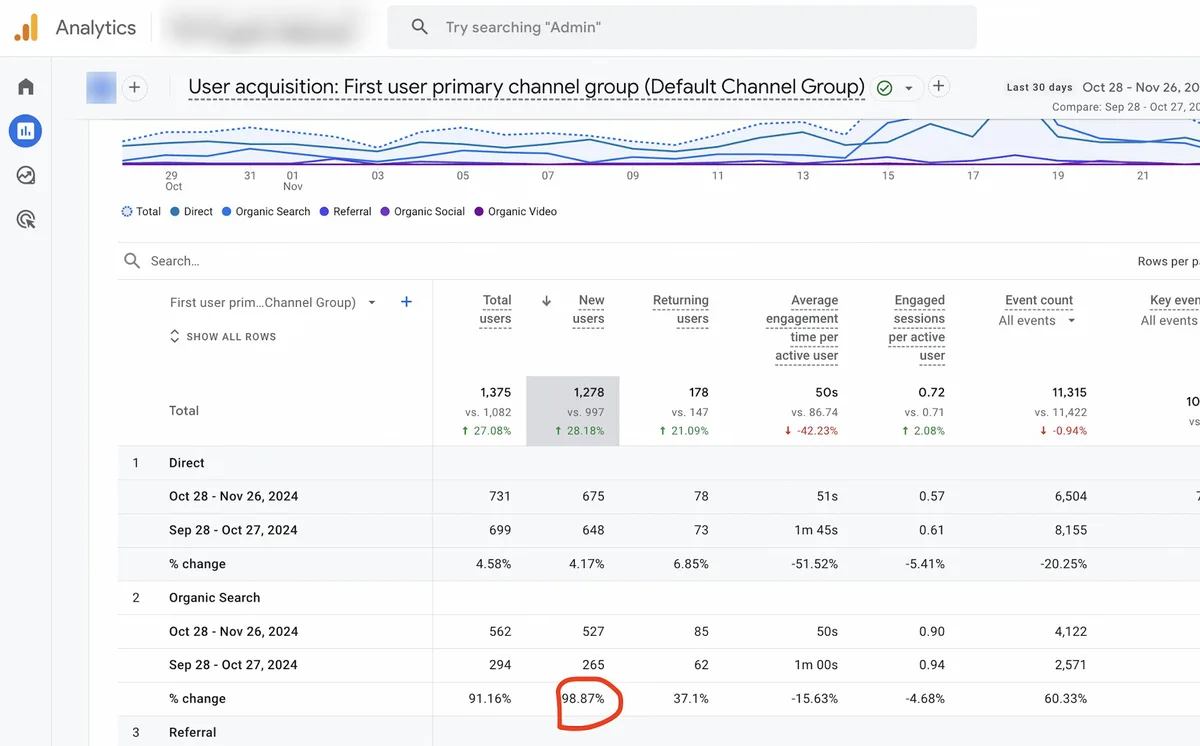
Train Your Pulse, English site. New organic-search users rose from 265 to 527, 28 Oct–26 Nov 2024 against the previous 30 days.
 Open the screenshot at full size ↗
One month against the month before is a short window, and this work predates AI Mode. We show it because it is the same method, measured honestly in GA4, and the case study sets out what was done. For B2B clients we now run the same mapping against buyer questions and AI answers, and track the result into enquiries.
Questions buyers’ marketers ask.
What is query fan-out in AI Mode?
It is how Google answers complex questions in AI Mode and some AI Overviews: it splits the question into subtopics, runs several related searches at once, and writes one answer citing the pages that support each part.
How many searches does AI Mode run for one question?
Google does not publish a number for standard AI Mode. It says Deep Search, the research mode, can issue hundreds of searches. Since 12 November 2026 Gemini 4 Hydrogen, now the default AI Mode model, widens fan-out further, according to Google.
Can I see the fan-out queries for my topic?
Not from AI Mode itself. The closest view is the Gemini API with Google Search grounding, which returns the queries the model executed. It is a different product, so treat it as a sample of how Gemini splits your kind of question, alongside your own buyers’ questions.
Does query fan-out apply to ChatGPT and Perplexity?
Other AI search engines also rewrite a question into one or more searches before answering, though each works differently and none publishes the details. The coverage method here works for all of them, because it starts from your buyers’ questions rather than one engine.
Should I create a page for every sub-search?
No. Most sub-searches are won by a clear section on an existing page. Create a new page only when a sub-question deserves its own full answer, such as a pricing model or a comparison. Pages made for every small variation tend to be thin, and Google’s core updates demote them.
Sources: Google Search Central, AI features and your website; Google Search Central, how generative AI features choose links, updated 24 Nov 2026; Google, AI Mode update, 20 May 2025; Google, Gemini 4 Hydrogen in Search, 12 Nov 2026; Search Engine Roundtable, 12 Nov 2026; Search Engine Roundtable on Peec AI link-position data, 24 Nov 2026; Google, Gemini API grounding with Google Search; Ahrefs, vendor study, 2 Mar 2026; Search Engine Journal, 2 Mar 2026 (BrightEdge comparison); seoClarity, vendor study, 2 Oct 2025; Search Engine Roundtable on the December 2026 core update, 24 Nov 2026. All accessed 25 November 2026. Client result: Train Your Pulse, GA4 new organic-search users, 28 Oct–26 Nov 2024 vs the previous 30 days.