
The short answer.
Programmatic SEO is building many pages from one template and a structured data source, each page targeting a specific variation of a search, such as “[your product] + Salesforce integration” or “contract software for UK housing associations”. It still works in 2026 when every page carries information that only that page has: data, steps, limits or examples that change from one row to the next. It fails when the only thing that changes is the keyword.
Google’s spam policies define scaled content abuse as “when many pages are generated for the primary purpose of manipulating search rankings and not helping users”, and add “no matter how it’s created”. A template is not the problem; a template with nothing underneath it is. For B2B companies the safe pattern is small: one page type where you own the data, 20 to 50 pages, measured before you expand. Location pages have their own rules, covered in our guide to multi-location local SEO without thin pages.
Prolinkage framework, drawn from Google’s spam policies on scaled content and doorway abuse (last updated 23 Nov 2026) and its helpful content questions. Illustrative, not a Google checklist.
What Google’s policies actually say.
Three spam policies decide whether a set of template pages is acceptable. None mentions programmatic SEO or bans templates; each describes a pattern a lazy template produces.
| Policy | Google’s wording (spam policies page) | How a template set trips it |
|---|---|---|
| Scaled content abuse | Typically “creating large amounts of unoriginal content that provides little to no value to users, no matter how it’s created”, including scraping “through automated transformations like synonymizing, translating”. | Rows that differ only by keyword; text spun from competitors’ pages; AI text with no data under it |
| Doorway abuse | Pages “created to rank for specific, similar search queries”, including “substantially similar pages that are closer to search results than a clearly defined, browseable hierarchy”. | Near-identical “[service] for [industry]” pages funnelling to one form |
| Thin affiliation | Affiliate pages that copy merchant content without adding anything original. | “Best tools” pages built from vendor feeds, with no testing |
The scaled content policy arrived on 5 March 2024, widening the older rule on automatically generated content to cover pages made by automation, by people or both. So “a human edited every page” is no defence on its own.
What 2026 added
Google ran three core updates and four spam updates in 2026, and has announced a fourth core update for December. The dashboard does not say any of them targeted programmatic pages. It does show quality systems re-run often, so a thin template set had little time to coast.
Google Search Status Dashboard, ranking incident history, read 25 Nov 2026. Durations rounded to whole days from the dashboard (for example 13 days 20 hours = 14). Bar length relative to 17 days.
One consultant’s write-up of four sites hit by the August 2026 spam update (GSQi, 31 August 2026; anecdotal) is instructive. One site had over 1.5 million indexed URLs, about 85% of them in a programmatic section where many pages were “just a photo and some information that you can find anywhere across the web”; the impact was site-level. Another scaled programmatic pages across countries, padded with AI-generated text, and lost rankings for more than 200,000 queries. The lesson for a B2B company: a weak template section can drag down the pages you care about. If you are already seeing a drop, start with our diagnosis of the November update; for what the coming update is likely to test, see our December 2026 core update guide.
Where programmatic pages fit a B2B site.
Consumer examples dominate this topic: travel routes, apartments by suburb, currency pairs. B2B sites have fewer opportunities, but often better ones, because a buyer searching a long, specific phrase is usually close to a decision.
| Page type | Search pattern | The data that makes each page different | Risk |
|---|---|---|---|
| Integrations | “[product] + [tool] integration” | Fields synced, direction, plan required, setup steps, known limits | Low, if the data is real |
| Use case by industry | “[category] for [industry]” | Rules, workflows, buyer roles and examples that differ by sector | High: the classic doorway pattern |
| Comparisons and alternatives | “[competitor] alternative”, “[A] vs [B]” | Dated feature and plan facts, where each option fits better | Medium: needs an honest view |
| Specs and parts | “[process] [material] [tolerance]” | Capabilities, tolerances, certifications, lead times | Low, if specs are first-party |
| Data and benchmark pages | “[metric] for [role] in [city]” | Figures with sample and date | Medium: sample size and refresh |
Two well-known pages show what the data column means. Zapier’s HubSpot and Slack integration page (read 25 November 2026) names the specific HubSpot triggers, such as “New Deal” and “Updated Deal Stage”, and Slack actions such as “Send Channel Message”; its seven FAQs name the pair in each question, but the answers would read the same for any other pair. Wise’s US dollar to pound sterling page carries the live rate, 30- and 90-day highs, lows and averages and conversion tables; the surrounding copy is shared template. In both, the data block is the reason the page exists.
Integration and specs pages are the safest B2B starting points, because you own the facts. Use-case and comparison pages need editorial input per page; our plays on use-case pages and comparison pages show what AI engines look for in each. Manufacturers will find the specs pattern worked through in our manufacturing SEO guide.
The data decides the page.
When a programmatic set fails, the data source is usually the weak part, not the template. Google’s helpful content questions ask whether content provides “original information, reporting, research, or analysis”, and whether you are “using extensive automation to produce content on many topics”. Your data source answers both before anyone writes a word.
| Source | Unique to you? | Accuracy | Verdict |
|---|---|---|---|
| Your product or catalogue data (integrations, specs, plans) | Yes | High, you control it | Best base |
| Your anonymised operating data (benchmarks, response times) | Yes | High if the sample is stated | Best, if the sample is honest |
| Expert-written rules that differ by sector or country | Yes | High after review | Good; costs reviewer hours |
| Public datasets (ONS, US Bureau of Labor Statistics, Companies House) | No | High | Good only when combined or interpreted |
| Partner or API documentation | Partly | Changes without notice | Good with a scheduled refresh |
| Scraped third-party pages or reviews | No | Unknown; legal risk | Avoid: named in Google’s examples |
| AI-written text with no data under it | No | Can invent facts | Avoid as the core of a page |
Our working threshold: list the fields that would change what a buyer does. If fewer than three differ from the nearest sibling page, the two probably belong on one page. A UK payroll software company, for example, has a real difference between its pages for Scotland and England (different income tax bands); it has no real difference between “payroll software for florists” and “payroll software for bakeries”.
Anatomy of a page that earns its place.
A good template has fixed scaffolding and variable substance. Navigation, the product explanation and the enquiry form can repeat; the substance must come from the row. We build templates in four layers:
- A data block at the top, in HTML text: the facts for this case, scannable in ten seconds.
- Conditional sections that appear only when the data calls for them, such as a “Before you connect” warning if the integration needs a higher plan. Empty sections are hidden, never padded.
- One worked example, written or reviewed by someone who knows the case.
- Links that follow the hierarchy: up to the owner page, across to the two or three closest siblings, never a grid of every page.
BEFORE · KEYWORD SWAPPED IN
Acme + NetSuite integration
Connect Acme with NetSuite to streamline your workflows and save time across your team.
[Same five FAQs as the other 140 integration pages] [Grid of 140 integration logos]
AFTER · CARRIES THE DATA
Acme + NetSuite: sync approved invoices both ways
Syncs vendors, bills and payment status every 15 minutes, both directions. Needs Acme Business plan and NetSuite SuiteCloud access. Multi-currency supported; custom segments are not.
[Field-mapping table] [Five setup steps] [“Known limits” box] [One customer workflow] [Links: ERP integrations hub, Sage Intacct, Dynamics 365]
Illustrative copy by Prolinkage; “Acme” is not a real company. None of the “after” facts would be true on another integration page.
Two details matter more than they look. Keep key facts in text: Google’s documentation on how AI features choose links (updated 24 November 2026) says so, and only indexed, snippet-eligible pages can appear as supporting links. And avoid rendering the data block only in the browser, which hides the one thing that makes the page different; our play on server-rendered content explains how to test this.
Build, merge or skip.
Every candidate row should pass five questions before it becomes a URL, in this order, because each is cheaper to answer than the next.
- 01 · DEMANDDo buyers search this specific variation, or ask AI about it?
- 02 · DATADo at least three fields differ from the nearest sibling?
- 03 · DIFFERENCEWould an expert answer this case differently?
- 04 · OWNERDoes it avoid competing with a hand-built page you already have?
- 05 · PILOTIs it in the first wave of 20–50, with a date to judge it?
A “no” at steps 1–3 means merge the row into a broader page or skip it. A “no” at step 4 means link to the existing page instead.
Demand is wider than keyword volume. Many B2B variations show zero searches in keyword tools yet come up in sales calls every week. Ask your sales team for the ten questions prospects ask most, and check site search and CRM notes.
Step 4 protects your best pages. If you have a strong “SOC 2 consultancy” page, generating versions “for fintech”, “for healthtech” and “for SaaS” can split the signals Google uses to pick one page for the topic. One owner per topic, with variations inside it or linked from it, is easier to rank and maintain. Our guide to SEO for complex B2B and SaaS products covers how owner pages and supporting pages divide the work.
Release in waves and control the index.
The commonest mistake is publishing every row on the same day: you learn nothing, and a weak template shows Google thousands of weak pages at once. A safer release:
- Wave 1: 20–50 pages for the strongest rows, each reviewed by a person, in the template’s own folder (such as /integrations/).
- A sitemap per template. Google allows 50,000 URLs or 50MB per sitemap, but a small one per template lets you read indexing by template. Google uses lastmod only if it is “consistently and verifiably” accurate, so change it only when the data changes.
- Noindex weak rows; don’t block them. Google says a noindexed page “must not” be blocked by robots.txt, or Googlebot never sees the tag.
- No empty combinations. A “0 results” page is a soft 404; return a real 404 or don’t create the URL.
- Judge, then expand. After 8–12 weeks, read the wave’s indexing and impressions (chapter 9).
| Status (Google’s label) | What it usually means for a template | What to do |
|---|---|---|
| Crawled – currently not indexed | Fetched and not indexed. Common on single pages; across most of a template, a verdict on the template. | Improve the data block or merge rows; resubmitting will not help. |
| Discovered – currently not indexed | Known but not crawled; Google rescheduled the crawl. | Slow the release, strengthen internal links, check server speed. |
| Duplicate without user-selected canonical | Google sees copies and picked one. | Differentiate, or merge and redirect. |
| Soft 404 | Pages that look empty to Google. | Return a 404, or stop generating those rows. |
Google’s crawl budget guide is written for sites with a million or more pages, or 10,000 or more changing daily, so most B2B sites are not short of crawling; for them, a large “Discovered” share is better read as a quality signal. If you are moving templates during a redesign, our website redesign SEO checklist covers redirects and canonicals in more detail.
Using AI to write at scale.
AI writing tools made programmatic SEO cheap, which is why so much of it is thin. Google’s guidance on generative AI content says that “using generative AI tools or other similar tools to generate many pages without adding value for users may violate” the scaled content abuse policy. The same page, last updated on 1 October 2026, says “it is critical to manually factcheck and review all AI-generated content for accuracy and trustworthiness before publishing”, and that the review applies to titles, meta descriptions, structured data and image alt text as well.
Where AI earns its place in a programmatic build:
- Turning structured fields into sentences, checked against the fields.
- Quality control: flagging pages whose variable text is too short, too close to a sibling, or contradicts the data block.
- Drafting conditional sections for an expert to correct, such as how a rule differs between the US and UK.
Where it fails: inventing the substance. Google’s own page reminds readers that generative models “don’t retrieve facts, but predict a likely sequence of words”. Asked about “NetSuite integration for construction firms”, a model writes plausible text whether or not your integration does anything special for them. If a fact is not in your data, it should not be on the page. Google also suggests telling readers how automated content was made; a short “How this page is built” line with the data source and date does that.
Measure by template, not by page.
One programmatic page tells you little; judge the template. Read four numbers per folder:
| Measure | Where | Healthy sign | Warning sign |
|---|---|---|---|
| Indexed share | Page indexing, filtered by the template’s sitemap | Most pages indexed after 8–12 weeks | Most “Crawled – currently not indexed” |
| Pages with impressions | Performance, page filter on the folder | Spread across many pages | A handful carry everything |
| Non-branded queries | Performance, brand excluded | Long queries matching the data | Only brand plus template name |
| Enquiries by template | GA4 landing page plus CRM | Enquiries or assisted pipeline | None after a full quarter |
The signs are our working thresholds, not Google criteria. The last row is the one most teams skip, and the one that decides whether a template deserves more rows. Splitting branded from non-branded queries is covered in our Search Console filter guide, and the report format we use with clients is in our monthly SEO and AI search report template. Pages with no impressions after two quarters get better data, a merge or a noindex tag.
The thin-page risk check.
Pick one template, enter roughly how many pages it would create, and tick what is true. Nothing is sent anywhere.
Tick what is true to see the risk level.
A self-check against Google’s published spam policies and the steps in this guide, not a ranking prediction.
“Lower risk” does not mean the pages will rank; it means the template gives Google something worth indexing.
Breadth without templates: our proof.
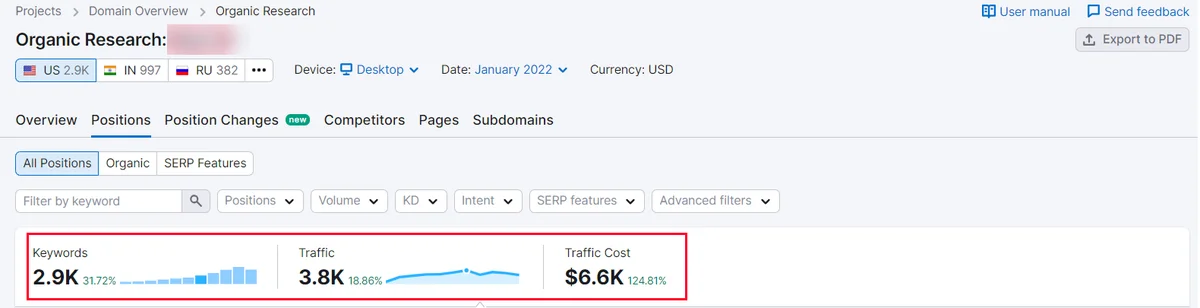
Programmatic SEO is often sold as the only way to rank for thousands of searches. It is not. Bipp Analytics sells a technical business-intelligence product. In Semrush’s US desktop database, bipp.io had 2.9K ranking keywords in the January 2022 snapshot. The published account of that work describes keyword research, product-relevant content and link building, not generated pages. It is a single snapshot, not a before-and-after; we show it because breadth for a complex product can come from pages written for its real use cases. The Bipp case study shows the source screenshot.
Bipp Analytics, a B2B business-intelligence product. Ranking keywords in Semrush’s US desktop database, January 2022 snapshot.
 Open the screenshot at full size ↗

“ProLinkage has the technical depth to understand the product and space.”
Read the Bipp case study
When we recommend a template, it is usually where the client already holds the data, such as integrations or specifications, starting with a small reviewed wave.
When not to do this.
Nobody outside Google knows exactly where its systems draw the line for your site, us included. What you control is whether each page would be worth publishing if search engines did not exist.
Questions owners ask.
What is programmatic SEO in digital marketing?
Building many pages from one template and a structured data source, so each answers a specific variation of a search, such as an integration or a specification. SEO is making a site findable and useful in search engines and AI answers; programmatic SEO covers many long, specific searches efficiently.
Is programmatic SEO against Google’s guidelines?
No. Google’s spam policies ban scaled content abuse: many pages generated mainly to manipulate rankings, with little value to users, however they are made. Template pages carrying unique, useful data are within the rules.
Can ChatGPT do programmatic SEO for me?
It can help: turning fields into sentences, drafting sections for an expert and checking for duplication. It cannot supply the facts that make each page worth indexing, and Google says AI content, titles and descriptions included, should be fact-checked before publishing.
Do I need to know how to code to do programmatic SEO?
Not necessarily; many CMS and no-code tools generate pages from a spreadsheet. You do need someone who understands canonicals, noindex, sitemaps and status codes, because those decide whether the pages help or hurt your site.
Is SEO still worth it in 2026, with AI answers everywhere?
Yes. Google says its AI features are integrated with its core ranking systems, and only indexed, snippet-eligible pages can appear as supporting links. Pages indexed because they carry real information are the ones AI answers can cite; thin pages lose in both places.
How many pages should a first programmatic launch include?
We recommend 20–50 pages for the strongest rows, in their own folder and sitemap, judged after 8–12 weeks on indexing, impressions and enquiries. That is our working rule, not a Google figure.
Sources: Google Search Central: spam policies (updated 23 Nov 2026), generative AI content (1 Oct 2026), helpful content (5 Oct 2026), AI features attribution (24 Nov 2026), crawl budget, sitemaps, noindex; Search Central blog, 5 Mar 2024; Search Console Help, Page indexing; Search Status Dashboard; GSQi, 31 Aug 2026; Zapier and Wise pages. All accessed 25 Nov 2026. Client figure: Bipp Analytics, Semrush Organic Research, US desktop, January 2022 snapshot.