
The short answer.
SEO for a recruitment agency means running two funnels on one domain. Candidates find you through job pages Google can show in its job search experience, so each live role needs its own page with valid JobPosting markup, and each closed role must come down quickly. Hiring managers find you through sector and city pages, your Business Profile and, increasingly, AI answers, so those pages must say what you fill, where, how you charge and what proof you have.
The candidate side is usually busy and the client side thin. With UK candidate supply rising sharply in October 2026 while permanent placements fell (KPMG and REC, 9 November 2026), the vacancy brief is the scarce thing, and the pages that win it deserve most of the effort.
Prolinkage framework. Example searches are illustrative. The rest of this guide takes each box in turn.
Two markets, one website.
The Recruitment and Employment Confederation counts 31,345 recruitment businesses in the UK in 2025, up from 29,635 in 2023 (REC, 8 December 2025). Over the same period the market they share shrank. The REC estimates 536,400 permanent placements in 2024, down 33.5% from 806,400 in 2023, against a pre-pandemic average of about one million a year.
REC, UK Recruitment Industry Status Report 2024/25, press release 8 December 2025. Survey of REC members’ last completed financial year (2024 or 2024/25).
More agencies chasing fewer placements is the background to every decision below. The KPMG and REC Report on Jobs for October 2026 (published 9 November) found permanent placements fell for the first time in four months, temporary billings fell after six months of growth and candidate supply rose sharply. A site that ranks for hundreds of job titles but has one generic “Employers” page is optimised for the side of the market that is already crowded.
In the US, the American Staffing Association reported staffing employment in Q2 2026 just 0.6% above a year earlier, with revenue up 3.3% (ASA, 22 September 2026). With growth that slight, new clients come from other firms.
What changed in search for recruiters in 2026.
Two shifts matter this year: Google moved visibility away from aggregators, and AI tools began sending some job-seekers to career sites.
Aggregators lost ground in the March core update
Amsive’s analysis of Google’s March 2026 core update (published 30 April 2026, using the Sistrix visibility index between 27 March and 8 April) found job boards among the clear losers, while employers and government sites gained. Its summary of the pattern: the winners were “the company that owns the thing”, and the losers “the platform people use to talk about the thing”.
Amsive, March 2026 core update winners and losers (30 April 2026), Sistrix visibility index. Monster and Indeed percentages are our calculation from Amsive’s published points; the others are Amsive’s. Visibility is not traffic, and Amsive notes Indeed recovered in the following weeks.
As the originator of the role, your own site now has a better case, but only if the job page carries more than the board listing: the real salary, the real location, the client sector and how the process works.
AI tools are a small, growing source of applicants
HireClix, a recruitment marketing agency, reported that AI platforms produced 1.07% of visits across the career sites it hosts in June 2026 (ERE, 1 July 2026; vendor data, sample size not stated). One government contractor took 6.89%, up from 1.33% in January, and ERE puts about 90% of the AI traffic down to ChatGPT. Small, but growing.
The bigger AI effect is on the client side: a hiring manager may now ask an assistant which agencies specialise in finance roles in Leeds and what they charge (chapter 9). If your organic traffic has moved this year and you are not sure why, our guide to separating a core update from AI Overview click loss walks through the diagnosis.
Which page owns which search.
Decide the owner of each search family once, then make every other page link to it rather than chase it. This is a recruitment-specific map; for the general method of choosing keywords by buying stage, our B2B SEO strategy for lead generation covers it.
| Search family | Who searches | Owner page | What decides it |
|---|---|---|---|
| “[job title] jobs [town]” | Candidate | Each live job page, plus a job search page | Valid JobPosting markup, salary shown, quick apply |
| “[sector] recruitment agency [city]” | Hiring manager | Sector and city service page | Proof of roles filled locally; Business Profile for the map |
| “[sector] recruiters”, “temp staffing agency” | Hiring manager | National sector page | Depth on roles, fees approach and process |
| “how much do recruitment agencies charge” | Hiring manager | A plain fees page | Clear terms AI answers can quote |
| “[sector] salary guide 2027” | Both | Salary guide hub | Your own dated placement data |
| “register CV [sector]” | Candidate | Candidate registration page | Short form, clear privacy notice |
| “[agency name] reviews” | Both | Business Profile, review sites, About page | Recent reviews from both sides |
Two rules keep the map honest. A blog post never targets a sector-and-city search. And every job page links back to its sector page in one line (“We recruit finance roles across Yorkshire”). Hundreds of job pages pointing at one sector page is internal linking most sites cannot match; most agencies spend it on a generic “Jobs” link.
Job pages Google can show.
Google’s job search experience is available in the UK, across North America and in many other countries (Google Search Central, job posting documentation, updated 8 September 2026). To be eligible, a page needs JobPosting structured data with five required properties: title, description, datePosted, hiringOrganization and jobLocation. Google asks that the title be the job title only, with no codes, dates, salaries or company names, and that the description be the full job in HTML, not a copy of the title.
The recommended properties that change applications
- baseSalary: the actual salary from the employer, not an estimate. Candidates filter on it.
- validThrough: required for any role with a closing date; leave it out if you do not know one.
- jobLocationType: TELECOMMUTE: only for 100% remote roles, stated in the description; hybrid does not qualify. Add
applicantLocationRequirementswith at least one country. - directApply: says people can apply on the page; Google says it is still being developed.
- identifier and employmentType: your reference number and full-time, part-time, temporary or contract.
The rules that lose agencies their listings
JobPosting markup belongs only on pages holding a single job, never on search or category pages. The job must offer a way to apply, cannot charge the applicant and cannot sit behind a login. Fake jobs, misleading employer details and expired postings break policy, and Google warns ignored expired jobs can bring a manual action.
UK law points the same way. GOV.UK says an agency must not advertise a job without its full details and the hirer’s confirmation, every advert must carry the agency’s full name and say whether the job is temporary or permanent, and work-seekers cannot be charged for work-finding. A “talent pool” advert for a role that does not exist breaks both sets of rules.
1 Title: “Payroll Officer”, the job title only
2 Fact strip: salary band from the client, town and postcode area, hybrid or on site, permanent or temporary
3 Full description in HTML, not a PDF, readable without logging in
4 Apply in a few fields; CV upload optional on mobile
5 Agency name and employment type, as UK advert rules require
6 Closing date, matching validThrough
7 One line up to the sector page
1 Heading: “Finance recruitment in Leeds” and one sentence on what you fill
2 Roles you place and the salary bands you see this year
3 How you work: contingency or retained, and rebate terms in plain words
4 Proof: placements by year, client names with permission, reviews
5 The consultant who runs the desk, with a real profile
6 Live roles in the sector, linked but not marked up
7 Vacancy form: role, location, start date, contact
Prolinkage page patterns, based on Google’s job posting guidelines and GOV.UK rules for agency adverts. Example titles are illustrative.
Most agencies post through an applicant tracking system (ATS) that generates the pages. Check its output first: run three live jobs through Google’s Rich Results Test. The usual faults are a missing salary, a location that says only “UK”, a job title stuffed with “URGENT” or a reference code, and markup left on the page after the job closes.
Closed jobs and the Indexing API.
A recruitment site creates and retires pages faster than almost any other B2B site, so crawl timing is the main technical problem. Google offers three ways to take a closed job out of its job results: set validThrough to a date in the past, remove the page so it returns a 404 or 410, or remove the JobPosting markup from the page.
- 01 · PUBLISHPage live with markup, salary and closing date
- 02 · NOTIFYIndexing API “updated” call, plus the sitemap
- 03 · FILLEDMarkup removed or page returns 410 the same day
- 04 · NOTIFYIndexing API “deleted” call
- 05 · REDIRECT?Only a long-running role moves to its category page
Every step after “filled” should be automatic. If it relies on a consultant remembering, it will not happen.
The Indexing API is the one place Google gives job sites special treatment. It can only be used for pages with JobPosting markup or livestream video (quickstart, updated 7 November 2026). Google’s job posting guide recommends it over a sitemap for job URLs because it prompts a sooner crawl, but still wants a sitemap for the whole site. Every submission goes through spam detection and abuse can lose you access, so never use it for service pages or blog posts.
Ask your ATS supplier in writing whether it calls the Indexing API when a job opens and closes, and what status code a closed job returns. “This job has closed” with a 200 status and the markup still in place is the fault Google warns about.
One judgement call: roles you recruit for constantly, such as care assistants or warehouse operatives, attract searches all year. Do not keep an old vacancy alive to hold the ranking. Build an evergreen category page (“Care assistant jobs in Bristol”) that lists what is live, carries no JobPosting markup and explains pay and shifts. Our guide to what a technical SEO engagement covers describes how this kind of template work is scoped.
Sector and city pages for hirers.
This is where agencies win or lose vacancy briefs. The temptation is a page for every sector in every town, with the town name swapped. Google’s spam policies describe exactly that as doorway abuse: “multiple domain names or pages targeted at specific regions or cities that funnel users to one page”, and “substantially similar pages that are closer to search results than a clearly defined, browseable hierarchy”.
Build a page only where you can prove local work
The test: does a hiring manager in that city learn something the next city’s page does not tell them? If you placed 40 finance roles in Leeds last year and none in Hull, Leeds gets a page and Hull does not. A page earns its place with things only you know:
- The roles you fill most often there, and the salary bands you see this year.
- How long a typical search takes, from your records, with the year.
- The consultant who runs the desk, with a real profile.
- Local employers who have agreed to be named, and reviews that mention the city or sector.
- Your office address and Business Profile, if there is a real office there.
From one office, one regional page with a section per city usually beats six thin city pages. Our guide to multi-location local SEO without thin pages explains how to decide, and if you plan to generate pages from data, our piece on programmatic SEO without thin pages sets out where the line sits.
Say how you charge
You do not need to publish a percentage, but a fees page that explains contingency against retained search, when the fee is due, the rebate period and temp-to-perm terms gives AI answers something accurate to quote. Agencies that say nothing get described from someone else’s guess.
One Business Profile per real office.
For “recruitment agency near me” and sector-plus-city searches, the map often sits above the organic links. Google’s guidelines exclude virtual offices; a coworking desk qualifies only with clear signage, staffed and receiving customers during business hours. One profile per location, never two.
A profile per sector desk at one address rarely qualifies: Google allows separate department profiles only with a distinct name and category. What helps instead: the right primary category, real hours, photos of the actual office, posts about current roles and reviews from both candidates and clients, asked for the day an offer is accepted. Our local SEO service covers profiles for firms with several offices.
Being named in AI answers.
When a hiring manager asks ChatGPT, Gemini or AI Mode for “specialist cyber security recruiters in London”, the answer is built from the searches the assistant runs and the pages it reads; see how ChatGPT decides which companies to recommend. For an agency, four things decide whether you are in that answer.
- A plain statement of what you recruit for. One sentence near the top of each sector page naming sector, role levels, regions and contract types. AI systems quote that; they skip slogans.
- Facts on other sites that match yours. Your REC or trade body membership, Business Profile, review profiles and LinkedIn company page should describe the same specialisms in the same words. Our guide to the off-site sources AI uses to recommend B2B firms lists where to look.
- Dated, specific proof. A line in the form “we placed [number] nurses across the South West in 2026”, with your real figure, is quotable. “Award-winning, people-first recruitment” is not.
- Pages built to be quoted. A short answer under each heading, a fees explanation and an FAQ that uses the hirer’s own questions. Our guide to the page patterns AI engines quote shows the formats.
Test it first: ask two or three assistants a client’s question for your main sector and city, three times each, and note which agencies and sources appear. Answers vary between runs, so repeat monthly and look for patterns.
Content that serves both sides.
Interview tips and CV advice rarely bring a vacancy. The pieces that work are the ones only an agency can write, because they come from placement data.
| Content | Candidates | Clients | Why it works |
|---|---|---|---|
| Annual salary guide by sector and region | Strong | Strong | Your own dated data; earns links and AI citations |
| Hiring market update, quarterly | Weak | Strong | Gives hiring managers a reason to call |
| “How to hire a [role]” guide | Weak | Strong | Matches a hirer’s research before a brief |
| Role profile: what a [role] does and earns | Strong | Medium | Feeds job pages and category pages |
| Generic interview and CV tips | Medium | None | Crowded; rarely leads to placements |
A salary guide is the one asset that serves both funnels. Publish it as a web page, not only a gated PDF, with the date of the data and how many placements it draws on, so search engines and AI systems can read and credit it.
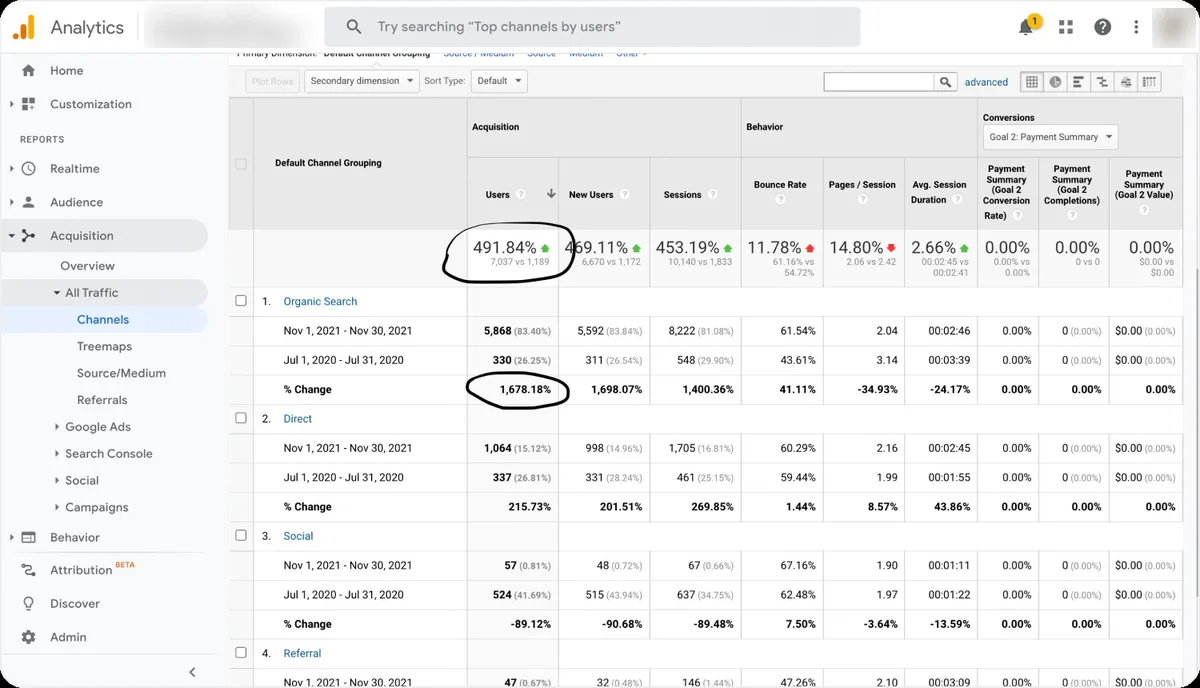
Proof done properly is a dated metric with its source. One from our own work:
JustShip, a Singapore parcel-shipping platform. Organic-search users a month rose from 330 in July 2020 to 5,868 in November 2021, up 1,678%.
 Open the screenshot at full size ↗
“Prolinkage conducted a detailed audit followed by in-depth discussions, providing valuable insights into the implementation process and ensuring seamless execution.”
 John Naughton
CEO, Institute of Project Management
Measuring each side.
A single “leads” number hides the question that matters: is search bringing vacancies, or just more applications? Measure the two funnels separately.
| Measure | Candidate side | Client side |
|---|---|---|
| Key event in GA4 | Application submitted; CV registered | Vacancy form submitted; call clicked on a sector page |
| Search Console filter | Pages under /jobs/ | Sector, city and fees pages |
| Health check | Applications per live job, by source | Vacancy briefs a month from organic search |
| Outcome in the ATS or CRM | Candidates shortlisted and placed | Briefs that became placements, and fee value |
The ATS records where candidates came from but rarely where clients did, because briefs arrive by email and phone. Add a source field to the client record, filled from hidden form fields or asked on every new brief. Our guide to website lead tracking shows how to carry the source from the first visit into the CRM.
Watch job pages weekly; compare sector pages and AI answers quarter on quarter.
The recruitment site check.
Tick what is true of your site today. The basics are in the order we fix them, so the first unticked one is your starting point. Nothing you tick is sent anywhere.
0 of 8 basics in place.
First gap to close: give every live job its own page with valid JobPosting markup; test three in the Rich Results Test.
Questions recruiters ask.
Does Google for Jobs work in the UK?
Yes. Google lists the United Kingdom, and all of North America, where its job search experience is available. Each job page needs JobPosting markup with the five required properties and must follow Google’s content policies.
Should a recruitment agency keep closed job pages live?
Not as job postings. Set a past closing date, remove the markup or return a 404 or 410; Google says ignored expired jobs can bring a manual action. For roles you recruit constantly, keep an evergreen category page.
How is SEO for a recruitment agency different from other B2B SEO?
It runs two funnels on one site: short-lived job pages for candidates, and sector, fees and Business Profile pages plus AI answers for clients. Each side needs its own pages and measures; the client side usually needs the most work.
Do I need a page for every sector and every city?
No. Google treats near-identical city pages as doorway abuse. Build one only where you place roles regularly and can show local proof; cover the rest with a regional or national sector page.
Can a recruitment agency appear in ChatGPT recommendations?
Yes, if it finds clear, consistent facts about you: sectors, regions and contract types stated plainly on your pages, the same facts on your trade body listing, Business Profile and review profiles, and dated proof such as placements by year.
Sources, all read 25 November 2026: Google Search Central (job postings, Indexing API, spam policies), Google Business Profile guidelines, GOV.UK agency rules, REC (8 Dec 2025), KPMG and REC (9 Nov 2026), ASA (22 Sep 2026), Amsive (30 Apr 2026, Sistrix data), ERE (1 Jul 2026, HireClix vendor data).