
The short answer.
SaaS PPC reaches pipeline when Google’s bidding learns from the stage your sales team cares about: a qualified lead or an opportunity, not a trial or demo sign-up. Google’s own lead-generation guidance says to bid towards qualified or converted leads, to give leads different values where you can, and to upload offline outcomes daily. The difficulty in SaaS is timing. Google prefers a conversion that happens within 7 days of the click and at least 15 conversions in 30 days, while a B2B software deal often takes months. The answer is a ladder: bid on the deepest stage that has the volume, and value the earlier stages by how often they turn into revenue.
Keywords, competitor campaigns, landing pages and brand all follow from that choice. It is the first thing our Google Ads management work settles. If your question is about click prices rather than what you bid towards, our guide to Google Ads cost per click in 2026 covers benchmarks and waste.
Prolinkage framework. The “about 15 a month” threshold comes from Google Ads Help on lead-generation bidding (at least 15 conversions in the last 30 days). Stages 3 to 6 reach Google only if you send them back from your product or CRM.
Why trial-tuned accounts stall.
A trial sign-up costs the same to Google whether the person is a student, a competitor, an existing customer or a 400-seat buyer. Bid on sign-ups and Smart Bidding will find the cheapest sign-ups, which are rarely the buyers.
The published benchmarks show how wide the gap between a sign-up and a paying customer is. ChartMogul’s Conversion Report (February 2026; 200 software companies surveyed in January 2026, written with Kyle Poyar of Growth Unhinged and ProductLed) measured sign-up-to-paid conversion within six months. The median was 8%. Among trial products, 20% converted fewer than 2.5% of sign-ups, and only 23% converted more than 25%. Trials that ask for a card up front converted about 30%, more than five times those that do not, but only 20% of trial products ask for one.
ChartMogul, The Conversion Report, 4 February 2026: 200 software products, survey run January 2026. “Good” is the 50th percentile, “great” the 75th. Bars are drawn to scale on a 0–60% axis.
Read that as an ad buyer. If your trials convert at 5%, a campaign reporting a $60 cost per trial is really paying $1,200 per paying customer, before any sales cost. Our article on cost per lead versus cost per qualified opportunity works through the same arithmetic for service firms.
There is also the buying committee. G2’s 2026 buyer behaviour research (more than 1,000 B2B software buyers, 22 July 2026) found finance involved in 46% of software decisions, up from 31% a year earlier, and IT security review named as the biggest source of delay by 39%. The person who starts a trial is often not the person who signs.
The signal gap: 7 days vs months.
Google’s bidding wants fast, frequent conversions. SaaS revenue arrives slowly and rarely.
Google Ads Help on generating high-quality leads says to choose a conversion action that “happens within 7 days of the ad interaction”, with at least 15 conversions in the last 30 days, and to avoid optimising to goals from several stages of the lead journey at once. Its Target CPA page recommends judging performance over periods with at least 30 conversions. Meanwhile, Dreamdata’s 2026 LinkedIn Ads benchmarks (a vendor study of B2B customer journeys, August 2024 to July 2025, reported by PPC Land on 10 March 2026) put the average time from first marketing touch to closed revenue at 272 days, up from 211.
Not to scale. Days 7, 63 and 90: Google Ads Help (lead-generation best practice; offline conversion imports FAQ). Day 272: Dreamdata 2026 benchmarks, vendor study, via PPC Land. The SQL window is our illustration; measure your own.
So you cannot bid on closed-won revenue in most SaaS accounts: the deal arrives after the click ID has expired. A qualified-lead stage within a few weeks is usually the deepest stage fast and frequent enough. Where it is too rare, use a proxy that predicts it.
Which stage to bid on.
Count how many times each stage happened from paid search in the last 30 days, then pick the deepest stage with at least 15. Everything shallower becomes a secondary action you report on but do not bid towards.
- 01 · 15+ OPPORTUNITIES A MONTH?Bid on opportunities, with Target CPA or values by plan size
- 02 · 15+ SQLs A MONTH?Bid on SQLs. Keep sign-ups as secondary actions
- 03 · FEWER SQLs, BUT A PRODUCT SIGNAL?Bid on activated trials or qualified demo bookings, valued by their SQL rate
- 04 · NONE OF THESE YET?Bid on sign-ups with tight keywords, exclude existing users, and build the SQL feed first
Google advises one bidding stage at a time. Moving up a rung means a new primary action and a fresh learning period.
Define an “activated trial” from product data, not guesswork: the action that best separates trials that paid from those that did not, such as inviting a second user or connecting a data source. Test it on two quarters of trials; if trials that hit it convert at three or four times the rate of those that do not, it is a useful proxy.
| Bid on | Volume and speed | What bidding learns | Main risk |
|---|---|---|---|
| Sign-up | High, same day | Who signs up cheaply | Students, job seekers, competitors and existing users |
| Activated trial | Medium, days | Who uses the product | A weak definition of “activated” |
| Qualified demo | Medium, days | Who fits your target accounts | Rules applied unevenly by reps |
| SQL | Low, weeks | Who sales wants | Too few to learn; late uploads |
| Opportunity | Very low, weeks to months | Who buys | Rarely enough volume outside large accounts |
Giving leads a value.
If you can say one lead is worth more than another, Google recommends Maximise conversion value, with or without a target return on ad spend (ROAS). If you cannot, it recommends Target CPA on qualified or converted leads. Most SaaS teams can assign values; they just have not done the sum.
The simplest method values each stage by what it is worth on average:
Stage value = average first-year contract value × the share of that stage that becomes a customer.
Worked example, with invented figures: average first-year contract value $12,000; SQL-to-won rate 12%; activated-trial-to-won 3%; sign-up-to-won 0.6%. That gives values of $1,440 per SQL, $360 per activated trial and $72 per sign-up. Bidding now treats one SQL as worth 20 sign-ups, which is roughly the truth.
Three refinements make it sharper:
- Value by company size. If your form or enrichment tool captures size, set values by size band.
- Keep values relative. They need to be right in proportion, not to the dollar. Google’s guidance on conversion values asks for at least two different values across at least two actions, with none set to zero.
- Re-check every quarter. Rates shift when pricing or the sales process changes.
Our guide to offline conversion tracking for B2B SaaS covers how the stage values travel from the CRM to Google Ads. The Google Ads conversion tracking setup for lead generation covers the tags at the front end.
Account structure by intent.
A SaaS account should be split by what the searcher already knows, because each group converts to pipeline at a very different rate and deserves its own budget, target and landing page.
| Campaign | Example searches | Typical pipeline quality | How to run it |
|---|---|---|---|
| Category, ready to buy | “contract management software for legal teams”, “expense software UK” | High, but contested | Exact and phrase match first; bid on SQLs |
| Competitor and alternatives | “[competitor] alternative”, “[competitor] pricing” | Mixed; strong for switchers | A fair comparison page; never the competitor’s name in the ad text |
| Integration and use case | “HubSpot contract approval workflow”, “Xero expense integration” | High, low volume | One ad group per integration; landing page shows it working |
| Problem-aware | “how to speed up contract approvals” | Low in the short term | Small budget; content or a tool, not a trial page |
| Brand | Your product name, “[product] login” | Looks excellent | Separate campaign, separate reporting (next chapter) |
On competitor campaigns, Google’s trademark policy does not restrict using trademarks as keywords, but it does restrict a direct competitor’s trademark in ad text. Bid on the name if switchers are worth it, and say what you do differently on the landing page instead.
Review search terms weekly for the first month. In SaaS the usual leaks are “login”, “jobs”, “salary”, “template”, “open source”, “tutorial”, “certification” and searches for the consumer version of your category. Broad match and AI Max widen the net; our cost per click guide covers blocking that waste.
If you sell in both the US and the UK, give each its own campaigns: pricing, currency and data-residency questions differ, and a combined campaign lets the larger market set bids for both.
Brand traffic flatters you.
Brand searches convert at a rate generic keywords never reach, so a blended cost per sign-up hides how the rest of the account performs. Report brand and non-brand as if they were two different channels.
SaaS is worse than most B2B accounts: existing users search your name to log in, and some start a second trial or book an upgrade demo. Both count as new conversions.
Same account, two readings
What the platform shows: 400 conversions this month at $50 each. Target CPA met. Every campaign looks healthy.
What the CRM shows: 140 of the 400 came from brand searches, and 30 of those were existing customers. The 260 non-brand sign-ups cost $13,000 of the $20,000 and produced 22 SQLs: about $590 per SQL.
The decision it changes: raising the non-brand budget because “CPA is on target” would buy more of the weakest stage, not more pipeline.
Invented figures for illustration only, not taken from any client’s data.
Three fixes, in order of effort:
- Split brand out into its own campaign, and add brand terms as negatives to the others. In Performance Max, use brand exclusions.
- Exclude existing customers with a Customer Match list from your billing or product database, and send logged-in users from the app to a page without the trial form. Google’s help says Customer Match memberships expire after 540 days, so keep the list refreshed.
- Test brand incrementality. Pause brand ads in one region for a few weeks, where no competitor bids on your name, and watch total sign-ups from that region. If organic picks up most of them, your brand budget is buying little.
Landing pages: trial, demo or both.
Match the page to the intent of the search and the size of the buyer, not to whatever the homepage offers. A self-serve trial suits small teams and specific searches; a demo suits searches that signal a larger company or a complex rollout.
ChartMogul’s report found that about 80% of trial products add human touchpoints when an enterprise user enters the trial, so most SaaS companies already run a hybrid. The paid landing page should make the route explicit:
- Two clear paths: “Start a trial” for individuals and small teams, and “Talk to us” for companies above a set seat count. Ask for team size on the trial form and route larger teams to sales automatically.
- Answer the committee: a pricing page that shows how cost scales, a security page that answers the questionnaire basics, and integration proof. G2 found security review was the main delay for half of enterprise buyers.
- Filter lightly: work email, company website and team size. Google’s lead guidance also suggests reCAPTCHA, double opt-in or server-side validation.
Our B2B landing page trust audit has the full checklist, and if leads arrive but stall with sales, the recovery playbook for Google Ads leads that do not convert covers follow-up.
The measurement you need.
To bid beyond the sign-up, Google needs the later stages back, matched to the original click or person. These are the five checks where SaaS setups usually break.
| Check | What Google Ads Help says | Why it matters in SaaS |
|---|---|---|
| Enhanced conversions for leads | Hashed form data on your site, matched to the hashed data you upload; the Google tag must sit on the page, not inside an iframe | Embedded trial and demo forms often break the match |
| Click ID stored | GCLIDs kept for 90 days; uploads with user data only, 63 days | Save the GCLID on the CRM record at sign-up, or it is lost |
| Upload frequency | At least daily for Smart Bidding | Weekly batches leave bidding a week behind |
| Switching the primary action | After the longer of 1–2 conversion cycles or 4 weeks | Switching too soon resets learning on thin data |
| Upload route | From 15 June 2026, uploads moved to the Data Manager API | Older scripts using the Google Ads API were blocked |
Once a month, compare the SQLs your CRM credits to paid search with those Google Ads reports. A large gap usually means a broken form, a lost click ID or late status changes. Our GA4 lead numbers audit catches most of these, and the AI referrals to pipeline guide shows the same CRM reporting for AI traffic.
The pipeline calculator.
Enter a month of paid search figures and your funnel rates from the CRM. The calculator turns cost per sign-up into cost per SQL, per opportunity and per customer, and shows the pipeline created. The defaults are examples only. Nothing is sent anywhere.
Cost per SQL: 625 (cost per sign-up: 50)
Change any input to update the figures.
If cost per customer is far above what a customer is worth over your payback period, fix the bidding stage and landing route before adding budget.
What this looks like in our work.
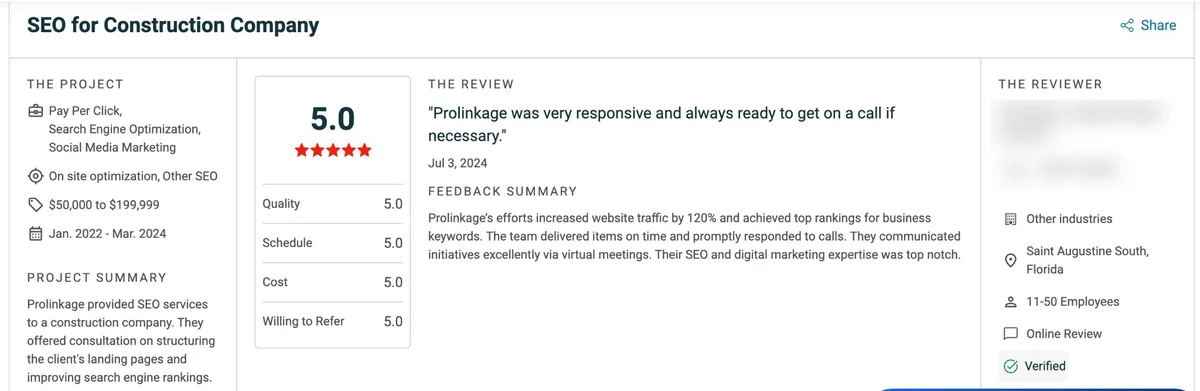
We run paid search for B2B companies alongside SEO and measurement. The client below is a services firm, not SaaS, but the review covers our pay-per-click work. In a Clutch verified review dated 3 July 2024, Leopard Project Controls, a US project-controls firm, rated our work 5.0 overall and 5.0 on quality, schedule, cost and willingness to refer, for a project covering pay-per-click, SEO and social media from January 2022 to March 2024.
 Open the screenshot at full size ↗
For SaaS specifically, our closest work is with Bipp Analytics, a business-intelligence platform up against far larger vendors. That engagement was organic search: bipp.io had 2.9K ranking keywords in Semrush’s US desktop database in the January 2022 snapshot (Bipp case study). What carries over is knowing a technical product well enough to tell which searches can become pipeline.

“ProLinkage has the technical depth to understand the product and space.”
Read the Bipp case study
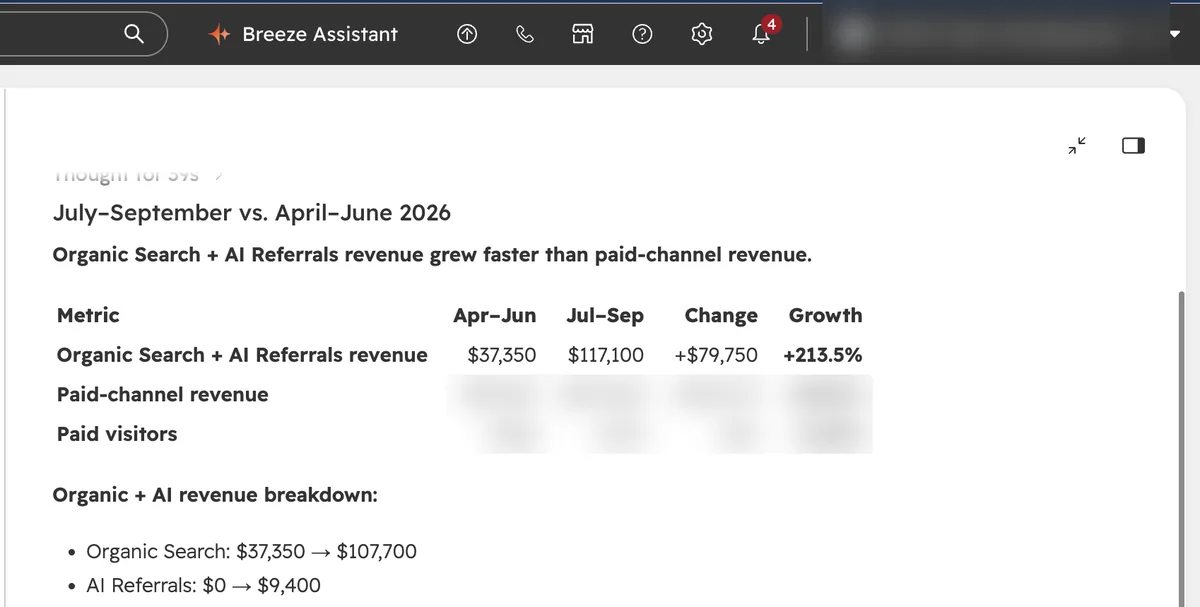
The measurement is what connects any channel to pipeline. For a US B2B company (name withheld), we set up HubSpot reporting by original traffic source, so closed-won revenue could be traced to the channel that first brought each buyer in.
A US B2B company (name withheld). Closed-won HubSpot revenue credited to Organic Search and AI Referrals: $37,350 (Apr–Jun 2026) to $117,100 (Jul–Sep 2026). AI Referrals alone: $0 to $9,400.
 Open the screenshot at full size ↗
That result is organic and AI referrals, and one quarter against another is not a controlled test. It is the report a SaaS PPC programme should be judged on: revenue by source in the CRM.
Hiring a SaaS PPC agency, and when not to.
A SaaS PPC agency plans, builds and runs paid search (and often LinkedIn and Microsoft Ads) for software companies, and should be judged on cost per SQL, opportunity and customer rather than cost per click or sign-up. There is no single best SaaS PPC agency; there is the one whose questions in the first call are about your funnel. Ask:
- Which stage would you bid on, and why? A good answer asks for your SQL volume first.
- How will CRM stages get back into Google Ads, and who owns that work?
- How will brand and non-brand be reported, and how will existing customers be excluded?
- What will you show us at 30, 60 and 90 days, given our sales cycle?
- Will the ad accounts, tag manager and data stay in our name?
Our checklist for choosing a B2B search engine marketing company has the full scorecard. Prolinkage is a Google Partner. Paid search should not carry acquisition alone, because every customer organic search brings in is one you did not buy a click for. For JustShip, a Singapore parcel-shipping platform, organic-search users rose from 330 a month in July 2020 to 5,868 in November 2021 (Universal Analytics), as the JustShip case study shows. Our SaaS SEO agency buyer’s guide and the Google Ads versus LinkedIn Ads comparison help you decide the mix.
Questions SaaS teams ask.
What does a PPC agency do for a SaaS company?
It plans and runs paid search and social campaigns: research, account structure, ads, landing pages, bidding and reporting. For SaaS, the important part is connecting campaigns to product and CRM data so bidding learns from qualified leads, not sign-ups.
Should SaaS Google Ads optimise for trials or SQLs?
For SQLs or another qualified stage, once there are at least about 15 a month from paid search, which matches Google’s lead-generation guidance. Below that, bid on an earlier stage such as an activated trial or qualified demo, valued by how often it becomes an SQL.
What is a good trial-to-paid conversion rate for B2B SaaS?
ChartMogul’s February 2026 report puts the “good” range at 4–6% for trials with no card and 25–35% when a card is required, within six months. For B2B-focused products, good is 6–10% and great 15–20%.
Can we bid on competitor names in Google Ads?
Yes, as keywords: Google’s trademark policy does not restrict trademarks used as keywords. It does restrict a direct competitor’s trademark in your ad text. Send that traffic to a fair comparison or switching page.
How long before Google Ads shows pipeline for a SaaS company?
Sign-ups show in days; SQLs in weeks; revenue in months. Google suggests switching the primary conversion action only after the longer of one to two conversion cycles or four weeks, so judge a new bidding stage over at least a quarter.
Sources: Google Ads Help, best practices for generating high-quality leads; Google Ads Help, Target CPA; Google Ads Help, enhanced conversions for leads; Google Ads Help, upgrading offline conversion import; Google Ads Help, offline conversion imports FAQs; Google Ads Help, conversion values best practices; Google Ads Help, Customer Match; Google Ads trademark policy; ChartMogul, The Conversion Report, 4 Feb 2026; G2, buyer behaviour research, 22 Jul 2026; PPC Land on Dreamdata’s 2026 benchmarks (vendor study), 10 Mar 2026. All accessed 25 November 2026. Search demand for “saas ppc agency”: Google search data via DataForSEO, US and UK, November 2026. Client results: Clutch verified review, 3 July 2024; Bipp Analytics, Semrush snapshot January 2022; JustShip, Universal Analytics, Nov 2021 vs Jul 2020; a US B2B company (name withheld), HubSpot, Q3 vs Q2 2026.