
The short answer.
Google’s December 2026 core update was pre-announced on 24 November 2026 and is “scheduled to be released in December 2026”, with no start date given. Google says it “focuses on multiple improvements to how our systems understand and rank relevant content (including for longer and more complex questions)”, plus better personalised results for people who have personalisation turned on. It applies to all locations and languages. Google will post the start on its Search Status Dashboard on the day.
For a B2B company, the practical reading is this: the pages most exposed are service pages written for two-word head terms, because buyers increasingly ask long, specific questions about scope, fit, timelines, compliance and proof. Google’s guidance warns against quick fixes made for an update. Use the weeks before the start to make sure each service page answers the questions your buyers actually ask, in plain text, with evidence, and to take a clean baseline so you can read the result in January. If your traffic has already fallen, start with our 30-minute diagnosis of the November update; this guide is about preparation, not diagnosis.
Sources: Google Search Status Dashboard (November and December 2026 core update entries, read 25 Nov 2026); GOV.UK, CMA announcement of 17 Jun 2026 (“6 months to implement the fair ranking requirement”); Google Search Central, core updates guidance (“wait at least a full week” after completion). The December start date had not been announced when this was published.
What Google has said, and what it has not.
This update comes with unusually specific wording, so separate Google’s statements from everyone’s reading of them, including ours.
| What Google said | Where | What it means for a service page |
|---|---|---|
| “scheduled to be released in December 2026” | Search Status Dashboard, 24 Nov | No date. A spokesperson told Search Engine Roundtable “It’s not imminent” and that the start will be announced when it begins |
| Improvements to how systems “understand and rank relevant content (including for longer and more complex questions)” | Dashboard | Pages that answer one narrow phrase may lose ground to pages that answer a full question with its conditions |
| “improving personalized results for people who have personalization turned on” | Dashboard | Signed-in buyers may see a different order from your rank tracker. Chapter 6 covers what that does to B2B reporting |
| Applies to “all locations and languages where Google Search is available” | Dashboard | US and UK sites are equally in scope, even though the early notice is driven by UK rules |
| AI features are “integrated directly with Google’s core Search ranking and quality systems” | Search Central, AI attribution doc, 24 Nov | A core update is also an AI Overview and AI Mode event, not a separate one |
What Google has not said matters as much. It has not named any industry, content type or page type. It has not said that service pages, commercial pages or B2B sites are targeted. It has not given a duration, though recent core updates have taken about two weeks: the November 2026 update ran from 10 to 24 November. Anyone selling a “December update recovery package” before the update starts is selling a guess.
On the same day, Google published a new ranking section in Search Central. It includes a short principles for ranking results page (“No result receives preferential treatment”), a stay-informed page explaining how updates are announced, and a feedback channel for ranking changes. Check those before acting on anything you read, this guide included.
Why you got notice: the UK rule.
Google usually announces a core update on the day it starts. The early notice comes from the UK. On 17 June 2026 the Competition and Markets Authority imposed a fair ranking conduct requirement on Google Search. It requires Google to rank organic results “based on objective and non-discriminatory criteria, including in search generative AI features”, to be transparent about how it ranks, and to “provide sufficient notice and information about material changes that could affect publishers”. The CMA gave Google six months to implement it, which runs to 17 December 2026.
Google’s stay-informed page now says that “for changes where UK users may experience a significant ranking shift, we provide advance notice to site owners”. Because a core update is global, everyone gets the notice, including US companies.
What this gives a B2B site owner, in the US or the UK
- Time. The weeks before the start are a usable window.
- A feed to subscribe to. The Search Status Dashboard has an RSS feed; add it to what your team already reads.
- A feedback route. Verified site owners can send feedback through Search Console with a hashtag for the update. Google is clear about its limits: feedback “doesn’t result in manual ranking adjustments for individual URLs”, and engineers review it in aggregate.
For UK readers: the requirement explicitly covers AI features, so AI Overviews and AI Mode fall under the same duty as the blue links.
What a long B2B question looks like.
“Longer and more complex questions” is abstract until you write a few down. In B2B, a complex question usually bundles four or five conditions that a buyer would otherwise have checked across several searches and a sales call. Google’s own AI features page says AI Mode suits “queries where further exploration, reasoning, or complex comparisons are needed”, and that people “can ask nuanced questions that might have previously taken multiple searches”.
Illustrative question, written by Prolinkage. Most B2B service pages answer the first box and skip the other four.
Some US and UK examples from the sectors we work in:
- “B2B SEO agency for a Series B SaaS company selling to US healthcare buyers, with HubSpot reporting, monthly billing and no long contract.”
- “Freight forwarder for temperature-controlled pharma shipments from Rotterdam to Felixstowe, with GDP certification and live tracking.”
Each has a category (the head term your service page was built for) plus several conditions. A page that names only the category gives Google nothing to match the conditions against. How AI Mode breaks such a question into sub-searches is covered in our guide to query fan-out in AI Mode; here the point is simpler: every condition a buyer can type should have a plain answer somewhere on the page that sells that service.
Why service pages are exposed.
Service pages are usually written to look credible to someone who has already arrived, not to answer a question. In the B2B sites we audit, the same four gaps recur:
- Claims without conditions. “Tailored solutions for every business” matches no condition a buyer types.
- Facts in images and PDFs. Certifications as badge images, case studies as gated downloads, pricing approach in a sales deck. Google’s 24 November attribution doc says it plainly: “Make sure important information is available in text.”
- One page for five audiences. A single “Services” page trying to serve a 20-person firm and a 2,000-person group answers neither question well.
- No dated proof. A result without a date, metric and source is hard for a reader to trust, and Google’s helpful content guidance asks whether content has “easily-verified factual errors”.
BEFORE · NAMES THE CATEGORY
Managed IT services
We deliver tailored, end-to-end IT solutions that empower businesses of every size to grow with confidence.
[Row of certification badge images, no text] [“Download our credentials pack”]
AFTER · ANSWERS THE CONDITIONS
Managed IT for UK professional services firms, 50–300 seats
We support law, accountancy and consulting firms on Microsoft 365 across England and Wales. Cyber Essentials Plus certified (renewed March 2026). A typical switch from another provider takes six to eight weeks; the steps are below.
[Certifications listed as text, with dates] [Onboarding steps, week by week] [Two dated client results]
Illustrative copy by Prolinkage, not a real company. The “after” version is longer by three sentences, and every sentence carries a condition a buyer could type.
None of this is new advice. It is what Google’s helpful content guidance already asks for, and what our plain service pages play covers for AI engines. What is new is a dated reason to do it before Christmas rather than “some time next quarter”.
Personalised results in B2B.
The second named focus is “improving personalized results for people who have personalization turned on”. Google’s help page on personalisation explains the mechanism in two sentences: Search “shows you results based on info in your Google account”, and “Sometimes, personalization changes the order of the search results.” It can also change the type of result, for example putting videos first for someone who usually watches them. Location, language, device type and current searches are used even when personalisation is off.
Three practical consequences for B2B teams:
- Your own searches are the worst test. Your marketing team visits your site daily. Personalised results may flatter you. Use the “Try without” link at the bottom of the results page, which Google says shows results without personalisation, or a signed-out browser.
- Rank trackers will diverge further from Search Console. Trackers record a neutral position; Search Console records what real, sometimes personalised, users saw. During the November update, Search Engine Roundtable reported third-party trackers “struggling” to follow the changes. When the two disagree, Search Console is the record of what happened to your traffic.
- Report branded and non-branded apart. Google has not said how personalisation treats B2B research, so don’t plan around a guess. Do measure branded and non-branded search separately, because the two can move in opposite directions.
There is nothing to optimise for personalisation directly. Stop reporting single rank positions as fact, and tell your board before the update why December numbers will be noisier.
The service-page readiness check.
Open your most valuable service page, the one that should produce enquiries, and tick what is true today. The check scores it against the questions in chapters 4 and 5. Nothing you tick is sent anywhere.
Tick what is true to see your score.
A self-check against Google’s published guidance, not a ranking prediction.
The “fix first” order is deliberate: who it is for, where you work and dated proof answer the conditions buyers type most often. A score of 10 does not protect a page from a core update; it gives Google something to match a long question against.
What not to do before the rollout.
Pre-announcements create pressure to be seen doing something. Google’s guidance on core updates is consistent: avoid “quick fix” changes, focus on changes that serve people over the long term, and treat deleting content as a last resort. The new attribution doc adds one more: “Avoid changing a page’s date unless the content has substantially changed.”
| Do | Leave alone |
|---|---|
| Add the missing conditions (who, where, stack, steps, proof) to your top service pages | Bumping “last updated” dates on pages you have not substantially changed |
| Turn badge images and gated PDFs into plain text on the page | Mass-producing location or “near me” variants of one service page |
| Fact-check every number and date on commercial pages against evidence you own | Rewriting pages with an AI tool and publishing without expert review |
| Fix technical blockers: noindex, canonicals, slow templates, broken internal links | Deleting old pages because they “might be thin”, without checking their traffic and links |
| Ship changes early, so they are crawled before the rollout | Redesigning or migrating the site in December |
The last row matters for B2B teams with year-end projects. A migration during a core update makes both impossible to read: you will not know whether a January drop came from the update or from the redirect map. If a relaunch is already booked, our website redesign SEO checklist sets out what to protect, and moving it to after the rollout is usually the cheaper choice.
On AI rewriting: Google’s guidance on generative AI content, updated on 1 October 2026, now says “it is critical to manually factcheck and review all AI-generated content for accuracy and trustworthiness before publishing.” On service pages, the reviewer should be someone who delivers the service. Our guide to SEO for complex B2B and SaaS products covers how to get expert input without stalling the work.
Take your baseline now.
Google’s core updates page gives the measurement rule: wait until the rollout is complete, then wait “at least a full week” before analysing, and compare with the period before it started. For December that creates a B2B problem: the comparison window will run into the Christmas and New Year slowdown, when research searches fall in most sectors. The fix is to record your baseline now, while the period is clean.
- 01 · EXPORTSearch Console: last 28 days by page and query, for your top 10 service pages
- 02 · SPLITBranded and non-branded queries, US and UK separately
- 03 · ENQUIRIESForm fills and qualified leads from organic search, from your CRM
- 04 · AIGenerative AI performance report impressions, noting the 9–11 Nov logging bug
- 05 · YEAR AGOThe same pages for December 2025 to January 2026, as a seasonality guide
Five exports, about an hour. Store them with the date you pulled them.
Step 5 is the one most teams skip: last year’s curve shows how much of a January dip is seasonal. Step 4 needs care: Google confirmed a data logging bug in the Generative AI performance report between 9 and 11 November 2026 that lowered impressions (reported by Search Engine Roundtable), so exclude those days. Our guide to the Search Console AI performance report explains what that report can and cannot show.
Then add three dates to your calendar: the day Google posts the start, the day it posts completion, and one week after completion. If, at that point, positions on your service pages have really fallen, the traffic-down diagnosis is the next step. Our monthly SEO and AI search report template has a slot for annotating updates.
What durable looks like in our work.
Core updates reward pages that answer real questions over a long period, so the useful proof is growth that held, not a one-month spike. For JustShip, a Singapore parcel-shipping platform, organic-search users rose from 330 a month in July 2020 to 5,868 a month in November 2021, measured in Universal Analytics. The JustShip case study shows the report.
JustShip, a Singapore parcel-shipping platform. Organic-search users a month rose from 330 in July 2020 to 5,868 in November 2021, up 1,678%.
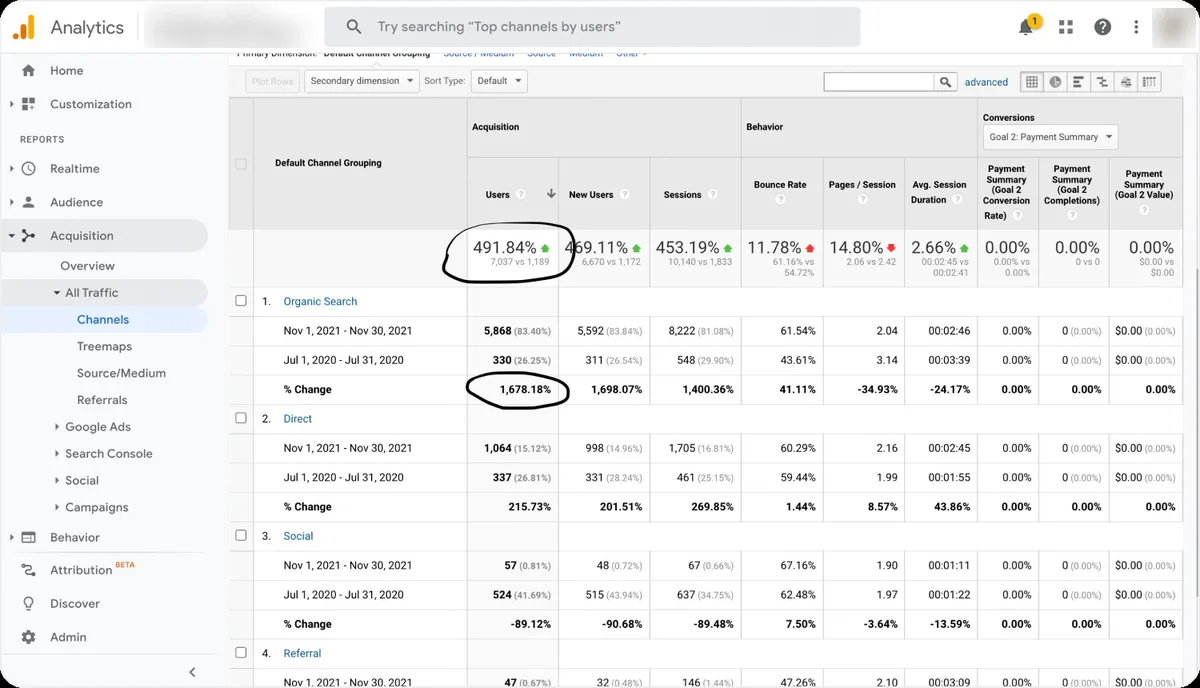 Open the screenshot at full size ↗
A single client result over one period is not a controlled test of any update, and we do not present it as one. Most of our audits start the way the readiness check above does: by reading each commercial page against the questions buyers ask, before anything is rewritten.

“Prolinkage conducted a detailed audit followed by in-depth discussions, providing valuable insights into the implementation process and ensuring seamless execution.”
See our case studies
When this does not apply.
Nobody outside Google knows how the December update will affect a particular site, us included. If your service pages already answer the long questions in this guide, the best preparation may be to take the baseline and wait.
Questions owners ask.
When is the December 2026 core update?
Google has said only that it is “scheduled to be released in December 2026”. It was pre-announced on 24 November 2026 with no start date, and a Google spokesperson said it was not imminent. The start will be posted on the Search Status Dashboard when the rollout begins. Recent core updates have taken about two weeks to complete.
What’s the newest Google update?
As of 25 November 2026, the November 2026 core update is the most recent completed update. It ran from 10 to 24 November 2026 and was the third core update of the year, after March and May. The December 2026 core update has been announced but has not started.
Should I change my content before a core update?
Change what would help buyers anyway, early enough to be crawled before the rollout. Google advises against quick fixes, against changing a page’s date without substantial changes, and against deleting content except as a last resort.
Does the core update affect AI Overviews and AI Mode?
Google’s 24 November 2026 documentation says its AI features are integrated directly with its core ranking and quality systems, so a core update can change which pages AI Overviews and AI Mode link to. In the UK, the CMA’s fair ranking requirement also covers generative AI features.
What should I check in my data after the Google core update?
Wait until Google posts that the rollout is complete, then at least a full week. Compare Search Console clicks, impressions and positions by page against the period before it started, split branded and non-branded queries, and check enquiries in your CRM. Allow for the Christmas slowdown by comparing with the same weeks a year earlier.
Who decides which page ranks first on Google?
Google’s automated ranking systems. Its ranking principles say they prioritise “helpful, reliable information” and that no result receives preferential treatment. Google’s page on hiring an SEO says nobody can promise a top position and to be wary of anyone who claims to. With personalisation, two buyers may not see the same first result.
Sources: Google Search Status Dashboard, December 2026 and November 2026 core update entries and 2026 ranking history; Google Search Central: core updates, stay informed, principles for ranking results, submit feedback, AI attribution and factuality (updated 24 Nov 2026), AI features, creating helpful content; Google Search Help, personalisation and Google Search results; GOV.UK, CMA fair ranking conduct requirement and 17 Jun 2026 announcement; Google Search Central, using generative AI content and “Do you need an SEO?”; Search Engine Roundtable, 24 Nov, 16 Nov and 13 Nov 2026, and 1 Oct 2026. All accessed 25 Nov 2026. Client result: JustShip, Universal Analytics organic-search users, Nov 2021 vs Jul 2020.