
The short answer.
A B2B company needs three things before it needs any paid SEO tool: Google Search Console, GA4 and Bing Webmaster Tools set up on its own accounts, plus a CRM that records where each enquiry first came from. On top of that, most B2B teams need exactly one paid research suite (Semrush or Ahrefs, not both), whose entry plans list at $129 to $139 a month on monthly billing, and a site crawler once the site outgrows the suite’s audit. Everything else, from content scorers to a second rank tracker, is optional and often unused.
There is no single top SEO tool for B2B. The right stack is the smallest one that answers six questions every month: are we found, is the site healthy, who beats us, what should we write, do AI answers name us, and did search produce pipeline.
Prolinkage framework. Dark rows are the minimum stack for a B2B site selling to US or UK buyers.
Six jobs, not twenty tools.
Budgets should be organised by job, not product, because two products often do the same job. Write down which of these jobs your team does each month, and who does it. If nobody owns a job, a tool for it will not be opened.
| Job | The question it answers | No-cost starting point | Pay when |
|---|---|---|---|
| 1. Measure | Which searches and pages bring visits and enquiries? | Search Console, GA4, Bing Webmaster Tools | Rarely; pay for storage only if you need more than 16 months of history |
| 2. Crawl and fix | Can search engines reach and read every page that matters? | Search Console page indexing report; Ahrefs’ no-cost site audit on a verified site | The site passes a few thousand URLs, or a migration is coming |
| 3. Research and track | Who ranks instead of us, and for which buyer searches? | Keyword Planner (needs a Google Ads account), your own Search Console queries | You need competitor data or a tracked keyword set; usually from month one |
| 4. Content | What should the next page say, and is the old one still right? | The suite’s keyword and question data, plus interviews with your experts | You publish several pieces a month with writers who need structured briefs |
| 5. AI answers | Do ChatGPT, Copilot and Google’s AI features name us? | Bing AI Performance; a monthly manual prompt test | Buyers clearly research in AI tools and the manual test takes too long |
| 6. Pipeline | Did organic search produce qualified enquiries and revenue? | CRM original-source fields, GA4 key events, a no-cost dashboard | Rarely a new tool; usually setup time inside the CRM you already pay for |
Notice where the money goes. Jobs 1 and 6 are mostly setup, not subscriptions. Job 3 is where nearly every B2B team needs one paid product. Jobs 2, 4 and 5 depend on the size of the site and how much you publish. If you are still deciding the plan the tools will serve, our B2B SEO strategy for lead generation comes first.
The layer you already own.
Before any subscription, check that the first-party tools are owned by your company, not a past agency or former employee. They are the only sources that report what Google and Bing themselves recorded.
Google Search Console
Four details matter for a B2B team:
- History: Search Console keeps data for the last 16 months. Older days drop out, so export monthly if you want year-on-year comparisons beyond that.
- Rows: report tables show a maximum of 1,000 rows. For larger sites, the bulk export to BigQuery is not affected by the daily row limit, though it leaves out anonymised queries.
- Branded and non-branded: since November 2025 a branded queries filter splits your data in the Performance report, using an AI-assisted classifier that Google says can occasionally misidentify a query. It works only on top-level properties with enough queries and impressions. Our guide to branded versus non-branded search shows how to read it.
- AI features: Google says traffic from AI Overviews and AI Mode is included in the overall search traffic in Search Console, under the “Web” search type. It cannot be separated out there (see chapter 7).
GA4 and Bing Webmaster Tools
GA4 records what visitors do after the click and which key events, such as enquiry forms, they complete. One setting catches B2B teams out: on standard properties, data retention for explorations and funnel reports can be set to 2 or 14 months, and many properties are still on 2. Standard reports are not affected, but a quarter-on-quarter exploration needs 14. Change it on day one.
Bing Webmaster Tools is worth the twenty minutes it takes to verify. Since a public preview on 10 February 2026 it has included an AI Performance report: citation counts, cited pages and a sample of “grounding queries” across Microsoft Copilot, AI summaries in Bing and some partner integrations. In June 2026 Microsoft added intent and topic groupings, a citation share view and period comparisons.
The rest of the no-cost layer
PageSpeed Insights reports Core Web Vitals (LCP, INP and CLS) from real Chrome users over a 28-day collection period, alongside lab tests. Ahrefs’ no-cost plan (formerly Ahrefs Webmaster Tools) gives a site audit, with 5,000 crawl credits per verified project per month, and keyword and backlink data on sites you verify. Google’s Keyword Planner gives search-volume estimates, but you need a Google Ads account with billing details to use it. Data Studio, Google’s reporting tool formerly called Looker Studio, is described by Google as a no-cost tool and connects to all of the above.
A 15-minute monthly check from the no-cost layer
Search Console, non-branded filter, last 28 days vs previous: clicks 412 → 455; impressions 61,300 → 70,900.
← growth from people who did not already know your name
Top rising query: “soc 2 audit cost for startups”, average position 14.2, landing on a blog post, not the service page.
← a page to update or link, not a new tool to buy
Bing AI Performance: 38 citations; 4 pages cited; top grounding query “soc 2 readiness checklist”.
← which pages AI answers already lean on
GA4 key event “enquiry_submit”, organic search: 9. CRM, original source organic, marked qualified: 4.
← the line that decides next month’s priorities
Invented figures for a fictional compliance-software company.
One paid suite, not two.
The first-party tools only describe your own site. A paid suite adds who else ranks for your buyers’ searches, which pages and links put them there, how tracked keywords move, and volume estimates across related phrases. For B2B, that competitor view is the main reason to pay: Search Console never shows you the comparison site or rival use-case page sitting above you.
Semrush and Ahrefs are the two suites most B2B teams choose between. Both now bundle AI visibility features into some plans.
Vendors’ pricing pages, read 25 Nov 2026, before tax. Semrush lists $117.33 a month for its SEO plan on annual billing; Ahrefs says annual billing saves up to 17%. Enterprise tiers of both are quoted, not listed.
| Plan | Monthly billing | Projects | Tracked keywords | Worth knowing |
|---|---|---|---|---|
| Semrush SEO | $139 | 5 | 500 a day | Extra users from $45 a month |
| Semrush Starter | $199 | 5 | 500 a day | Adds 300 AI visibility reports and 50 tracked prompts a day |
| Semrush Pro+ | $299 | 15 | 1,500 a day | 100 tracked AI prompts a day |
| Ahrefs Lite | $129 | 5 unverified, unlimited verified | 750 | 6 months of history; 150 AI prompt checks |
| Ahrefs Standard | $249 | 20 unverified, unlimited verified | 2,000 | 2 years of history; extra users $60 a month |
To choose, run your buyers’ five main commercial searches through both trials and see which shows your real competitors. Then check the limit you will hit first: usually history (Ahrefs Lite keeps six months) or seats (extra users cost more on both). Pick one; paying for both mainly buys a second estimate.
The crawler.
A crawler visits your site the way a search engine does and lists broken links, redirect chains, missing titles, blocked pages and duplicates. Both suites include a cloud site audit, and for a 200-page services site that is usually enough.
A dedicated crawler earns its place in three situations: the site has several thousand URLs, often because of documentation, a help centre or resource libraries; a redesign or platform migration is coming; or you need custom extraction, such as checking that every product page carries the right schema. Screaming Frog’s SEO Spider and Sitebulb are the two desktop crawlers most technical SEOs use. Sitebulb’s Lite desktop plan covers 10,000 URLs per audit and its Pro plan 500,000, with a cloud version from £95 a month. We could not open Screaming Frog’s pricing page on 25 November 2026, so check its current licence price there.
The crawl is the cheap part; the fixes need a developer’s time. Our guide to what a technical SEO engagement covers describes the work, and the website redesign SEO checklist lists what to crawl before and after a migration. If you also want to see which AI crawlers reach your pages, your server logs answer that better than any crawler; see our AI crawler log file check.
The CRM is an SEO tool.
This is the job most B2B tool lists leave out, and it decides whether SEO keeps its budget. A B2B company sells weeks or months after the first visit, through a sales team, so the result lives in the CRM.
The setup is mostly configuration, not new software:
- Count enquiries as key events in GA4, and only real enquiries: not newsletter sign-ups or job applications. Our guide to tracking website leads from first visit to CRM walks through it.
- Keep the original source on every contact. HubSpot sets an Original Traffic Source on each contact automatically, with “Organic search” and “AI Referrals” as separate values; other CRMs usually need hidden form fields or an integration to do the same.
- Report revenue by that source each quarter, in the CRM itself or in a no-cost dashboard that reads from it. Our sibling guide to HubSpot attribution reporting covers the report settings.
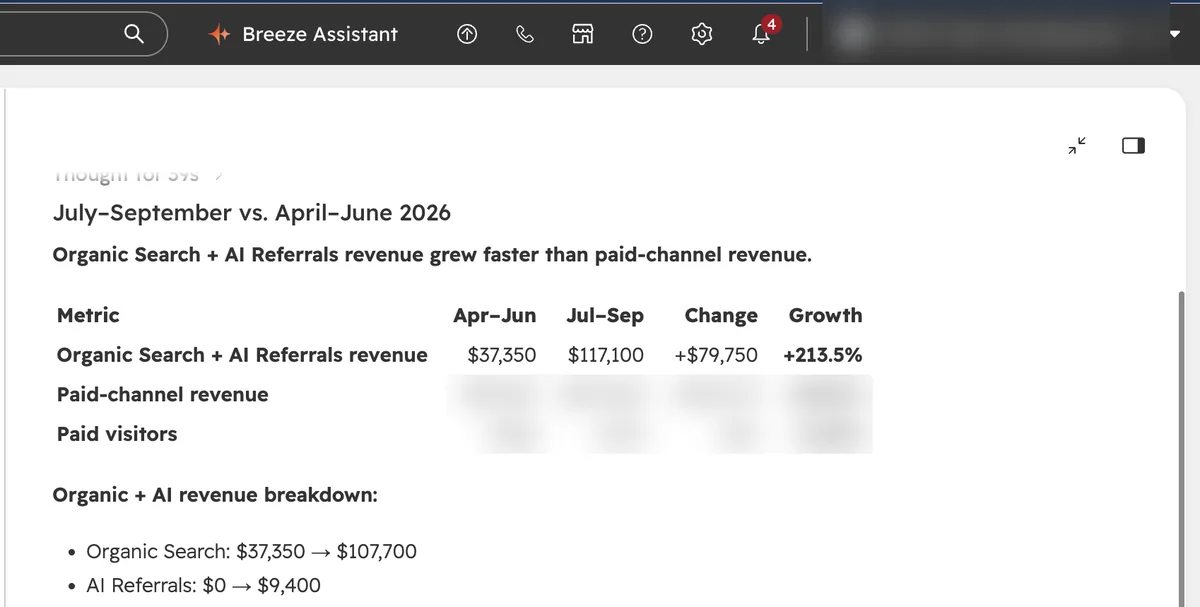
Here is what that reporting looked like for one client, from the CRM rather than from an SEO tool:
A US B2B company (name withheld). Closed-won HubSpot revenue credited to Organic Search and AI Referrals: $37,350 (Apr–Jun 2026) to $117,100 (Jul–Sep 2026). AI Referrals alone: $0 to $9,400.
 Open the screenshot at full size ↗
One quarter against another is not a controlled test, and no single tool produced the result. We show it because it is the report every B2B SEO stack should be able to produce. No rank tracker can. If your CRM stages should also feed Google Ads bidding, our guide to offline conversion tracking covers the import.
AI answers: check before you buy.
Both suites now sell AI visibility features: Semrush with daily prompt tracking from its Starter plan up, Ahrefs through prompt checks and its Brand Radar AI add-on, listed from $199 a month. Stand-alone trackers sell the same job. We compare eleven of them, with what each tracks and costs, in our separate guide to AI visibility tracking tools. Here the question is simpler: does a B2B stack need one yet?
Often not in the first year. Start with three no-cost checks. Read Bing’s AI Performance report each month. Watch the AI referral sources in GA4; our custom AI channel group for GA4 separates them properly. And run a fixed set of ten buyer prompts in ChatGPT, Copilot and Google’s AI Mode once a month, recording whether you are named and whether the description is accurate. If that manual test starts taking more than an hour, or leadership wants a trend line, a paid tracker becomes worth comparing.
Budget tiers.
The tiers below add tools in the order the work usually needs them. Figures are list prices from the vendors’ pages, in US dollars on monthly billing; UK buyers pay the dollar price or a local equivalent at checkout, plus VAT.
| Tier | Monthly tool cost | What it includes | Right for |
|---|---|---|---|
| 0. Owned layer | $0 | Search Console, GA4, Bing Webmaster Tools, PageSpeed Insights, Ahrefs’ no-cost plan on your own site, Data Studio, CRM source fields | A small services site, a founder or marketer doing SEO part-time, or the first month of any programme |
| 1. One suite | About $129–$139 | Tier 0 plus the entry plan of one suite (Ahrefs Lite or Semrush SEO) | Most B2B companies with one marketer owning SEO in one or two markets |
| 2. Working team | About $250–$500 | A middle suite plan, one extra seat, a crawler licence when the site needs it | Larger sites, a small team or agency publishing every week, US and UK pages tracked separately |
| 3. Enterprise | Quoted | Enterprise suite tiers with API access and single sign-on, log-file analysis, a paid AI visibility tracker | Sites with tens of thousands of URLs, several product lines and in-house SEO staff |
The tool bill is small next to the people; our guide to what B2B SEO costs has dated retainer ranges, and budgeting for SEO and AI search in 2027 shows how to split tools, content and technical work. If an agency runs your SEO, ask whether its suite licence covers your project, so you do not pay twice.
What to skip.
Most tool waste comes from overlap and dashboards nobody owns. These are the subscriptions we most often recommend cancelling when we take over a programme.
- Two research suites, both on one seat
- A separate rank tracker as well
- A content scorer grading keyword counts
- An AI writer publishing drafts unedited
- A monthly report of rankings and “authority score”
- Search Console owned by a former agency
- One suite, with the tracked set cut to buyer searches
- Rank tracking inside that suite
- Briefs built from the suite and an expert interview
- AI drafting only with an expert reviewing every page
- A report of enquiries and revenue by source
- Search Console, GA4 and Bing in the company’s name
Skip, unless a specific job needs it
- A second suite. Both estimate the same things from different data. Keep one, and use the trial of the other when you need a second opinion on a big decision.
- Stand-alone rank trackers. Both suites track rankings. A separate tracker is worth it only for many locations or daily tracking at a scale the suite cannot match.
- Content scoring tools as a target. A score built from word counts and term frequency says little about whether a head of finance will trust the page. Use them, if at all, as a checklist for missing subtopics.
- Authority scores as a KPI. Domain-level scores are vendor metrics, not Google’s. Report on links from publications your buyers read; the sibling guide to B2B link building in 2026 covers what to count instead.
- Seats for people who never log in. Check last-login dates before renewal.
The stack picker.
Answer five questions about your site and team. The picker suggests a tier from chapter 8 and the tools to add first. It runs in your browser and nothing you choose is sent anywhere.
Suggested: Tier 0, the owned layer ($0 a month).
Change any answer to update the suggestion.
If you are unsure between two tiers, start in the lower one for a quarter and move up when a limit visibly blocks a job.
What this looks like in our work.
We run client programmes on the same lean stack: the client’s own Search Console, analytics and CRM, one research suite and a crawler where the site needs it. Accounts stay in the client’s name, we take least-privilege access and the contract assigns the IP to the client.
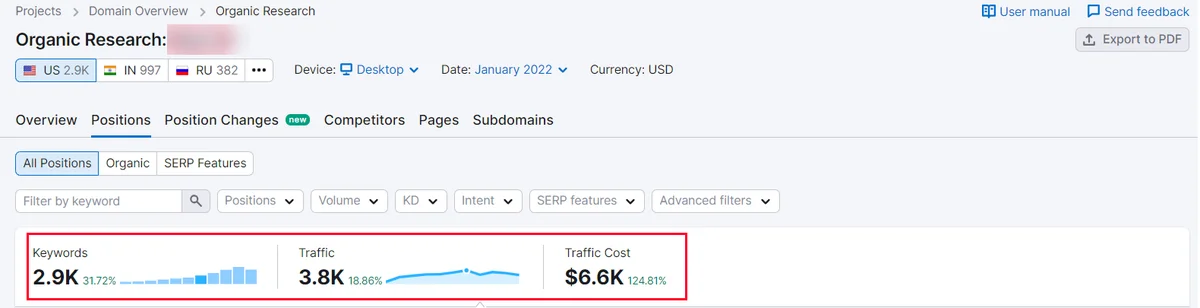
A suite earns its fee when it measures progress against competitors your own data cannot see. For Bipp Analytics, a US analytics software company competing with much larger vendors, the Semrush snapshot below recorded 2.9K ranking keywords in the US desktop database in January 2022.
2.9K
Bipp Analytics, a US analytics software company. 2.9K ranking keywords in Semrush’s US desktop database, January 2022 snapshot. Read the Bipp case study.
 Open the screenshot at full size ↗

“ProLinkage has the technical depth to understand the product and space.”
Read the Bipp case study
The keyword count is a suite estimate, which is exactly how a suite should be used: as a trend against rivals, read alongside Search Console and the CRM. For the report format we send each month, see our monthly SEO and AI search report template.
Questions buyers ask.
What is the top SEO tool for a B2B company?
There is no single one. Google Search Console is the most important, because it reports what Google actually recorded for your site at no cost. After that, most B2B teams need one research suite, usually Semrush or Ahrefs, for competitor and keyword data. Choose the one that shows your real competitors most clearly in a trial.
Do we need both Semrush and Ahrefs?
Rarely. Both estimate keywords, rankings and links from their own data, and their entry plans list at $129 to $139 a month on monthly billing. Paying for both mostly buys a second estimate of the same numbers. Keep one and use the other’s trial when you need a second opinion on a big decision.
Are no-cost SEO tools enough for B2B?
For a small site with one person doing SEO part-time, often yes: Search Console, GA4, Bing Webmaster Tools, PageSpeed Insights and Ahrefs’ no-cost plan cover measurement and basic technical checks. They cannot show who outranks you and why; once you compete for commercial searches, a research suite usually earns its fee.
How much should a B2B company spend on SEO tools?
From $0 to about $500 a month covers most B2B companies, at the vendors’ list prices in November 2026: nothing for the owned layer, about $129 to $139 for one suite’s entry plan, and up to about $500 with a middle plan, an extra seat and a crawler. Enterprise tiers are quoted. People and content cost far more than tools.
Which tools show whether AI answers mention us?
Start with Bing Webmaster Tools, whose AI Performance report shows citations of your pages in Copilot and Bing’s AI summaries, and with AI referral sources in GA4. Google includes AI Overviews and AI Mode traffic in Search Console’s Web totals but does not separate it. Paid trackers are compared in our AI visibility tools guide.
Sources, all read 25 November 2026: Semrush; Ahrefs; Ahrefs no-cost plan; Sitebulb; GA Help, Search Console data; Search Console Help, rows; bulk export (Feb 2023); bulk export help; branded filter (Nov 2025); AI features; GA4 retention; Bing AI Performance (Feb 2026); Bing update (Jun 2026); PageSpeed Insights; Keyword Planner; Data Studio; HubSpot source properties. Client results: Semrush, January 2022 snapshot (Bipp Analytics); HubSpot, Apr–Sep 2026 (name withheld). Monthly check and picker are illustrative.