
The short answer.
B2B link building in 2026 means earning links and named mentions from the sites your buyers already trust: trade publications, industry associations, technology partners, customers and event organisers. Google still uses links to find pages and as one of many ranking signals, and its spam policies treat links that are bought, swapped or placed purely to move rankings as link spam. AI answers lean even harder on what the web says about you, so a mention in the right trade title can matter even when it carries no link.
In practice: build a few assets worth citing (original data, a tool, a reference page), turn existing partner, customer and event relationships into pages that link to you, and refuse anything that pays for ranking credit. “20 links a month” is the wrong unit; relevance to your buyer is the right one.
Ratings are Prolinkage’s judgement, not a measured score. Basis: Google Search Central spam policies and ranking systems guide; Ahrefs, AI Overview brand visibility study (75,000 brands, 26 May 2025). Read 25 Nov 2026.
Which review sites, directories and lists AI engines read when recommending suppliers is covered in the off-site sources AI engines use to recommend B2B companies. Here we stay with links: what earns them, and which to leave alone.
What links still do for Google.
Google’s own documents are more measured than most link-building sales pages. Three statements to know before you spend anything:
- Discovery. The SEO Starter Guide says “Google primarily finds pages through links from other pages it already crawled.” A new product page with one relevant link gets found sooner than an orphan.
- Ranking. Google’s guide to its ranking systems says it has “various systems that understand how pages link to each other” to work out what pages are about, and that PageRank “continues to be part of our core ranking systems.”
- Proportion. The same Starter Guide adds: “We have many ranking signals, and PageRank is just one of those.” In April 2024, at SERP Conf, Google’s Gary Illyes was reported as saying “We need very few links to rank pages… Over the years we’ve made links less important.”
Read together: links help, especially against well-known rivals, but they sit on top of pages that answer the buyer’s question. A thin page does not become a good result because it has links, and a strong page with a handful of relevant links can outrank a weaker one with hundreds.
Anchor text, the quiet risk
Google’s link guidance asks for anchor text that is “descriptive, reasonably concise, and relevant”, and warns: “resist the urge to cram every keyword that’s related to the page that you’re linking to.” Its spam policy lists “links with optimized anchor text in articles, guest posts, or press releases distributed on other sites” as link spam. If a supplier asks which keyword to put in the link, stop there.
Where links fit in a whole programme: B2B SEO strategy for lead generation.
Links, mentions and AI answers.
AI answers change what a link is worth, not whether you need one. Two correlation studies from Ahrefs, a tool vendor, are the most useful public evidence. The first measured which factors moved with how often 75,000 brands appear in Google’s AI Overviews (26 May 2025). Branded web mentions correlated most strongly; raw backlink counts sat near the bottom.
Ahrefs, “An Analysis of AI Overview Brand Visibility Factors (75K Brands Studied)”, 26 May 2025, Spearman correlations; vendor study. About 26% of brands had no AI Overview mentions and were excluded. Correlation, not causation.
Brands in the top quarter for web mentions averaged 169 AI Overview mentions, against 14 for the next quarter down. And “branded anchors”, links whose text is your company name, rank second. Being named by relevant sites is the asset, and a link is the best form of that mention: it carries your name, sends visitors and passes ranking signals at once.
The second study (2 March 2026, 863,000 keyword results and 4 million cited URLs) found that only 37.9% of pages cited in AI Overviews also ranked in Google’s top 10 for the same search. A July 2025 run of the same kind of study had put it at 76%. Ahrefs offers two possible causes, Gemini 3 and the extra background searches AI Overviews run, and notes its own parsing improved between the runs; see query fan-out in Google’s AI Mode.
Ahrefs, “38% of AI Overview Citations Pull From The Top 10”, 2 March 2026, 863K keyword results, 4M AI Overview URLs, all result blocks; vendor study. Bar length relative to 50%.
So a page cited around the web for one specific thing has more routes into AI answers than one ranking for a head term. For ChatGPT specifically, see how ChatGPT decides which companies to recommend.
Which B2B links are worth earning.
B2B has an advantage consumer brands lack: a small, identifiable world of publications, partners, associations and events your buyers read. Every link worth having comes from that world.
| Link type | Typical source | How it is earned | What goes wrong |
|---|---|---|---|
| Trade press citing your data | Sector titles, newsletters, analyst blogs | Original numbers a reporter can quote, with method and date | A “survey” of 40 people that no editor trusts |
| Expert quotes | Features in trade and business titles | A named specialist who answers fast, with a specific view | Generic quotes that get cut, or no link to the expert’s page |
| Partner and integration pages | Software marketplaces, partner directories, reseller pages | A real integration or partnership, and asking for the listing | Listings that link to the homepage, or out-of-date descriptions |
| Customer pages | A client’s supplier page, case study or press release | A joint case study the client is proud to publish | Never asking; or demanding a link as a contract term |
| Calculators and reference pages | Blogs, forums for practitioners, university and training sites | A tool or reference that saves someone an hour | Built for links, not users, so nobody comes back |
| Associations, events, awards | Member directories, speaker pages, shortlists | Membership, speaking, sponsoring with a qualified link | Pay-to-enter “awards” that exist to sell badges |
| Unlinked mentions | Articles that name you without a link | A polite note with the right page to link to | Asking for a keyword anchor or a homepage link |
Missing on purpose: generic guest posting, bulk directories and “high DR” placements on sites your buyers have never heard of. Links should point at a specific solution, integration or data page, rarely the homepage; our guide to SEO for complex B2B and SaaS products covers those page types.
Assets that earn links in B2B.
Outreach without something worth citing is begging. Four kinds of B2B asset earn links repeatedly because they answer what other writers cannot answer themselves.
1. Original data with a stated method
Anonymised numbers from your own product or service are the strongest asset most B2B companies never publish: implementation time, the share of audits that find a given fault, price movements across a year. It needs a sample size, a date range and a definition a reporter can repeat; a big sample matters less.
2. Calculators and checkers
A freight cost estimator, a compliance deadline checker, a payback calculator. Practitioners link to tools that do a job, for years after launch.
3. Reference pages
A glossary of your field, a regulation explained clause by clause, a dated changelog of a standard. Trainers and writers cite them; keep them current or someone else’s replaces yours.
4. Case studies written with the client
A named, dated case study the client approved is one they will often link to as well. Our play on case studies AI engines can quote shows the format.
ANATOMY · A DATA PAGE A REPORTER CAN CITE
- The finding in one sentence at the top, with the number, unit and period: “Median onboarding took 23 working days in 2026, down from 31.”
- The method box: sample, date range, definitions, what was excluded.
- Three to five charts, each with a caption a reporter could paste.
- A US and a UK cut where the sample allows it. Sector titles in each market prefer local numbers.
- A named expert with a short quote and a way to reach them the same day.
- A stable URL and an update date, so links keep pointing at the current edition.
Each asset sits on your site, so every link it earns also strengthens the pages it links to.
Outreach editors answer.
Most pitches miss on relevance. In Muck Rack’s State of Journalism 2026, as reported by PR Daily on 26 March 2026, 47% of journalists said PR pitches are “seldom or never relevant” to their work, and 51% said only 1–10% of their published stories started with a pitch. BuzzStream’s State of Digital PR 2026, a vendor survey of digital PR practitioners updated 19 February 2026, found 66.2% now list getting mentioned in AI citations as an effective use of digital PR.
The editor, not the link, is the customer. A B2B pitch that works:
- 01 · FITWhy this matters to their readers this month, in one line
- 02 · FINDINGThe number, with sample and date
- 03 · EXPERTA named person, available today
- 04 · ASSETA page with charts and method they can link to
- 05 · NO ASKNo request for a link, an anchor or a placement
The link follows when the asset is the obvious thing to cite.
Point five is deliberate: asking a journalist for a followed link with a chosen anchor marks you as a link builder, not a source. Our plays on which trade press mentions AI engines pick up and on expert quotes and guest contributions go deeper on choosing titles and writing contributions that survive the edit.
Reclaiming mentions you already have
The cheapest links are mentions you have already earned. Search recent articles for your company, product and experts’ names; where a page names you without linking, send the author one short note offering the most useful page to cite, not the homepage. Our mention gap audit extends the same search to pages that name your competitors but not you.
Partner, customer and event links.
The fastest relevant links usually come from relationships that already exist. Google’s policy targets “excessive link exchanges” and “partner pages exclusively for the sake of cross-linking”, not a real partnership with a page that explains it.
- Technology partners and marketplaces. If you integrate with a CRM, ERP or cloud platform, get listed in its marketplace, linking to your integration page.
- Resellers and distributors. Give UK distributors and US channel partners current copy and the right URL for each market.
- Customers. A client’s supplier list, joint case study or press release is among the most relevant links you can get. Ask; never make it a contract term, which Google’s policy names when the other site cannot qualify the link.
- Associations and standards bodies. Member directories and speaker pages are read by exactly your buyers.
- Events you sponsor. Sponsorship is advertising, so the link should carry
rel="sponsored", which Google accepts. Sponsor for the audience, not the link.
Check these pages quarterly: AI answers repeat whatever they say about you, and stale descriptions are a common source of wrong facts.
The links we refuse.
We receive link offers like every agency does: placements on “high-authority” blogs for a fee, swaps (“we link to you, you link to us”), and requests to add a company to one of our comparison pages with a link. We turn all of them down, and we do not buy them for clients. Google’s spam policies define link spam as “creating links to or from a site primarily for the purpose of manipulating search rankings”, and its examples read like a typical link vendor’s menu.
Links we refuse, and the policy line behind each
- Paid placements that pass ranking credit. Google lists “exchanging money for links, or posts that contain links” and “exchanging goods or services for links” as link spam.
- Link swaps. “Excessive link exchanges (‘Link to me and I’ll link to you’)” are named directly.
- Guest posts written to carry a keyword link. “Links with optimized anchor text in articles, guest posts, or press releases distributed on other sites.”
- Networks and automated links. “Using automated programs or services to create links to your site.”
- Bulk directories and bookmarks. “Low-quality directory or bookmark site links.”
- Content placed on another site to borrow its rankings. Google’s site reputation policy covers third-party content published “mainly because of that host’s already-established ranking signals”.
Paying for advertising is fine. Google says paid links are acceptable “as long as they are qualified” with rel="sponsored" or rel="nofollow". Buy the audience, not the ranking credit.
The risk is real but often misdescribed. Google says sites that violate its policies “may rank lower in results or not appear in results at all”, through automated systems including SpamBrain or a manual action. Google ran several spam updates in 2026; the one that began on 18 August was described by Google as “a normal spam update”, not a link-specific one. The commoner outcome is quieter: money spent on links that pass nothing.
Inherited a bad link profile? Do not panic-disavow. Google reserves the disavow tool for “a considerable number of spammy, artificial, or low-quality links” that have caused, or likely will cause, a manual action, and says “most sites will not need to use this tool.” Check the Manual actions report first.
Ask any provider for their excluded tactics in writing. Our 20 questions to ask an SEO agency before hiring includes the follow-ups.
What link building costs.
Published link prices come mostly from vendor surveys with self-selected samples: market colour, not a quote.
- Editorial.Link, a link-building vendor, surveyed 518 SEO professionals (page updated 25 March 2026; 25.5% in the US, 16.2% in the UK). The average acceptable price for one high-quality link was $508.95, 80.9% expect link costs to rise over the next two to three years, and 73.2% believe backlinks influence the chance of appearing in AI search results.
- BuzzStream’s State of Digital PR 2026 (updated 19 February 2026): among practitioners who know their cost per link, the most common range was $300–$500 (19.6%); the share at $750 or more rose from 3% in 2025 to 10.2%. 39.2% did not know their cost per link at all, down from 51.4%.
Editorial.Link, link building statistics survey, 518 SEO professionals, updated 25 Mar 2026; vendor survey. Remaining answers not shown. Bar length relative to 60%.
A “price per link” is itself a warning sign. Editorial work is priced by the effort behind the asset and the outreach; a quote that fixes the number of links in advance is quoting for placements. The honest budget question is what the asset costs (a data study, a calculator, expert time) and how many hours of outreach sit behind it each month. Our guide to what B2B SEO costs in 2026 shows where authority work sits inside a full retainer.
| If the proposal says | It usually means | Ask |
|---|---|---|
| “20 links a month, DR 50+” | Placements bought from a vendor list | Which sites, who decides the anchor, are any paid |
| “Guest post package” | Articles written to carry a link | Would the site publish it without the link |
| “Digital PR campaign” | A story or data asset pitched to press | Which titles your buyers read, and what the asset is |
| “Partner and mention audit” | Relationship work on links you are owed | Which partners, customers and events are in scope |
Measuring it, with proof.
Link counts and authority scores are tool estimates, not results. Measure link work on what it was meant to do:
- Relevant referring domains, as a list you could read to a buyer, not a total.
- Referral visits and enquiries from the linking sites, in GA4 and your CRM.
- Rankings and clicks for the linked pages, in Search Console, over two or three months.
- Branded search, which rises when more people meet your name; see branded and non-branded search in Search Console.
- AI answers: whether the assistants name you for the questions your linked pages answer, checked monthly.
What a dated result looks like
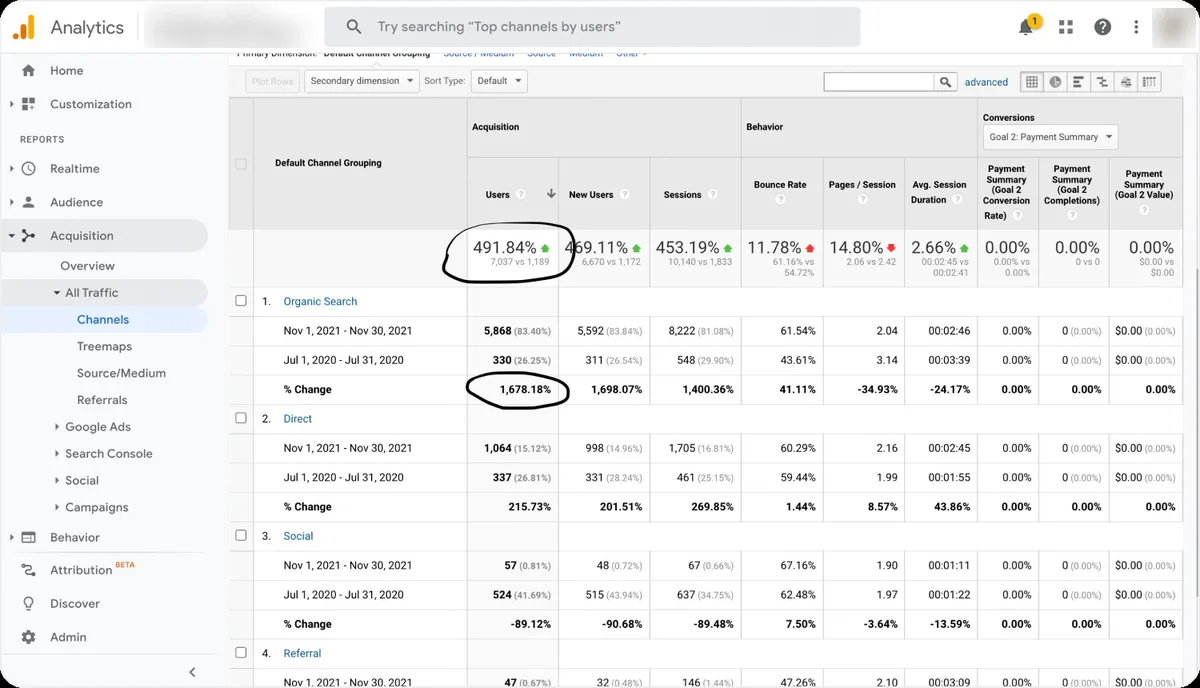
JustShip competed with established carriers on generic shipping searches. Our work combined a site rebuild, route pages for specific searches, and link work alongside them, because content alone did not give a smaller site the authority to compete.
JustShip, a Singapore parcel-shipping platform. Organic-search users a month rose from 330 in July 2020 to 5,868 in November 2021, up 1,678%. Organic sessions rose from 548 to 8,222 a month and new organic users from 311 to 5,592 over the same months.
 Open the screenshot at full size ↗
Caveats: not a controlled test, the months fall in different seasons, and we cannot separate the links’ share from the pages they pointed at. What we can say: the links went to pages worth linking to. The JustShip case study sets out each phase.

“His expertise in SEO structure, keyword research, and content planning resulted in a highly optimized platform tailored to both English-speaking and Greek markets.”
Check a link offer.
Got an offer, or a line in a proposal? Tick what is true. The check applies Google’s spam policies from chapter 8. Nothing you tick is sent anywhere.
Tick what is true about the offer.
A guide based on Google’s published spam policies, not legal or ranking advice.
The links that pass are rarely offers at all; they are relationships you started.
Where link building is not the answer
- Your pages do not answer the buyer’s question yet. Fix the page first; links to a weak page are wasted.
- Google cannot crawl or index the site properly. Technical problems block what links could do.
- You sell to a handful of named accounts. Account-based outreach and events will reach them faster than search.
- You have a manual action. Clean up first, following Google’s Manual actions report, before building anything new.
How we built this guide
Every source was read on 25 November 2026. Google’s wording is quoted from Search Central and Search Console Help. Ahrefs, BuzzStream and Editorial.Link sell SEO tools or link building, and are labelled as vendors. Muck Rack figures are as reported by PR Daily; the report is gated. Link-type ratings are our judgement.
Questions buyers ask.
Is link building still worth it for B2B in 2026?
Yes, if it means earning links from sites your buyers read. Google says PageRank is still part of its core ranking systems, and branded mentions correlate strongly with AI Overview visibility. Buying volume breaks Google’s spam policies and often passes nothing.
How many backlinks does a B2B website need?
There is no target number. In April 2024 Google’s Gary Illyes was reported as saying Google needs “very few links to rank pages”. Compare the relevant sites linking to the pages that outrank yours, and aim to match their quality, not their count.
Are guest posts against Google’s rules?
Writing for another publication is not. Guest posts written mainly to carry a keyword-rich link are named in Google’s link spam policy. Write where your buyers read and let the editor decide on links.
Do backlinks help you appear in ChatGPT and AI Overviews?
Indirectly. In Ahrefs’ 75,000-brand study, branded web mentions correlated with AI Overview visibility at 0.664, raw backlinks at 0.218. Links from relevant sites help because they are mentions, and because they help pages rank in the searches AI tools draw on.
How long does link building take to show results?
Links are found when the linking page is recrawled, often within weeks; ranking effects usually take two to three months to read. Judge data studies and tools over at least two quarters.
Sources, read 25 Nov 2026: Google Search Central (spam policies; ranking systems guide; SEO Starter Guide; link best practices; qualifying outbound links); Search Console Help (disavow); Search Engine Roundtable (Apr 2024; Aug 2026); Ahrefs (May 2025; Mar 2026); BuzzStream (Feb 2026); Editorial.Link (Mar 2026); PR Daily on Muck Rack (Mar 2026). Client result: JustShip, Universal Analytics, Nov 2021 vs Jul 2020.