
The short answer.
An enterprise SEO strategy for a mid-market B2B company is an operating model, not a bigger keyword list. Past roughly 1,000 indexable pages, most problems and most gains live in shared page templates rather than individual pages, so the strategy has five parts: an inventory of templates, one named owner for each, an SEO check inside every release, reporting by section of the site, and a regular cycle of refreshing, merging and retiring content.
What usually does not change at that size is crawl budget. Google’s own crawl budget guide is written for sites with 1 million or more pages that change weekly, or 10,000 or more that change daily, calls those numbers a rough estimate, and says sites without many rapidly changing pages “don’t need to read this guide”. A 5,000-page B2B site rarely has a crawling problem. It has an ownership problem: nobody is responsible for what the blog template or the help centre does in search. For the technical side, our guide to what a technical SEO engagement covers sets out the deliverables; this one is about how the work is organised.
Prolinkage framework. Thresholds: Google Search Central, crawl budget guide for large sites; Search Console export limit of 1,000 rows (Google Search Central blog, 19 Oct 2022). Template counts are our observation from B2B sites we have audited, not a published benchmark.
What actually changes past 1,000 pages.
“Enterprise SEO” is usually defined by company size. The more useful line is where a site stops being manageable by one person looking at pages. Three things in Google’s own tools mark it.
- Search Console stops showing you everything. The most you can export from the Search Console interface is 1,000 rows. Once you have more than 1,000 pages getting impressions, the Pages table is a sample, and Google’s help page calls the download “1,000 rows of representative examples of your data”.
- Directories start to matter. Google’s SEO starter guide says grouping similar topics in directories “can help Google learn how often the URLs in individual directories change”, and that once a site has more than a few thousand URLs, how it is organised “may have effects on how Google crawls and indexes your site”.
- One change reaches hundreds of pages. A wrong canonical in the blog template, a noindex left in the help-centre layout or a broken breadcrumb in the integrations directory is not a page error. It is a site error with a long tail.
| Under 1,000 pages | 1,000–50,000 pages (mid-market) | 1 million+ pages (large enterprise) | |
|---|---|---|---|
| Unit of work | The page | The template and the directory | The template, the market and the platform |
| Crawl budget | Not a concern | Rarely a concern; duplicate URLs from filters and parameters are the exception | Google’s large-site guide applies |
| Search Console | The interface is enough | Interface plus API or bulk export, properties by directory | Bulk export to BigQuery as standard |
| Biggest risk | Thin or missing pages | Unowned templates and unchecked releases | Coordination across teams and markets |
Most B2B software, manufacturing and professional-services sites land in the middle column once a blog, documentation and event pages pile up. Most published enterprise advice is written for the right-hand column.
Mid-market is not a small enterprise.
In this guide, mid-market means a B2B company with one marketing team, at most one SEO specialist, a development team shared with the product or IT, and a site of roughly 1,000 to 50,000 indexable URLs. That is our working definition, not an industry standard. In the US and the UK it covers a lot of companies with somewhere between 50 and 1,000 staff.
A dedicated SEO engineer, an enterprise platform licence and a cross-team council are normal at the top end. Copied at mid-market size, that structure produces meetings, not changes. Borrow the discipline underneath it instead:
| Borrow | Skip, for now |
|---|---|
| A written list of templates and who owns each one | A standing SEO steering committee |
| An SEO line in the definition of done for every release ticket | A separate SEO engineering backlog |
| Reporting split by directory and template | An enterprise SEO platform before you have used the Search Console API, which has no licence fee |
| A quarterly content review with three outcomes: refresh, merge, retire | Rewriting the whole blog in one project |
SEO also competes with the product for developer hours, so ask in templates: one fix that touches 2,000 pages is an easier ticket to win than 40 page fixes, and usually worth more. Our guide to SEO for complex B2B and SaaS products covers how to get product experts to contribute without stalling their roadmap.
Count templates, not URLs.
The first deliverable of an enterprise SEO strategy at this size is a one-page inventory. Every indexable URL belongs to a template, and the B2B sites we audit usually have between eight and fifteen of them. Once you can see pages, clicks and owners by template, the order of work is visible on one sheet.
| Template | Path | URLs | Share of organic clicks | Owner today | First question |
|---|---|---|---|---|---|
| Product and platform | /platform/ | 18 | 14% | Product marketing | Answers to buyer questions, or only features? |
| Solutions by industry | /solutions/ | 24 | 6% | Nobody | Distinct pages, or one with the name swapped? |
| Blog | /blog/ | 1,850 | 41% | Content lead | Which posts bring enquiries, and which nothing? |
| Documentation | /docs/ | 3,100 | 27% | Engineering | Are old versions indexable? |
| Integrations | /integrations/ | 310 | 7% | Partnerships | More than a logo and one sentence? |
| Customer stories | /customers/ | 85 | 3% | Customer marketing | Dated results in text, or only PDFs? |
| Events and webinars | /events/ | 640 | 1% | Field marketing | What happens after the event? |
| Tag and author archives | /tag/, /author/ | 373 | under 1% | Nobody (CMS default) | Indexable at all? |
Illustrative figures written by Prolinkage to show the method; the pattern, with a few templates holding most of the value and two or three holding most of the waste, is what we usually find.
How to build it in an afternoon
- Take every URL from your XML sitemaps. Google caps one sitemap at 50,000 URLs or 50MB, so larger sites already split them by section: a good first guess at your templates.
- Group URLs by first directory and check a few from each by eye; directories and templates do not always match.
- Pull 90 days of clicks and impressions by page through the Search Console API, not the 1,000-row interface.
- Add two columns by hand: who owns the template today, and who should.
Rows with “Nobody” as owner come first, whatever their traffic: unowned templates are where indexable junk accumulates.
One owner per template.
At mid-market size, governance is a short table: for each recurring decision, who decides, builds, approves and only needs to know. The SEO lead rarely owns a template; their job is to make sure each has an owner and that SEO is a named step in its process.
| Decision | Decides | Builds | Approves | Told after |
|---|---|---|---|---|
| Template layout, headings, internal links | Template owner | Web or product developers | SEO lead | Sales |
| Indexing rules (noindex, canonicals, parameters) | SEO lead | Developers | Head of marketing | Template owners |
| New section or new template | Head of marketing | Developers and content | SEO lead and template owner | Everyone |
| Retiring or merging pages | Template owner | Content team | SEO lead (redirect map) | Sales, support |
| Claims, numbers and client names on pages | Template owner | Content team | Whoever holds the evidence | Legal, where needed |
| US and UK variants | Head of marketing | Content and developers | SEO lead (hreflang) | Regional sales |
Two rows cause most of the trouble we see. Indexing rules get changed by whoever is closest to the code, usually in a redesign, with nobody checking search afterwards. And claims drift: a customer story shows a 2021 result as if it were current, because nobody owns the evidence. Write both rows down first.
If you sell into both the US and the UK, the last row matters. Google’s guidance on regional variants such as en-us and en-gb says “each language version must list itself as well as all other language versions”: a template rule, owned by whoever owns the template code.
The release gate.
On a small site, an SEO mistake in a release is spotted within days. On a site with several thousand pages it can sit for months, because no one looks at the 900th blog post. The fix is a light gate inside the release process you already have.
- 01 · TICKETEvery ticket touching a template names which templates it changes
- 02 · CHECKLISTFive yes/no checks: indexability, canonical, title and headings, internal links, structured data
- 03 · STAGING CRAWLCrawl 50–100 sample URLs per changed template on staging, before and after
- 04 · RELEASEShip early in the week, never on a Friday or during a migration
- 05 · DAY 7Check Search Console’s page indexing and clicks for the changed directories
In our experience, about 20 minutes of SEO time per release that touches a template. Releases that only change content skip steps 3 and 5.
Step 3 catches the expensive errors: a staging noindex carried to production, a canonical pointing at staging, or JavaScript that leaves the main content out of the HTML. Our play on server-rendered content shows the quick test for that last one, which matters for AI crawlers as well as Google. A full redesign or replatform needs more than this gate; our website redesign SEO checklist covers it.
Keep it to five items; a 40-point checklist on a shared team gets ticked without being read. And the day-7 check is for spotting breakage, not judging success: Google’s starter guide says some changes take hours and “others could take several months”.
Prioritising: the 80/20 by template.
The 80/20 rule in SEO is the observation that a small share of pages brings most of the results. On large sites it is usually more extreme than 80/20. Ahrefs, a tool vendor, found in a study of about 14 billion pages in its index that 96.55% got no traffic from Google at all (published 1 December 2023).
Ahrefs, “96.55% of content gets no traffic from Google”, Content Explorer index of about 14 billion pages, published 1 Dec 2023. A web-wide study, not a B2B benchmark; bar lengths scaled to 100% = 83% width.
Your site will not look like the whole web, but the shape usually holds: a few templates carry the clicks and enquiries. So score work by template, with four questions:
- Pages affected. How many URLs does this fix change? A template fix beats a page fix almost every time.
- Value per page. Do these pages lead to enquiries, or only to visits? A fix on 18 product pages can outrank a fix on 1,850 blog posts.
- Confidence. Confirmed in your data, or a best-practice guess?
- Effort. Developer hours, and how many people must say yes.
Multiply the first three, divide by the fourth, and the order of work becomes defensible in a planning meeting. Tie the value column to enquiries rather than sessions; our guide to a B2B SEO strategy built from pipeline shows how to choose the pages that matter commercially. If you need to argue for the developer time, our 2027 SEO and AI search budget model helps frame it as a budget line rather than a favour.
Measuring past the 1,000-row limit.
Past a thousand pages, the question changes from “which pages did well?” to “which sections did well, and why?”. Search Console can answer it, but not through the interface alone.
| Route | Limit | Good for |
|---|---|---|
| Interface export | 1,000 rows | Quick checks on one directory, filtered by URL |
| Search Analytics API | Up to 50,000 rows per day per site per search type | A monthly page-by-template export into a spreadsheet |
| Bulk data export to BigQuery | Not affected by the daily row limit | Sites with tens of thousands of pages; needs a Google Cloud project |
| URL Inspection API | 2,000 inspections per day per property | Spot-checking indexing for a sample of each template |
Google introduced the bulk export in February 2023 as “particularly helpful for large websites with tens of thousands of pages”. For most mid-market sites the API is enough: one export a month, joined to your template inventory, gives clicks, impressions and position by template. Remember that anonymised queries, which Google defines as queries not issued by more than a few dozen users over two to three months, are left out of query tables, so totals by query will not match totals by page.
Three report changes make the data useful:
- Report by template. A board needs eight lines and the two that moved, not 6,000 rows. Our monthly SEO and AI search report template has the layout.
- Split branded from non-branded. Brand searches flatter the product and docs templates. Our guide to branded vs non-branded search in Search Console shows the filter.
- Join to enquiries. Clicks by template lead; enquiries by landing template are the result.
For AI crawlers, server logs grouped by directory show which sections they read; see our AI crawler log file check.
Content operations: refresh, merge, retire.
Mid-market B2B sites grow by accretion: every campaign adds pages, few are removed. A content operation decides, on a cadence, what happens to each page in the low-value templates, with three outcomes and no others.
| Outcome | When | What happens to the URL |
|---|---|---|
| Refresh | The topic still matters to buyers; the page is out of date or thin | Stays; content and date updated only if the change is substantial |
| Merge | Two or more pages answer the same question | The weaker ones redirect to the strongest, which absorbs what was useful |
| Retire | No buyer value: expired events, duplicate tag pages, obsolete product versions | Removed or set to noindex; redirected only where a close equivalent exists |
The reason for retiring a page should be that it no longer helps a reader. Google’s helpful content guidance lists “removing a lot of older content primarily because you believe it will help your search rankings overall” as a warning sign of search-first content, so pruning for rankings alone is the wrong motive. Expired webinars and tag archives with one post each are easy calls; well-linked older articles need a look at their links and enquiries before anything is removed.
Two more rules for the review. Google’s sitemap guidance says lastmod should reflect “the last significant update to the page”, so do not bump dates on unchanged pages. And before a template produces hundreds of near-identical pages, read Google’s scaled content policy; our guide to programmatic SEO without thin pages covers when that is worth doing. Location pages are a common case; see multi-location SEO without thin pages.
Quarterly is enough for most mid-market sites; monthly reviews tend to become rewrites of the same 20 posts.
The operating-model check.
Enter your rough page count, choose how often you release, and tick what is already true. The check gives your size band and the first three things to put in place. Nothing you enter is sent anywhere.
Enter your page count to see your band.
A self-check against the model in this guide, not an audit.
The order is deliberate: you cannot assign owners to templates you have not listed.
What this looked like in our work.
Bipp Analytics, a US business-intelligence platform, described its starting point in its founder’s review: “We have a very complex technical product and we operate in a large space with billion dollar competitors, and we had no idea where to start on our SEO efforts.” The last clause is the common mid-market gap: not a missing keyword list, but no agreed place to start. A template inventory and an owner map answer that first.
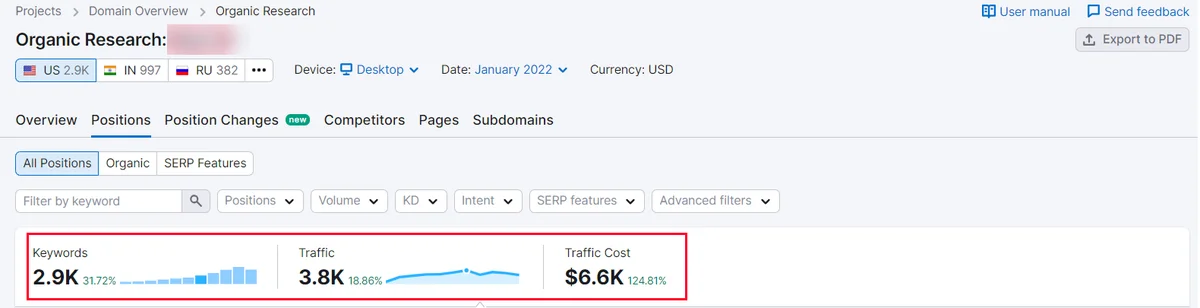
2.9K
Bipp Analytics, a US analytics software company with a complex technical product. 2.9K ranking keywords in Semrush’s US desktop database, January 2022 snapshot. See the Bipp case study.
 Open the screenshot at full size ↗
That figure is a one-month snapshot, not a before-and-after; the case study explains what it does and does not show.

“ProLinkage has the technical depth to understand the product and space.”
Read the Bipp case study
When this does not apply.
Who does the work is a separate decision; see B2B SEO consultant vs agency.
Questions owners ask.
What is enterprise SEO?
Enterprise SEO is search optimisation run as a process across a large site and several teams, where most changes are made at the level of templates, directories and releases rather than single pages. For a mid-market B2B company it usually starts around 1,000 indexable pages, when one person can no longer review the site page by page.
What is the 80/20 rule in SEO?
It is the observation that a small share of pages produces most of the search results. On large sites the split is often sharper: an Ahrefs vendor study (1 December 2023) found 96.55% of the pages in its index got no Google traffic. At mid-market size, apply it by template: find the few templates that bring enquiries and fix those first.
Is SEO dead or evolving in 2026?
Evolving. Google says the best practices for SEO remain relevant for its AI features, and that there are no additional requirements to appear in AI Overviews or AI Mode. For larger B2B sites the change is in how pages are found and quoted, which raises the value of clear templates, plain-text facts and dated proof.
What are the top SEO strategies that work for a large B2B site?
Five, in order: inventory the site by template; give each template an owner; add an SEO check to every release; report by template and connect it to enquiries; and review content quarterly to refresh, merge or retire it. Keyword research and content work through these.
Do we need an enterprise SEO platform?
Not at first. Most mid-market sites get the data they need from the Search Console API, a crawler and their analytics. A platform becomes worth its licence when several people need shared dashboards and workflows across tens of thousands of pages. Our guide to the B2B SEO tool stack for 2027 covers what each tool is for.
Sources: Google Search Central: crawl budget guide for large sites, SEO starter guide, URL structure, build and submit a sitemap, localised versions, creating helpful content, spam policies (scaled content abuse), AI features and your website; Google Search Central blog, performance data deep dive (19 Oct 2022) and bulk data export (21 Feb 2023); Search Console help, exporting report data; Search Console API usage limits; Ahrefs, search traffic study (1 Dec 2023, vendor study). All accessed 25 Nov 2026. Client result: Bipp Analytics, Semrush Organic Research, US desktop, January 2022 snapshot. Review: Vishal Joshi, Bipp Analytics, as published on prolinkage.com.