
The short answer.
Manufacturing SEO is the work of making each thing you can make findable in the words engineers and buyers search with: the process, the material, the tolerance, the size range, the batch size, the certification and the industry. It means one clear page per capability with the specification in HTML text rather than locked in a PDF, the same facts repeated consistently wherever AI assistants look, and an RFQ form that accepts a drawing. Success is measured by quote requests and won orders, not by visits.
The 2026 shift is the step in the middle. In the 2026 State of Marketing to Engineers survey, 69% of technical buyers said they use generative AI during purchasing, and 74% still go to supplier websites for product information. So the site has two jobs: give AI answers specific, consistent facts to repeat, and give the engineer who clicks through enough detail to send the RFQ.
Stages can loop: a buyer who finds a gap at stage 4 goes back to stage 2 or 3. Stage 3 is the newest and the one most suppliers have not planned for. Framework: Prolinkage.
How technical buyers search now.
The best current picture is the 2026 State of Marketing to Engineers report from GlobalSpec and TREW Marketing with Elektor, in its ninth year, with more than 1,000 respondents. Three findings matter for a manufacturer’s website.
Source: GlobalSpec and TREW Marketing, 2026 State of Marketing to Engineers (n = 783 for this question; 13 sources were offered, seven shown). Read 25 November 2026.
- Your website is still a primary source. 74% use supplier or vendor websites, second only to online technical publications at 76%. Print publications came third at 53%, sales and application engineers fourth at 41%; industry directory websites, the Thomasnet-style listings many manufacturers rely on, scored 31%.
- Search engines still start most research. Asked whether they start with a search engine or generative AI, 77% said a search engine, 8% generative AI and 16% both equally. Among respondents aged 35 and under, generative AI rose to 14%.
- AI use is climbing. 69% use generative AI during purchasing. “Never” fell from 42% in 2025 to 31% in 2026; “often” rose from 6% to 11%.
Read together: the first query still lands mostly in Google or Bing, an AI assistant increasingly sits beside it, and both send the buyer to your site to check. Manufacturing SEO therefore starts with pages, not with an AI-specific trick.
The shortlist forms before the RFQ.
Industrial buyers rarely send drawings to many suppliers. In a Thomas survey of 266 industrial buyers (January 2019, the most recent edition of that question we could find), 71% vetted fewer than five suppliers, 25% vetted five to ten and 3% more than ten. The same survey found 73% paid close attention to a supplier’s website when evaluating it. The numbers are old, but the shape has not changed: the shortlist is short and it is built before anyone calls you.
AI now builds part of that list. In a vendor-commissioned survey of 300 US and European manufacturing leaders (Xometry, a manufacturing marketplace, with John Zogby Strategies, reported 9 February 2026), 85% of aerospace and defence respondents were prioritising AI-driven sourcing tools, against 63% in general industry.
Demand is also moving toward services you can describe on a page. Thomas’s 2025 sourcing data, summarised by Distribution Strategy Group in January 2026, put contract and private-label manufacturing top of the services sourced, with sharp rises in machining, fabrication, coating, stamping and plastic moulding.
“Which UK contract manufacturers do medical-grade injection moulding in a cleanroom, certified to ISO 13485, for runs under 10,000?”
Needs: process page, cleanroom class, certificate, batch range and UK location on one crawlable page.
“US machine shops that do 5-axis CNC in titanium for aerospace, AS9100, prototypes and small batches.”
Needs: material and machine list, AS9100 status, minimum order, and the same facts on directory profiles.
“What tolerance can I expect from laser cutting 3 mm stainless, and who quotes from a DXF?”
Needs: a stated tolerance by thickness, accepted file types and an RFQ form that takes the file.
A homepage that says “precision engineering solutions” answers none of these. A capability page that states the facts answers all three. The rest of this guide is about closing that gap.
Map searches to pages.
Most manufacturing searches combine a small set of parts. Build your page structure from those parts, and give each kind of search one page that owns it, so pages do not compete with each other.
| Search part | Examples a buyer types | Page that owns it |
|---|---|---|
| Process | CNC turning, sheet metal fabrication, powder coating, die casting, overmoulding | One capability page per process |
| Material | 6061 aluminium, 316 stainless, PEEK, titanium grade 5, glass-filled nylon | A material section on each process page; a material page only where demand justifies it |
| Specification | ±0.005 mm, Ra 0.4, 3 mm stainless, 500 mm bed, IP67 | The capability table on the process page, in text |
| Volume and stage | prototype, low volume, production run, short run | Stated batch range on each process page; a prototyping page if you sell it separately |
| Assurance | AS9100, ISO 13485, IATF 16949, ITAR registered, UKCA marked, material certs | A quality and certifications page, linked from every process page |
| Industry | for aerospace, medical device, automotive, food processing, defence | Industry pages that link down to the relevant processes, not copies of them |
| Place | contract manufacturer Midlands, machine shop Ohio, made in USA | The process page or an about page with plant locations; separate location pages only for real plants |
Two rules stop this turning into hundreds of thin pages. A page needs a fact its neighbours lack (a different machine, certificate or capacity); a “CNC machining for medical” page that only swaps in the word “medical” helps nobody. And link general to specific and back, so an engineer moves from “sheet metal fabrication” to “laser cutting” to the RFQ in two clicks.
To see where you stand, filter Search Console’s Performance report by your process names. Google confirms AI Overviews and AI Mode traffic is counted there too, under the Web search type.
Anatomy of a spec page.
A capability page has one job: let an engineer decide in under a minute whether you can make the part. This is the layout we build towards (illustrative values).
Zones A and B hold the facts search snippets and AI answers can quote; zones C to F carry the trust and the next step. Illustrative values.
What most manufacturing pages get wrong, zone by zone:
- A and B. Pages open with a mission statement and keep the specs in an image or a PDF. Open with the capability in one quotable sentence, then an HTML table with tolerances as numbers and units, split into standard and achievable on request.
- C and E. “ISO certified” with no standard named. Name the standard (AS9100, ISO 13485, IATF 16949), the certifying body and which sites and processes it covers.
- F. A generic “contact us” link. Put the RFQ on the page, with drawing upload, and say how fast you reply.

“ProLinkage has the technical depth to understand the product and space.”
Technical buyers notice when a page is written by someone who does not understand the process, so every number on a spec page should be checked with your production leads before it goes live.
Datasheets, PDFs and CAD files.
Google can index PDFs; Adobe Portable Document Format is on its list of indexable file types. But a PDF datasheet that ranks sends the engineer to a file with no navigation, no RFQ button and often no company name above the fold. Publish the same specifications in HTML on the capability page and keep the PDF as the linked download.
CAD files are where manufacturers argue about gating. In the 2026 State of Marketing to Engineers survey, 34% of technical buyers named a CAD drawing as content they would give contact details for, 23% a product configurator, and 15% said they never fill out a form for content. So CAD is worth an email address to many engineers, but a hard gate loses a real minority just when they are designing you in.
Field note: a gating pattern that works for both sides
Keep the datasheet and a CAD preview or PDF drawing open to everyone. Gate only the native CAD file (STEP, IGES, SolidWorks), and ask for no more than name, work email and company. The open assets do the search and AI work; the gated file captures the engineers who are already designing you in.
Three details make downloads work harder:
- File names in plain words. “316-stainless-flange-datasheet.pdf”, not “DS_0042_rev3.pdf”. It is what the engineer sees when the sheet is forwarded to purchasing.
- A revision date on every datasheet. Engineers check whether a sheet is current.
- One canonical home. If distributors host your datasheets, make sure your own page carries the same version and is linked from theirs, so your page is the one search engines treat as the source.
Catalogues and filters.
Component makers with thousands of part numbers have the opposite problem: too many URLs. Filters for material, size, thread, pressure rating and finish multiply into combinations search engines crawl but no buyer needs indexed.
Google’s guidance on faceted navigation is direct. Crawlers typically access a very large number of filter URLs, and time spent on them leaves less for new, useful pages. If you do not need filtered pages in search, Google suggests blocking filter parameters in robots.txt or using URL fragments, which it says have no effect on crawling. If you do want some indexed, use the standard “&” separator, keep the filter order consistent and return a 404 for combinations with no results.
| Page type | Index it? | Why |
|---|---|---|
| Product family (for example, ball valves) | Yes | Matches how buyers search; carries the comparison table |
| Single part number with its own spec | Yes, if the part is in stock or regularly quoted | Engineers search exact part numbers when replacing or second-sourcing |
| One meaningful filter (for example, stainless ball valves) | Only where demand exists | Can deserve a page; check Search Console impressions first |
| Stacked filters and sort orders | No | Near-duplicates that waste crawling |
| Discontinued parts | Keep, with the replacement linked | Buyers still search the old number; send them to the successor |
Google’s product snippet markup needs a review, a rating or an offer and only supports single-product pages, so for quote-only parts treat rich results as optional; clean HTML specs matter more. If you plan to generate part or location pages at scale, our guide to programmatic SEO without thin pages covers the safeguards, and our website redesign SEO checklist covers protecting rankings when a catalogue moves platform.
Getting into AI supplier shortlists.
There is no separate AI index to submit to. Google states that there are no additional requirements to appear in AI Overviews or AI Mode, and no special optimisation is necessary; a page must be indexed and eligible to show with a snippet. It also explains that these features may run several related searches across subtopics, a technique it calls query fan-out, which is why a buyer’s long question can surface pages that rank for its parts. Our piece on query fan-out in AI Mode goes deeper.
For ChatGPT, OpenAI’s crawler documentation says OAI-SearchBot is the crawler used to surface websites in ChatGPT search, and recommends allowing it in robots.txt. Sites that block it can still appear as navigational links but not in answers. Some sites block AI crawlers through a security plugin or CDN setting without knowing it; our guide to llms.txt, schema and AI crawler access shows how to check.
Beyond access, three things decide whether an assistant names you:
- Facts that agree everywhere. Processes, certificates, plant locations and batch ranges should match across your site, directory profiles such as Thomasnet, LinkedIn and trade association listings. Conflicts give an assistant reasons to leave you out or describe you wrongly.
- Specific pages for specific questions. The examples in chapter 3 each need a page that answers them. Generic pages give AI answers nothing to cite.
- Expertise with a name on it. Engineers trust people over tools. The 2026 survey asked how trustworthy different content authors are:
Share rating each author “extremely” or “very” trustworthy. Source: GlobalSpec and TREW Marketing, 2026 State of Marketing to Engineers (n = 782). Read 25 November 2026.
So put your engineers’ names on application notes and process guides: that is the author buyers trust most, and first-hand detail gives AI answers something specific to quote. Buyers then check what an assistant told them, which our guide to how B2B buyers verify vendors after an AI answer covers.
Check your RFQ form.
Most manufacturing sites lose RFQs at the last step: a form that cannot take a drawing, asks for ten fields, or never says when a quote will arrive. Tick what your RFQ form does today and enter how many fields are required. Nothing you enter is sent anywhere.
Score: 0 of 13
Tick what your form does to see the most valuable fix.
The weights reflect what stops a technical buyer most often; they are our judgement, not survey data. Once the form works, the reply decides the order: our guide to the first reply after a form covers response time and what to say.
Measure RFQs, not traffic.
A capability page with 40 visits a month and two RFQs from the right sector beats a blog post with 4,000 visits and none (illustrative numbers). Report on what predicts revenue.
| Measure | Where it comes from | What it tells you |
|---|---|---|
| Impressions by capability page | Search Console, page filter | Which processes buyers find you for, including AI features traffic |
| RFQs by capability and sector | A hidden page field on the form, plus a sector question | Which pages produce quotable work |
| AI assistant referrals | Analytics, separated from organic search | Whether AI answers send buyers to you |
| Quote-to-order rate by source | CRM, with the source kept on the deal | Whether search RFQs are the right work at the right price |
| Won revenue by first source | CRM closed-won report | The number your board will ask for |
If an RFQ becomes an order six months later, the source has to survive in the CRM until then. Our guide to offline conversion tracking shows how to carry it through, and our piece on cost per lead versus qualified opportunity explains why counting form fills alone misleads.
Two dated examples from our own client work. Neither client is a manufacturer; they show the two things this guide asks for: revenue traced to its first source, and technical content that ranks.
+213.5%
A US B2B company (name withheld). Closed-won revenue credited in HubSpot to Organic Search and AI Referrals (original traffic source) rose from $37,350 (Apr–Jun 2026) to $117,100 (Jul–Sep 2026). AI Referrals alone went from $0 to $9,400.
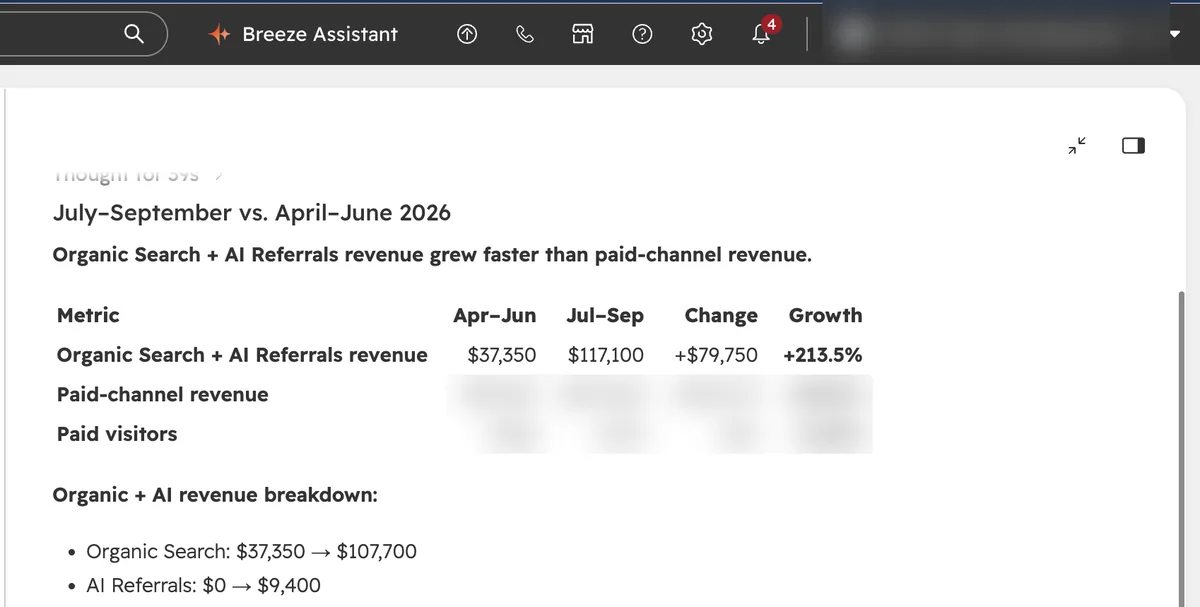 Open the screenshot at full size ↗
2.9K
Bipp Analytics, a US analytics software company with a complex technical product. 2.9K ranking keywords in Semrush’s US desktop database, January 2022 snapshot. See the Bipp case study.
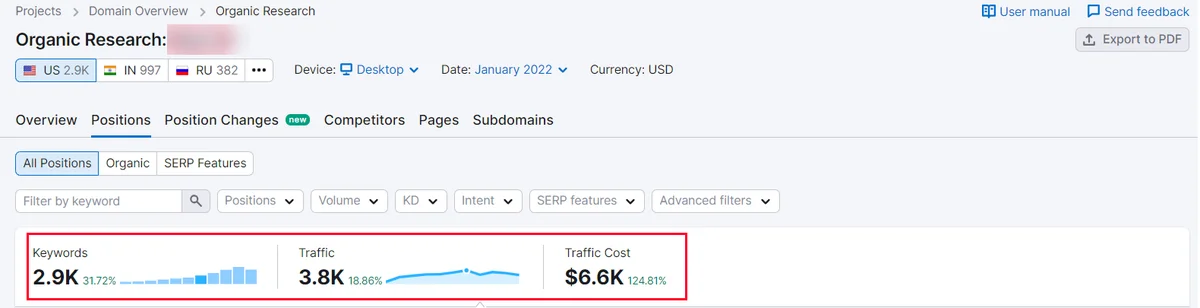 Open the screenshot at full size ↗
More dated results are on our case studies page.
When SEO is the wrong first move.
Where this guide does not apply
- Build-to-print for a handful of OEMs. If almost all your work comes through approved-supplier lists and tender portals, a supplier-portal profile and account management matter more than search.
- You cannot publish the detail. Defence work under export controls, or customer contracts that forbid naming programmes, can stop you stating capability specifics. Publish what you can; SEO will do less.
- The plant is full. At capacity for the next year, more RFQs add quoting cost, not revenue.
- Distributors own the demand. For catalogue parts sold mainly through distributors, their pages may rightly outrank yours. Make sure they carry your current datasheets, and focus your own site on what they cannot say.
For everyone else, the usual order is: crawler access and indexing, capability pages for your highest-margin processes, the RFQ form, measurement, directory consistency, then named engineering content. A technical audit first, as our technical SEO engagement guide describes, tells you how much of the first step is needed. If you are pricing the work, see what B2B SEO costs.
If you run a testing or calibration lab rather than a production plant, the buying logic turns on your scope of accreditation instead; our guide to how buyers search for calibration services covers that case.
Method and sources
We did not survey manufacturers for this guide. Buyer figures come from the published studies named in each chart and paragraph, read on 25 November 2026; the Xometry study is vendor-commissioned and labelled as such, and the Thomas buyer survey dates from 2019. Platform behaviour comes from Google’s and OpenAI’s own documentation. The buyer prompts, the spec-page values and the RFQ checklist order are our illustrations and judgement, not data.
Questions manufacturers ask.
What is manufacturing SEO?
Manufacturing SEO is making each process, material, specification and certification you offer findable in the words engineers and buyers search with, on pages that state the facts in HTML, and connecting those pages to an RFQ form and a CRM so you can measure quote requests and won orders rather than visits.
How do manufacturers get recommended by ChatGPT or Google’s AI Mode?
Let AI crawlers reach your site (OpenAI recommends allowing OAI-SearchBot), publish capability pages that answer buyers’ questions, and keep processes, certificates and locations consistent across your site and directory profiles. Google says its AI features need nothing beyond being indexed and eligible for a snippet.
Should we gate CAD files and datasheets?
Keep datasheets and CAD previews open, and gate only native CAD files with a short form. In the 2026 State of Marketing to Engineers survey, 34% of technical buyers said they would exchange contact details for a CAD drawing, while 15% said they never fill out forms.
Do PDF datasheets rank in Google?
They can, because Google indexes PDFs, but a ranking PDF sends buyers to a file with no navigation or RFQ button. Publish the specs in HTML and link the PDF as the downloadable copy.
Are directory listings like Thomasnet still worth keeping?
Yes, as a supporting channel: in 2026, 31% of technical buyers used directory websites, against 74% for supplier websites. Keep listings consistent with your site, because conflicting facts can lead AI answers to describe you wrongly.
Sources, all read 25 November 2026: GlobalSpec and TREW Marketing with Elektor, 2026 State of Marketing to Engineers research report (1,000+ respondents); Thomas, “New Thomas Report Reveals Industrial Buyer Habits” (31 January 2019, 266 buyers); Distribution Strategy Group on Thomas’s 2025 sourcing activity (30 January 2026); Digital Commerce 360 on the Xometry and John Zogby Strategies survey (9 February 2026, 300 manufacturing leaders, vendor-commissioned); Google Search Central: AI features and your website, file types indexable by Google, managing faceted navigation, product snippet structured data; OpenAI, overview of OpenAI crawlers. Client results: a US B2B company (name withheld), HubSpot, Jul–Sep vs Apr–Jun 2026; Bipp Analytics, Semrush snapshot January 2022; both on file.